

If you are building an AI application in 2026, one of the first decisions you will face is what model to use. The choice between a Small Language Model (SLM) and a Large Language Model (LLM) is not just about size—it determines cost, latency, privacy, deployment options, and what your application can actually do.
The language model landscape has fractured. At one end, LLMs like GPT-4o, Claude 3.5 Sonnet, and Llama 3.1 70B exceed 70 billion parameters, run in the cloud, and cost dollars per million tokens. At the other, SLMs like Phi-3-mini (3.8B), Gemma 2B/7B, and Llama 3.1 8B fit on a phone, cost cents per million tokens, and run locally with minimal latency.
This guide compares SLMs and LLMs across the dimensions that actually matter for building applications: parameter scale, hardware, latency, cost, privacy, deployment, fine-tuning, accuracy, context handling, and use cases. It is not about which is better—it is about which is right for your application.
What Are SLMs and LLMs?
At a basic level, the difference is the number of parameters—the weights the model learns during training that determine its behavior.
Small Language Models (SLMs)
SLMs are compact language models typically ranging from 1 billion to 20 billion parameters. They are designed for efficiency, running on consumer hardware, mobile devices, and edge deployments with lower computational requirements. Microsoft's Phi-3-mini, with 3.8 billion parameters, achieves performance comparable to GPT-3.5. Google's Gemma family offers 2B, 7B, and 9B variants.
SLMs are well-suited for environments where resources are constrained—on-device mobile apps, embedded systems, or applications requiring low latency and low cost. They are less capable at complex reasoning, multilingual tasks, and very long-context understanding compared to their larger counterparts.
Large Language Models (LLMs)
LLMs are the heavyweights of the AI world, typically exceeding 70 billion parameters, with frontier models reaching into the trillions. GPT-4o, Claude 3.5 Sonnet, and Gemini 1.5 are all in this category. They require substantial hardware—often thousands of GPUs for training and multiple GPUs for inference—and are typically accessed via API or deployed in enterprise-grade data centers.
LLMs excel at complex reasoning, multilingual understanding, long-context tasks, and achieving state-of-the-art performance on benchmarks. They are more expensive to run but offer capabilities that SLMs cannot match—at least not without significant engineering effort.
SLMs vs LLMs: At a Glance
| Dimension | SLM (Small Language Model) | LLM (Large Language Model) |
|---|---|---|
| Parameter count | 1B – 20B | 70B – 1T+ |
| Hardware requirements | Consumer GPU, mobile, edge | Multiple enterprise GPUs |
| Inference latency | 10 – 50ms (local) | 500ms – 3s (API) |
| Operational cost | $0.05 – $0.50 / 1M tokens | $5 – $30+ / 1M tokens |
| Data privacy | Complete — local inference | Varies — data sent to cloud |
| Deployment | On-device, edge, on-premise | API, enterprise cloud |
| Fine-tuning | Feasible on consumer hardware | Requires substantial compute |
| Context window | Typically 8K – 128K | Typically 128K – 2M+ |
Parameter Scale: What the Numbers Mean
Parameter count is the most visible differentiator. The shift from billion- to trillion-parameter models has been well-documented: each additional parameter can capture more nuanced patterns in the data, leading to higher performance on complex tasks. But the scaling relationship is not linear.
Frontier LLMs (GPT-4o, Claude 3.5 Sonnet, Gemini 1.5) typically exceed 500 billion parameters, with some configurations exceeding 1 trillion. These models are trained on hundreds of trillions of tokens, giving them broad world knowledge and strong reasoning capabilities.
SLMs like Phi-3-mini (3.8B), Gemma 7B, and Llama 3.1 8B achieve impressive performance by leveraging high-quality, curated training data—Phi-3 was trained on 3.3 trillion tokens of heavily filtered, textbook-quality data. This data-centric approach allows SLMs to punch above their weight class. Microsoft reports that Phi-3-mini's performance is comparable to GPT-3.5, despite having roughly 50 times fewer parameters.
That said, performance gaps remain. On the MMLU benchmark, Phi-3-mini scores around 69%, while GPT-4o scores around 89%. On mathematical reasoning (GSM8K), Phi-3-mini scores around 82%, while GPT-4o scores over 95%. The gap is significant—but it depends on the task.
Hardware Requirements and Inference Latency
Hardware requirements are where SLMs and LLMs diverge most sharply.
SLMs can run on consumer-grade GPUs, laptops, and even mobile phones. With quantization and optimization, a 3.8B parameter model can run on a modern smartphone with acceptable performance. Inference latency is typically 10-50 milliseconds for local inference—fast enough for real-time applications.
LLMs, by contrast, require substantial compute. Running a 70B model requires multiple enterprise GPUs (e.g., A100 or H100) with significant memory bandwidth. Inference latency typically ranges from 500 milliseconds to several seconds—fast enough for many applications but not suitable for real-time, latency-sensitive use cases. The cost per token is substantially higher.
A small local model costs nothing per inference after the initial hardware investment. An LLM API call costs $5-30 per million tokens, and if you need real-time or multi-turn interactions, those costs compound quickly.
Cost: The Real Differentiator
For many applications, cost is the deciding factor. LLM APIs charge per token, and for high-volume applications, these costs can become significant.
An SLM deployed on consumer hardware has no per-token cost after the initial setup. You pay for the hardware once—or leverage hardware you already own. For applications handling millions or billions of tokens per day, the savings are substantial. A 2026 survey of AI engineers found that cost is the top reason organizations adopt SLMs over LLMs.
This dynamic is shifting the economic equation. When an LLM might cost $5 per million tokens, an SLM running locally costs effectively zero per token. For a chatbot handling 10 million tokens per day, the difference is $50/day—roughly $18,000/year. Scale that to 100 million tokens, and it is $180,000/year. There is no equivalent cost for a local SLM after the hardware is paid for.
Some platforms now offer automatic routing: small models for simple tasks, large models for complex ones. This "flywheel" approach is becoming increasingly common as teams optimize for cost without sacrificing performance.
Data Privacy and Security
Privacy is a major consideration for enterprise applications. SLMs can run entirely on-device or on-premise, meaning sensitive data never leaves the organization's control.
LLMs typically require sending data to cloud APIs, which creates privacy, security, and regulatory compliance concerns. Even when vendors commit to zero-data retention and enterprise-grade security, some organizations cannot take that risk—particularly in healthcare, finance, and government.
SLMs enable true data sovereignty. All data stays on the device or within the enterprise perimeter. This is a significant advantage for privacy-critical applications.
Deployment Options
The deployment path for SLMs and LLMs is fundamentally different.
SLMs are deploying through multiple channels: on-device (mobile, laptop), edge (local servers), and on-premise. Quantization tools like GGUF, the llama.cpp ecosystem, and ONNX Runtime make it straightforward to run optimized SLMs on consumer hardware. Frameworks like Ollama provide one-command setup. The barrier to entry for SLM deployment is now extremely low.
LLMs are typically accessed via API—OpenAI, Anthropic, Google, or hosted open-source platforms (Together AI, Fireworks, Replicate). On-premise LLM deployment is possible but requires substantial infrastructure. GPTQ, AWQ, and DeepSpeed help with compression and distributed inference, but enterprise-grade LLM deployment remains a significant undertaking.
Fine-Tuning and Customization
Fine-tuning is another area where SLMs and LLMs differ significantly.
SLMs are easier to fine-tune. They can be adapted to domain-specific tasks with less data, less compute, and lower cost. LoRA and QLoRA allow fine-tuning of SLMs on consumer GPUs in hours rather than days. A fine-tuned SLM can achieve performance close to a much larger model on a specific task.
LLMs are harder to fine-tune—at least for individuals and small teams. Fine-tuning a 70B+ model requires substantial compute (multiple A100s, days of training, thousands of dollars in cloud costs). Many organizations use RAG (retrieval-augmented generation) instead of fine-tuning for LLMs, adding external knowledge at inference time without modifying the base model.
Accuracy and Performance
Performance is where LLMs have a clear edge—but the gap is narrowing.
According to 2026 benchmark data:
- Phi-3-mini (3.8B): ~69% MMLU, ~82% GSM8K
- Llama 3.1 8B: ~72% MMLU
- Llama 3.1 70B: ~85% MMLU
- GPT-4o: ~89% MMLU
- Claude 3.5 Sonnet: ~88% MMLU, ~96% GSM8K
The gaps are significant but task-dependent. On simple classification and extraction tasks, SLMs often perform comparably to LLMs. On complex reasoning, multilingual tasks, and coding, the gap is larger.
For many applications, the combination of SLM + RAG (retrieval-augmented generation) can close the gap dramatically. Adding a retrieval step with relevant documents allows an SLM to answer questions that it would otherwise not know. When the task involves reasoning over specific documents rather than general world knowledge, the SLM may perform similarly to an LLM at a fraction of the cost.
Context Window
Context window—how much text the model can process at once—is one of the most important differentiators.
LLMs lead this category. GPT-4o supports 128K tokens; Claude 3.5 Sonnet supports 200K; Gemini 1.5 supports 2M tokens. These large context windows enable processing of entire books, codebases, or long documents without needing RAG.
SLMs typically have smaller context windows—8K to 32K is common, with some pushing to 128K. For tasks that require reasoning across very long documents, LLMs are usually the better choice—or the SLM will need RAG to stay within its context window.
When to Choose an SLM
Cost-sensitive applications: If you are handling millions of tokens per day and cost is a constraint, SLMs are the clear winner. No per-token cost means predictable operational expenses.
Privacy-critical applications: When data cannot leave the organization, an on-premise or on-device SLM is the only viable option.
Low-latency applications: When responses must be immediate (<50ms), local SLM inference is necessary. LLM APIs introduce network latency and queue delays.
On-device or offline applications: Mobile apps, edge devices, and embedded systems cannot depend on cloud APIs. SLMs are essential.
Simple, narrowly defined tasks: For classification, entity extraction, summarization of short documents, and other narrow tasks, SLMs often perform similarly to LLMs.
Organizations with limited compute resources: If you are a small team without GPU clusters, SLMs are the practical choice.
When to Choose an LLM
Complex reasoning and planning: For tasks requiring multi-step reasoning, planning, and subtle judgment—like coding, legal analysis, or research—LLMs are substantially better.
Large-context tasks: When you need to reason across entire documents, large codebases, or long conversations, the LLM's context window advantage is critical.
State-of-the-art performance: For applications where the best possible accuracy is required, LLMs still lead. If you are building a product that competes on quality, the LLM advantage matters.
Multilingual applications: LLMs typically support more languages with higher quality. SLMs are often trained on primarily English data.
When you cannot fine-tune: If you cannot access training data or lack the expertise to fine-tune, the LLM's general knowledge is the better option.
Prototyping speed: LLM APIs are the fastest path to building a working prototype. You can iterate quickly before optimizing for production.
Practical Deployment Considerations
Several practical factors influence the SLM vs LLM decision in 2026.
Quantization and Compression: SLMs can be quantized to 4-bit or 8-bit precision with minimal quality loss, running on consumer hardware. The GGUF format and llama.cpp make this straightforward.
Distillation: Distillation—training an SLM to mimic an LLM—is now a mature practice. You can distill an LLM's knowledge into a compact model for your specific domain, achieving similar performance with much lower cost.
RAG (Retrieval-Augmented Generation): Adding retrieval can close the accuracy gap between SLMs and LLMs. An SLM with RAG over a vector database can perform complex tasks by reasoning over retrieved documents rather than relying on memorized knowledge.
Flywheel Routing: Production systems often use routing layers—simple tasks go to an SLM; complex tasks go to an LLM. This reduces cost while maintaining quality.
Model updates: LLM APIs are updated automatically, while SLMs are static once deployed. If you need the latest capabilities without maintenance effort, an API-based LLM is simpler.
Ecosystem and tooling: The ecosystem for LLMs is broader and more mature. However, SLM tooling is catching up rapidly. Platforms like Ollama, llama.cpp, and the Hugging Face ecosystem make SLM deployment accessible.
Frequently Asked Questions
What is the difference between an SLM and an LLM?
The primary difference is parameter count. SLMs range from 1B to 20B parameters; LLMs exceed 70B, with frontier models reaching into the trillions. This difference drives cost, latency, hardware requirements, and performance.
Which is better: SLM or LLM?
Neither is universally better. LLMs offer higher accuracy, larger context windows, and better reasoning. SLMs offer lower cost, lower latency, better privacy, and the ability to run on consumer hardware. The right choice depends on your application's constraints.
When should I use an SLM instead of an LLM?
Use an SLM when cost, latency, privacy, or local deployment are priorities. Use an LLM when you need complex reasoning, large-context understanding, or state-of-the-art accuracy.
How much does an LLM cost to run?
LLM API costs range from $5 to $30 per million tokens for input and output. For high-volume applications, this can be significant—hundreds of thousands of dollars per year. SLMs have no per-token cost after hardware deployment.
Can SLMs be as accurate as LLMs?
On narrow, well-defined tasks, yes—especially with RAG. On complex reasoning, multilingual tasks, and coding, LLMs maintain a significant advantage. However, the gap is narrowing as distillation and data curation improve.
What is the best SLM in 2026?
Phi-3-mini (3.8B) and Phi-3-medium (14B) from Microsoft are widely considered the best SLMs for their size. Google's Gemma 7B and Llama 3.1 8B are also strong contenders. The best choice depends on your specific use case and hardware constraints.
What is RAG and why does it matter for SLMs?
RAG (Retrieval-Augmented Generation) adds a retrieval step to language model inference, retrieving relevant documents from a knowledge base and injecting them into the context. This allows SLMs to perform tasks that require specific knowledge, closing the accuracy gap with LLMs.
Can SLMs handle long documents?
SLMs typically have smaller context windows (8K-128K tokens). For longer documents, you can use RAG to retrieve relevant chunks, or use an LLM if you need to reason across the entire document at once.
Conclusion
The SLM vs LLM decision in 2026 is not about which is better—it is about which is right for your application. LLMs deliver state-of-the-art performance, large context windows, and powerful reasoning—but they come with cost, latency, and privacy trade-offs. SLMs offer efficiency, privacy, and predictable economics—but may require RAG, distillation, or fine-tuning to match LLM performance on complex tasks.
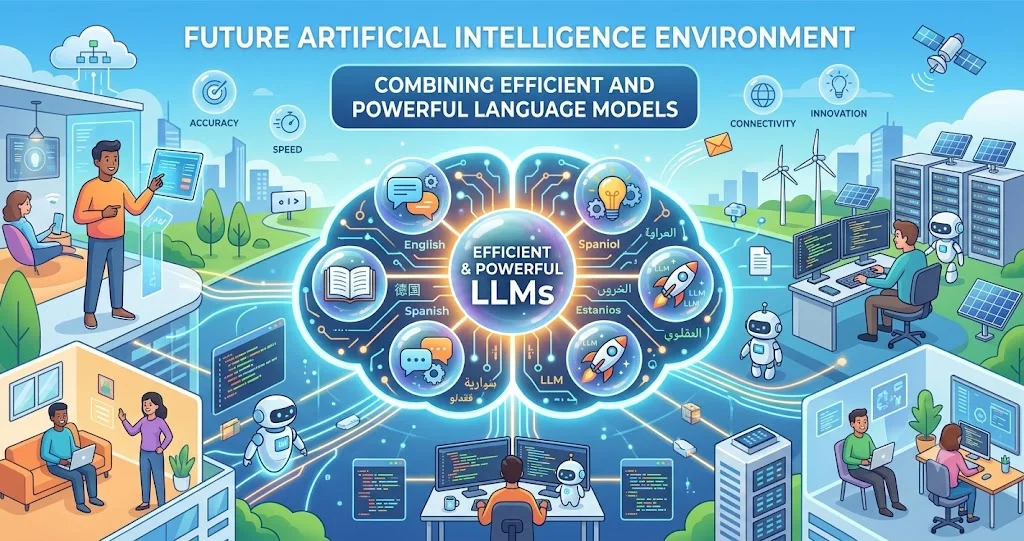
The trend is toward hybrid systems: SLMs for routine tasks, LLMs for complex ones, with routing layers deciding which model to use for each request. This "flywheel" approach optimizes for both cost and quality, recognizing that different tasks need different models.
For organizations building AI applications, the practical advice is: start with an LLM API to prototype, then evaluate whether an SLM (possibly with RAG or distillation) can meet your performance requirements at lower cost and with better privacy. The trade-off is real, but so is the upside of getting it right.