
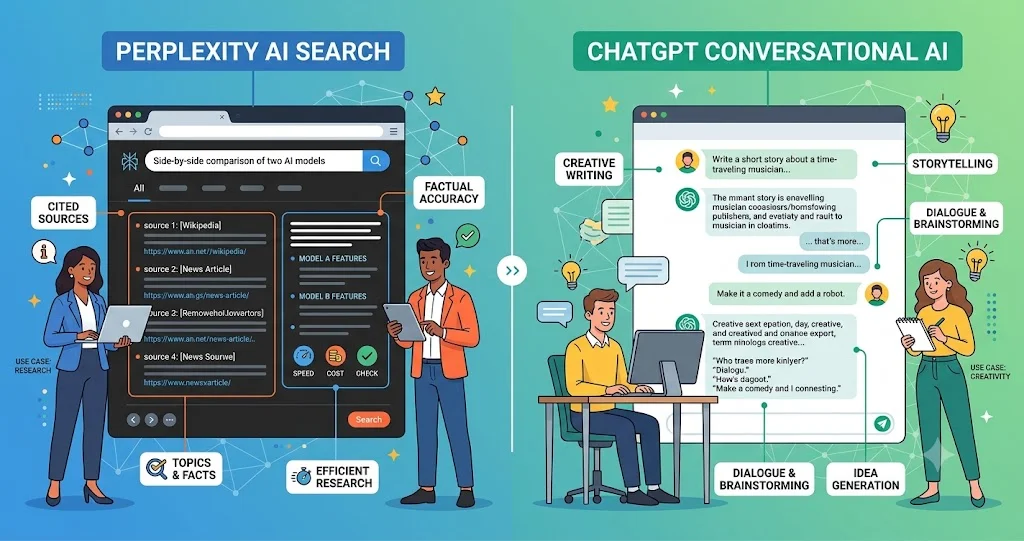
Perplexity and ChatGPT are no longer easy to classify as simply an AI search engine versus an AI chatbot. Both can search the web, answer follow-up questions, analyze files, conduct research, and help with writing and technical work. The more useful comparison is about workflow: Perplexity is especially search- and research-centered, while ChatGPT is built as a broader conversational workspace that can also search and research. The right choice depends on whether your typical task starts with finding and verifying sources or with an ongoing conversation that may branch into writing, analysis, coding, files, images, and connected tools.
Perplexity vs ChatGPT at a glance
Perplexity describes itself as an AI-powered search engine that searches the web and provides conversational answers backed by citations and links to original sources. Its current product also includes Research, file analysis, model selection, file and app creation, and access to multiple AI models.
ChatGPT combines conversational interaction with web search, deep research, file uploads, image understanding and generation, coding capabilities, and connected apps. OpenAI's documentation says ChatGPT can automatically search the web when a question benefits from current information, while deep research is designed for multi-step research and produces documented outputs with citations.
| Area | Perplexity | ChatGPT |
|---|---|---|
| Primary identity | AI-powered search and research platform | General-purpose conversational AI workspace |
| Web search | Central to the product | Integrated into conversations when useful |
| Citations | Core part of search answers | Available when web search or research uses sources |
| Research | Research mode and advanced research workflows | Deep research for multi-step web and source analysis |
| Writing | Strong for research-backed drafting and synthesis | Strong for iterative writing, editing, and transformation |
| File analysis | Supports documents, code, images, audio, and video uploads | Supports document uploads and image analysis, with capabilities depending on plan |
| Model access | Multiple leading models can be available through Perplexity | Uses OpenAI models and feature-specific systems, depending on plan and feature |
| Integrations | Web, connectors, files, and Perplexity projects | Connected apps, files, web, and other integrated tools |
What is Perplexity?
Perplexity is built around information discovery. Instead of returning a conventional list of search results, it uses AI to interpret a question, search relevant information, synthesize an answer, and attach citations that let the reader inspect the supporting sources. Perplexity says its answers include citations and links to original sources, making source verification part of the product's normal interaction model.
The product has expanded beyond short search answers. Its current plans include Research capabilities, advanced AI models, file uploads, file and app creation, and access to multiple models. Perplexity also offers connectors and premium data sources for some research and professional workflows.
This makes Perplexity particularly natural for questions such as “What changed recently?”, “What are the current options?”, “Compare these products using current sources,” or “Research this topic and show me where the information came from.”
What is ChatGPT?
ChatGPT is broader than an AI search interface. Its core interaction is conversational, but the product can also search the web, conduct deep research, analyze uploaded files, understand images, generate images, work with connected applications, and support coding-related workflows.
That breadth changes how people use it. A conversation can start with a question, move into an explanation, turn into a draft, incorporate an uploaded document, continue into data analysis, and then use web search or connected applications without necessarily changing the basic interaction model.
AI search: where Perplexity has a natural advantage
Search is at the center of Perplexity's product design. The platform says it searches the web to produce conversational answers and provides citations to the sources behind its claims. Its current Research feature can perform iterative searches, read sources, reason about next steps, and synthesize the results into a report.
That makes Perplexity particularly convenient when the user's first concern is source discovery. For example, a researcher investigating a new software framework may want current documentation, recent announcements, comparisons, and several independent sources in one response. Perplexity's search-first design makes that workflow immediately visible.
It is still important to open the underlying sources. Perplexity itself notes that its answers are based on web sources, and source quality matters. A citation is evidence of where a claim came from, not automatic proof that the claim is correct.
ChatGPT search: more conversational, but still source-aware
ChatGPT can also search the web and automatically decide when current information would improve an answer. OpenAI's documentation says web-search responses may include citations and a Sources view where users can inspect the sources used. It also cautions that search results and citations can sometimes be incomplete, outdated, or incorrect.
The practical difference is that search does not have to remain the center of the interaction. A user can ask ChatGPT to search for current information, then continue asking for an explanation, rewrite, calculation, code example, comparison, or structured output within the same conversation.
Citations and source verification
For research-heavy work, citations are not merely a visual feature. They change how the user can validate an answer.
Perplexity makes citations central to its answer format. Its official description says every answer includes inline citations showing where claims come from, and its Research workflow is designed to synthesize information from multiple sources.
ChatGPT also provides citations when web search or deep research uses external sources. OpenAI describes deep research as producing structured, documented outputs with citations or source links so users can verify the information.
The distinction is therefore less about whether citations exist and more about how central source discovery is to the workflow. Perplexity places source-backed search at the center of the experience. ChatGPT treats search and research as capabilities within a much larger conversational environment.
Deep research: similar destination, different product philosophy
Perplexity's Research mode is designed to conduct in-depth research by performing multiple searches, reading sources, refining the research process, and producing a report. Its current documentation also describes improved document processing and a code sandbox for calculations and data analysis.
ChatGPT's deep research follows a similar high-level pattern but is integrated into the broader ChatGPT environment. OpenAI says deep research can use the public web, uploaded files, and supported connected apps, and users can review or modify the proposed research plan before the research proceeds.
For a user who primarily wants a research report with visible web sourcing, Perplexity is a natural fit. For a user who wants research to become one stage in a larger workflow involving files, writing, analysis, connected applications, or continued conversation, ChatGPT can be more flexible.
Conversational interaction
ChatGPT's strongest conceptual advantage is the conversational workspace. The user can start with a broad question and progressively narrow it without needing to restate the entire problem. The conversation can move from explanation to brainstorming to editing to analysis.
Perplexity also supports follow-up questions and ongoing sessions. Its documentation describes conversational answers and project-based workflows in which prompts and files can be shared within a project.
The difference is one of emphasis. Perplexity's conversation is closely tied to information discovery, while ChatGPT's conversation can be the central workspace for many different types of tasks.
Writing and editing
Both products can write, rewrite, summarize, brainstorm, and transform text. The better choice depends on what surrounds the writing task.
Perplexity is particularly useful when the writing depends heavily on fresh research. A user can research a subject, inspect cited sources, and then use the resulting information as the foundation for a draft. Its current Pro offering also includes capabilities for creating polished documents and apps.
ChatGPT is well suited to iterative writing where the conversation itself becomes the editing environment. A user can provide a draft, specify a tone, ask for structural changes, upload supporting material, request several versions, and continue refining the output.
For evidence-heavy writing, neither tool removes the need to verify important claims against the original sources. AI-generated prose can be fluent while still carrying an incorrect interpretation of a source.
Coding and technical work
ChatGPT can support software development through code generation, explanation, debugging, file analysis, and other coding-oriented workflows. OpenAI also provides Codex as a coding-focused tool within its broader developer ecosystem, although the availability of specific coding capabilities varies by product and plan.
Perplexity can also analyze code and uploaded files. Its file-upload documentation specifically lists code among supported textual file types, while its broader research capabilities can be useful when developers need to investigate documentation, libraries, APIs, current releases, or technical alternatives.
The practical distinction is useful: ChatGPT is generally more naturally positioned as a coding assistant, while Perplexity is particularly useful when coding questions require current external information. For example, a developer researching a newly released framework may benefit from Perplexity's search-centered workflow, while a developer iterating on a codebase may prefer ChatGPT's broader conversational and file-based environment.
File analysis
Both platforms can work with uploaded files, but their documented capabilities differ in breadth and product emphasis.
Perplexity currently supports textual files such as PDFs and code, as well as images, audio, and video uploads. Its documentation says shorter files can be analyzed in their entirety, while longer files may be processed by extracting the most relevant portions.
ChatGPT supports uploads such as PDFs, presentations, and text documents, allowing users to summarize, extract information, and ask questions about the contents. ChatGPT can also analyze uploaded images and other visual material.
If your main task is “search this document and connect it with current information from the web,” Perplexity's search-centered workflow can be attractive. If your task is “work with this file as part of a longer conversation involving writing, analysis, coding, or visual interpretation,” ChatGPT's broader workspace can be more convenient.
Multimodal capabilities
Multimodal work means more than simply uploading a picture. It can include understanding screenshots, extracting information from charts, analyzing documents, working with audio or video, and generating or transforming images.
ChatGPT's current capabilities documentation includes image input and generation, with the ability to analyze uploaded images, diagrams, screenshots, and charts.
Perplexity's file-upload documentation also lists images, audio, and video alongside text, PDFs, and code.
The useful question is therefore not “Which one is multimodal?” Both are. Instead ask which combination of modalities your workflow actually requires and whether those capabilities are available on your specific plan.
Models and model choice
Perplexity has built model selection into its product strategy. Its current pricing information says Perplexity can orchestrate multiple leading models, including models from OpenAI, Anthropic, and other providers, and that Pro and Max users can select a preferred model.
That is valuable for users who do not want their workflow tied to one model provider. It also makes Perplexity useful as a model-access layer where the user can focus on the task rather than maintaining separate interfaces.
ChatGPT is centered on OpenAI's own model ecosystem, with different models and capabilities available according to the product and plan. This narrower model-provider scope can also be an advantage because the experience is more integrated rather than requiring the user to think about which external model to select for every task.
Productivity and integrations
Perplexity supports connectors and project-oriented workflows, and its current product documentation describes access to hundreds of app connectors on higher plans. It can therefore combine web information with connected data sources for certain research and professional workflows.
ChatGPT also supports connected apps. OpenAI says supported apps can let users search connected services, reference information, summarize documents, and, where supported, take actions. Availability depends on the app, plan, region, workspace, and other factors.
This is another area where the products are converging. The meaningful difference is increasingly the ecosystem and workflow each platform makes easiest rather than whether integrations exist at all.
Current pricing and plan considerations
Pricing is one of the fastest-changing parts of AI products, so plan pages should be checked before making a purchasing decision.
| Product | Current individual plan information | What matters for comparison |
|---|---|---|
| Perplexity Free | $0/month | Limited search and usage with citations and basic AI models. |
| Perplexity Pro | $20/month | More usage, advanced models, Research, file capabilities, and additional features. |
| ChatGPT | Multiple plans and usage levels | Capabilities and limits vary by plan; web search is available across current consumer and work plans. |
Perplexity's current pricing page lists Free at $0/month and Pro at $20/month, with Pro adding higher usage, advanced models, Research, file and app creation, and other capabilities.
ChatGPT's current web-search documentation states that web search is available on Free, Go, Plus, Pro, Business, Enterprise, and Edu, although usage limits and other feature availability vary by plan.
Because the two companies package capabilities differently, comparing only the subscription price can be misleading. A better comparison is the amount and type of search, research, model, file, image, and productivity usage you actually need.
Which should students use?
Students who frequently need source-backed research, current information, literature discovery, or quick comparisons may find Perplexity especially convenient because citations are built into its search-oriented workflow.
Students who use AI for a wider range of tasks—such as explaining concepts, creating study materials, rewriting notes, analyzing uploaded documents, working through problems, or practicing interactively—may prefer ChatGPT's broader conversational environment.
For academic work, neither platform should be treated as a substitute for checking the original source. Citations make verification easier, but the responsibility for using accurate and appropriate sources remains with the student.
Which should professionals and researchers use?
For researchers and professionals whose work starts with “find out what is currently known,” Perplexity's search and Research workflows are particularly relevant. Its premium data-source ecosystem can also matter for certain finance, market, and professional research use cases.
For professionals whose workflow is broader—research followed by drafting, document analysis, coding, brainstorming, data work, visual analysis, or connected-app tasks—ChatGPT may provide a more unified workspace.
Perplexity vs ChatGPT: choose by workflow
| If your main task is... | Natural starting choice | Why |
|---|---|---|
| Finding current information with visible sources | Perplexity | Search and citations are central to the product. |
| Conducting source-heavy research | Perplexity | Research mode is designed around multi-source discovery and synthesis. |
| Long conversational problem solving | ChatGPT | The conversation can remain the main workspace across different task types. |
| Iterative writing and editing | ChatGPT | Strong fit for repeated drafting, transformation, and instruction-driven editing. |
| Research-backed writing | Either | Perplexity emphasizes source discovery; ChatGPT combines research with broader creation workflows. |
| Analyzing uploaded files | Either | Both support file-based workflows, with different supported formats and limits. |
| Current technical research | Perplexity | Web and source discovery are central to the workflow. |
| Broad AI productivity workspace | ChatGPT | Combines conversation with search, research, files, multimodal capabilities, and connected apps. |
Important limitations to remember
Neither platform should be treated as an authority simply because an answer includes citations. Search systems can retrieve weak sources, misunderstand context, or synthesize information incorrectly.
OpenAI explicitly warns that search results and citations can be incomplete, outdated, or incorrect. ([OpenAI Help Center][2]) Perplexity's own product model also depends on the quality and relevance of the sources it finds, so users should open important citations and verify claims against the original material.
Another limitation is that product capabilities vary by plan. A feature mentioned in an older comparison may now be included, restricted, renamed, or replaced. This is especially relevant for AI search, research limits, models, file uploads, connectors, and agent-like capabilities.
A practical decision rule
Use Perplexity when the question is primarily about discovering, comparing, and verifying information from the web. It is particularly compelling when citations and research sources are central to the task.
Use ChatGPT when the task is primarily an ongoing conversation that may move between research, explanation, writing, coding, file analysis, images, and connected tools. Its web search and deep research capabilities mean you do not have to leave the conversational environment when current information is needed.
Use both when your workflow benefits from separating source discovery from deeper creation or analysis. For example, Perplexity can be used to locate current sources and competing perspectives, while ChatGPT can help turn verified material into a structured explanation, draft, analysis, or working document. The value of this approach depends on whether the additional step improves accuracy and workflow enough to justify it.
Final takeaway
There is no useful universal winner in the Perplexity vs ChatGPT comparison. The products overlap significantly, but their centers of gravity remain different.
Perplexity is particularly strong when search, current information, source discovery, and citations define the task. ChatGPT is particularly strong when conversation, creation, analysis, coding, files, multimodal work, and connected productivity need to coexist in one workflow.
The simplest way to choose is to look at your last ten AI tasks. If most began with “find current information and show me the sources,” Perplexity is likely to feel natural. If they began with “help me work through this problem” and then moved between research, writing, files, coding, or other tasks, ChatGPT may be the better general-purpose environment.
FAQ
Is Perplexity better than ChatGPT for web search?
Perplexity has a strong product advantage in search-oriented workflows because web discovery and citations are central to its design. ChatGPT also provides web search and citations, so the difference is more about workflow emphasis than whether one product can search and the other cannot.
Does ChatGPT provide citations?
Yes. When ChatGPT uses web search or deep research, responses can include citations and source links. OpenAI recommends opening cited sources because search results and citations can sometimes be incomplete or incorrect.
Can Perplexity analyze PDFs and other files?
Yes. Perplexity supports textual files such as PDFs and code, as well as images, audio, and video. Its documentation says uploaded files can be analyzed in the context of the user's question and follow-up conversation.
Can ChatGPT do deep research?
Yes. ChatGPT's deep research feature is designed for multi-step research and can use the public web, uploaded files, and supported connected apps. It produces documented results with citations or source links.
Which is better for writing?
Both can be effective. Perplexity is particularly useful when writing depends on current web research and source discovery, while ChatGPT is well suited to iterative drafting, editing, restructuring, and conversational refinement. The better choice depends on whether research sourcing or the writing workflow is the primary need.
Which is better for coding?
ChatGPT is generally the more natural general-purpose choice for coding assistance, especially when coding is part of a larger conversational workflow. Perplexity is valuable for technical research, current documentation discovery, and analyzing uploaded code or technical material. Perplexity's file documentation explicitly lists code as a supported textual upload type.
Can Perplexity use models from other AI companies?
Yes. Perplexity's current product information says it orchestrates multiple leading AI models and allows Pro and Max users to select a preferred model.
Is Perplexity Pro worth paying for?
It depends on how heavily you use search and research. Perplexity currently lists Pro at $20/month and includes higher usage, advanced models, Research, file and app creation, and other capabilities.
Can ChatGPT and Perplexity be used together?
Yes. Using both can make sense when source discovery and broader AI-assisted creation are separate parts of the workflow. The important consideration is whether the additional tool provides enough value to justify the extra subscription and context switching.