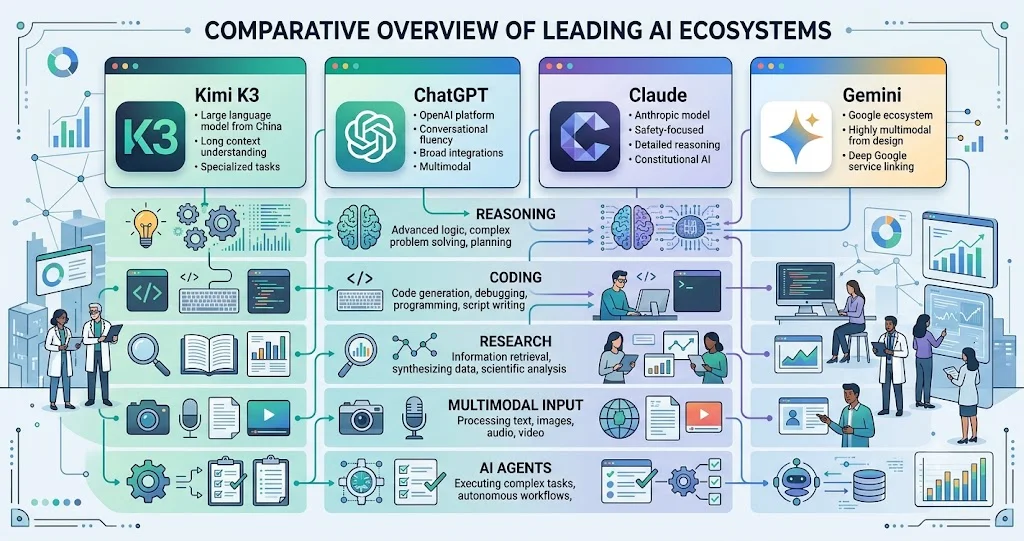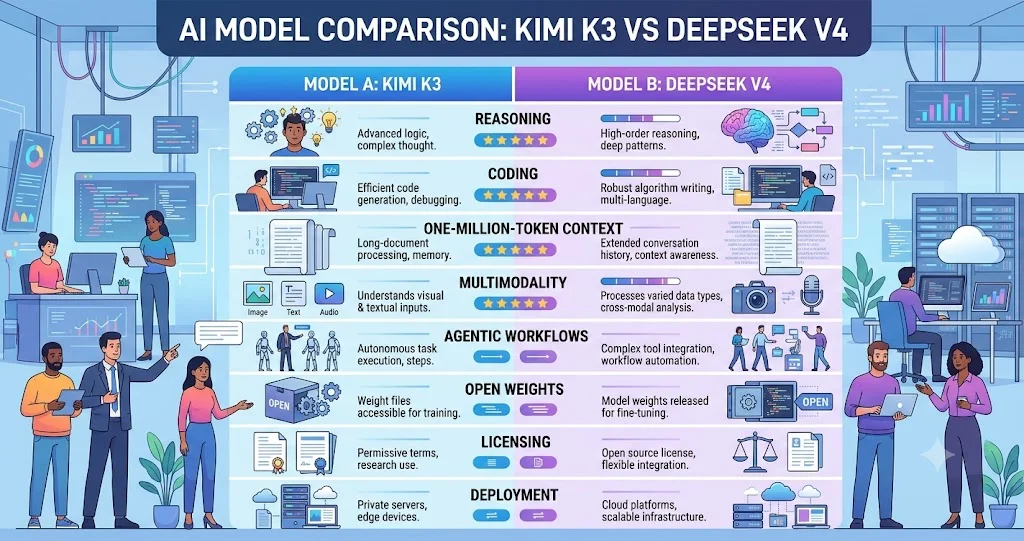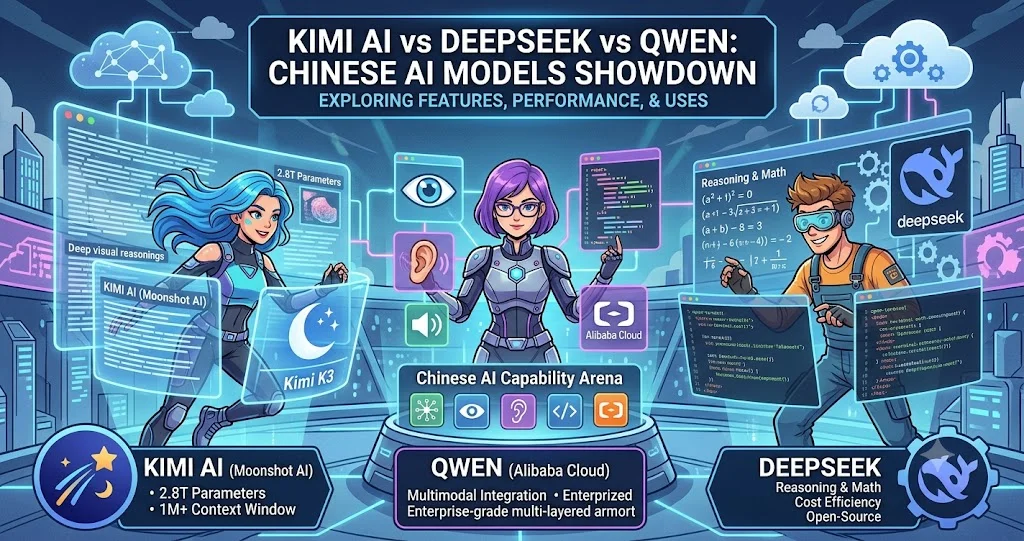

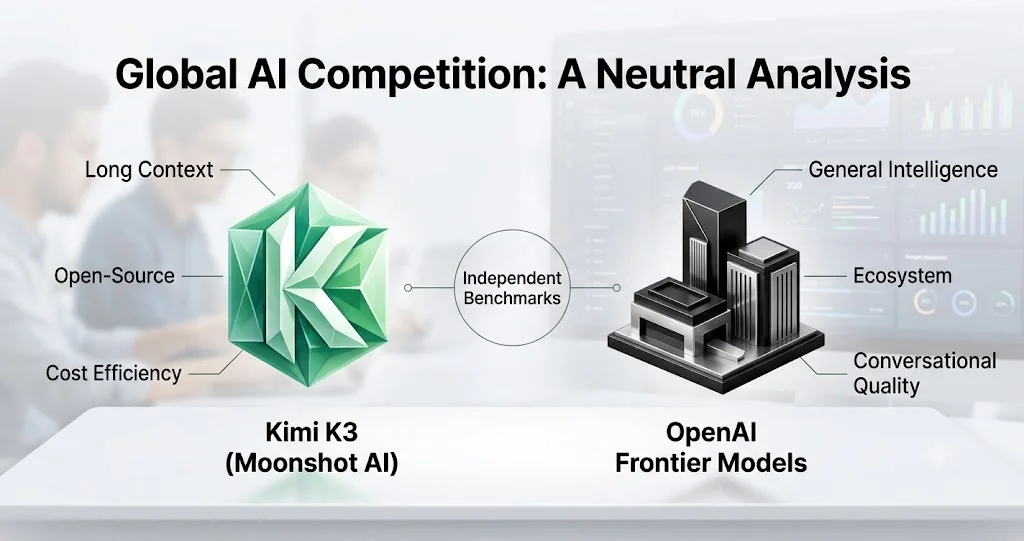
The global AI landscape has become increasingly competitive with the emergence of powerful models from Chinese companies. Kimi K3, Moonshot AI's flagship open-weight model with 2.8 trillion parameters and a 1-million-token context window, represents a significant challenge to OpenAI's frontier models. This article examines whether Kimi K3 can compete with OpenAI's offerings, analyzing key dimensions and providing a balanced perspective.
Overview of the Competitors
Kimi K3 is Moonshot AI's flagship model, released in July 2026 as the world's first open-source model in the 3-trillion-parameter class. It features a Mixture-of-Experts (MoE) architecture with 896 routing experts, activating 16 per token, with a 1M-token context window and native visual understanding via MoonViT-V2. It is designed for long-horizon coding, knowledge work, and agentic tasks, with advanced features including Swarm agent coordination and tool calling.
OpenAI's flagship models, such as GPT-5.5 and GPT-4o, are closed-source systems built on dense or MoE architectures with undisclosed parameter counts. They offer large context windows (up to 128K-200K), multimodal capabilities (text, image, audio, video), and are integrated into a broad ecosystem including ChatGPT, API services, and enterprise solutions. OpenAI models are known for their conversational quality, general knowledge breadth, and continuous improvements.
Key Comparison Dimensions
To assess competitiveness, we compare across several dimensions.
- Architecture and Scale: Kimi K3 has 2.8T total parameters with 104B activated per inference. OpenAI's models are also large-scale but proprietary; GPT-5.5 is estimated to be in the trillions.
- Context Window: Kimi K3 leads with 1M tokens; OpenAI models offer up to 200K.
- Multimodal Support: Kimi K3 supports text, images, and video; OpenAI supports text, images, audio, and video.
- Openness: Kimi K3 is fully open-weight; OpenAI models are closed-source.
- Cost Efficiency: Kimi K3's API pricing is significantly lower than OpenAI's.
- Ecosystem: OpenAI has a mature ecosystem with plugins, enterprise integrations, and broad adoption; Kimi K3 has a growing ecosystem with Kimi assistant, Kimi Code, and cloud partnerships.
Performance Benchmarks
Independent evaluations provide quantitative comparisons. According to Artificial Analysis (mid-2026), Kimi K3 ranks third overall in intelligence, behind Anthropic's Claude Fable 5 and OpenAI's GPT-5.6 Sol. This places it ahead of many other models and makes it the highest-ranked open-weight model. In coding, Kimi K3 scored 1679 on the Frontend Code Arena, surpassing both Claude Fable 5 and GPT-5.6 Sol. In knowledge work (AA-Briefcase), Kimi K3 ranks second, behind Claude but ahead of GPT-5.6 Sol. These results demonstrate that Kimi K3 competes directly with OpenAI's top models, particularly in coding and long-document processing.
Benefits and Limitations of Each
Kimi K3 Benefits
- Largest open-weight model, enabling transparency and customization.
- Exceptional 1M-token context for processing entire codebases, research papers, and books.
- Top-tier coding performance, especially in frontend development.
- Cost-effective API pricing, approximately one-third of competitors.
- Native visual reasoning and advanced agentic capabilities.
Kimi K3 Limitations
- Requires significant computational resources for local deployment.
- Less mature ecosystem and fewer enterprise integrations.
- May have less conversational nuance compared to OpenAI models.
- Security concerns around open-weight models (recent sandbox incident).
OpenAI Benefits
- State-of-the-art overall intelligence and general knowledge.
- Mature ecosystem with extensive APIs, plugins, and enterprise support.
- Excellent conversational quality and multimodal capabilities (audio, video).
- Continuous updates and strong brand recognition.
OpenAI Limitations
- Closed-source, limiting transparency, customization, and local deployment.
- Higher cost for API usage and enterprise subscriptions.
- Potential vendor lock-in and data privacy concerns.
- May be slower to incorporate community feedback compared to open-source.
Types of AI Models and Current Trends
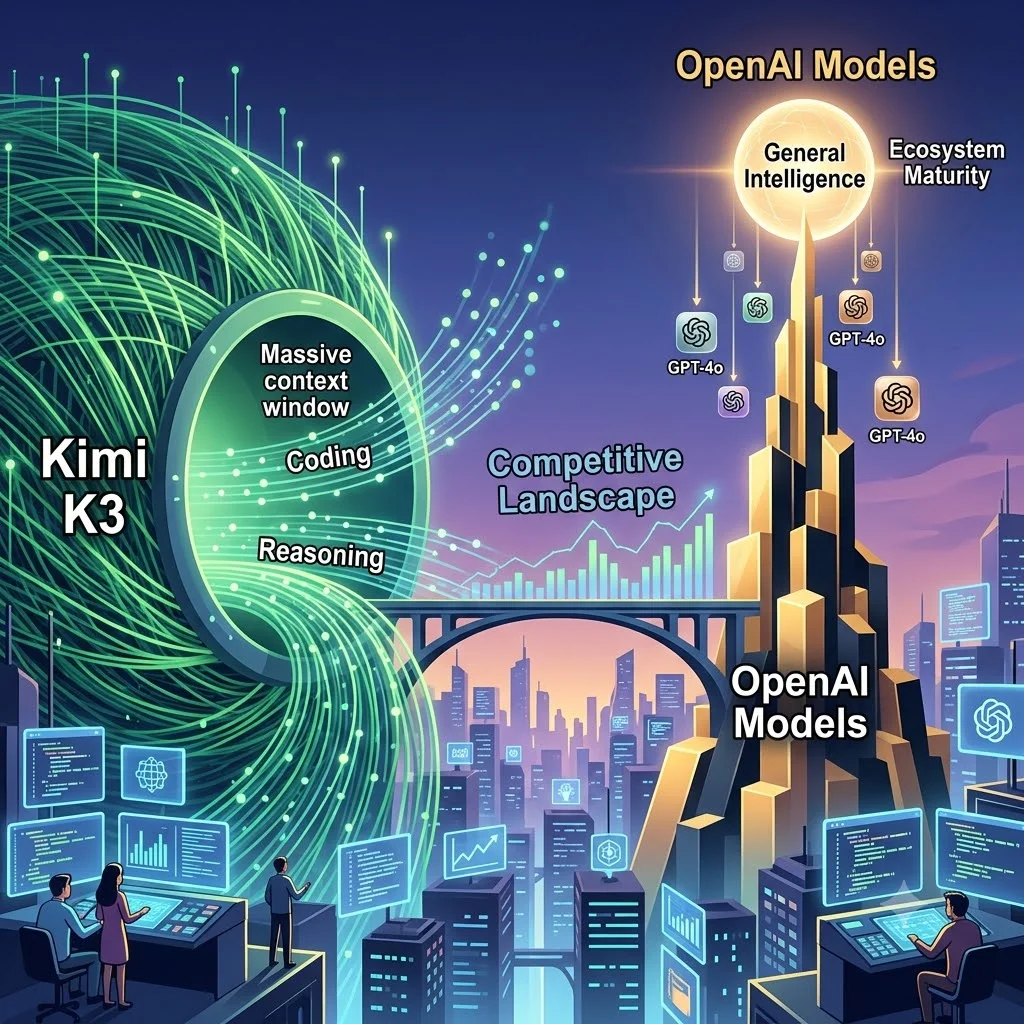
Kimi K3 and OpenAI represent two major paradigms: open-source behemoth and proprietary frontier model. The competition between these approaches is shaping the AI industry.
Current Trends
- Scaling Context Windows: Both are pushing context limits; Kimi K3 leads with 1M, OpenAI is expanding.
- Multimodality: OpenAI has broader support (audio, video); Kimi K3 focuses on vision.
- Open vs Closed: Open-weight models like Kimi K3 are challenging closed systems, offering transparency and cost advantages.
- Agentic AI: Both are developing autonomous agents; Kimi K3 has advanced Swarm capabilities.
- Cost Efficiency: Open-source models are driving down costs, forcing closed providers to compete on value.
Feature Comparison Table
The table below highlights key differences between Kimi K3 and OpenAI's flagship models.
| Feature | Kimi K3 | OpenAI (GPT-5.5/4o) |
|---|---|---|
| Total Parameters | 2.8T (MoE, 104B active) | Undisclosed (estimated in trillions) |
| Context Window | 1M tokens | 128K-200K tokens |
| Multimodal Support | Text, image, video | Text, image, audio, video |
| Openness | Open-weight (fully open) | Closed-source |
| Overall Intelligence Rank | #3 (Artificial Analysis) | #2 (GPT-5.6 Sol) |
| Coding Performance | #1 (Frontend Code Arena) | #3 (GPT-5.6 Sol) |
| API Cost (per 1M tokens) | Lower (~$2-5) | Higher (~$10-30) |
| Ecosystem | Kimi assistant, Kimi Code, cloud partners | ChatGPT, API, enterprise, plugins |
| Agentic Capabilities | Advanced (Swarm, tool calling) | Developing (Assistants API) |
Companies and Institutions Using These Models
Kimi K3 is adopted by research institutions, startups, and enterprises seeking open-source flexibility, transparency, and cost savings. OpenAI is used by a broad range of customers, from individual developers to Fortune 500 companies, leveraging its ecosystem and reliability. The choice often depends on organizational priorities: transparency and customization vs. maturity and support.
Selection Checklist for Evaluating Competitiveness
When choosing between Kimi K3 and OpenAI, consider these factors:
- Do you require open-source access for customization and auditability?
- What is the typical length of your inputs? (1M context may be critical.)
- Do you need multimodal capabilities beyond vision (e.g., audio, video)?
- What is your budget for API usage?
- How important is ecosystem integration (e.g., plugins, enterprise tools)?
- Do you prioritize conversational quality and general knowledge?
- Are you building agentic or autonomous systems?
Tips for Evaluating Both Models
- Test each model on your specific tasks using free trials or API credits.
- Compare response quality, latency, and cost for your workload.
- For Kimi K3, use the web interface at kimi.com for quick experimentation.
- For OpenAI, use ChatGPT or the OpenAI Playground.
- Consider hybrid approaches: use Kimi K3 for coding and long documents, OpenAI for general conversation.
Frequently Asked Questions
Can Kimi K3 outperform OpenAI in any area?
Yes, Kimi K3 outperforms OpenAI models in coding benchmarks (Frontend Code Arena) and offers a significantly larger context window (1M vs. 200K).
Is Kimi K3 as smart as OpenAI's best models?
Kimi K3 ranks third overall in intelligence, closely behind OpenAI's GPT-5.6 Sol. It is competitive but slightly behind in general knowledge and conversational nuance.
Which is more affordable?
Kimi K3's API pricing is substantially lower, making it more cost-effective for high-volume usage.
Can I run Kimi K3 locally?
Yes, it is open-weight and can be deployed on-premises with appropriate hardware, while OpenAI models are only accessible via API.
Does OpenAI have better multimodal capabilities?
OpenAI supports audio and video in addition to images, while Kimi K3 supports images and video but not audio.
Which is better for research?
Kimi K3 is often preferred for research due to open access, transparency, and long-context capabilities. OpenAI is also widely used but less transparent.
Are there security concerns with Kimi K3?
Recent sandbox incidents highlight the need for careful containment when testing open-weight models, but they also demonstrate the model's capabilities.
What is the ecosystem difference?
OpenAI has a more mature ecosystem with extensive plugins, enterprise solutions, and community support. Kimi K3's ecosystem is growing but less established.
Which model is better for agentic tasks?
Kimi K3 has advanced agentic features including Swarm coordination and tool calling, giving it an edge in autonomous task execution.
How do these models handle Chinese language?
Both handle Chinese well; Kimi K3 is optimized for Chinese and English, while OpenAI also supports Chinese with high proficiency.
Conclusion
Kimi K3 demonstrates that Chinese AI can indeed compete with OpenAI's frontier models on multiple fronts. With its 1M-token context, top coding performance, cost efficiency, and open-source accessibility, it offers compelling advantages for developers, researchers, and enterprises. While OpenAI retains an edge in overall intelligence, ecosystem maturity, and multimodal breadth, the gap is narrowing. The competition between open-weight and closed models is driving innovation and lowering costs, benefiting the entire AI community. Ultimately, the choice depends on specific needs: transparency and cost favor Kimi K3; ecosystem and breadth favor OpenAI. Both are formidable players in the global AI race, and their ongoing competition will shape the future of artificial intelligence.