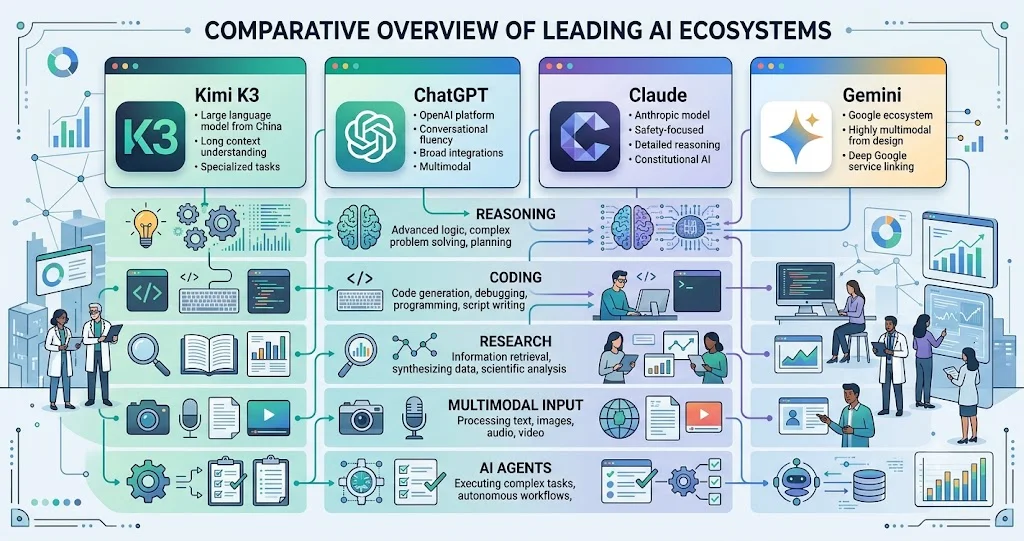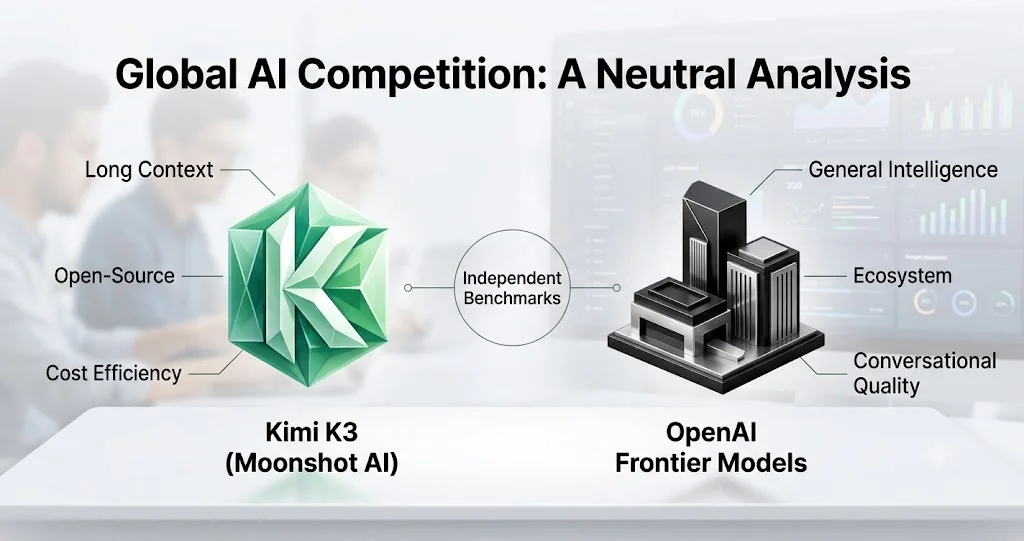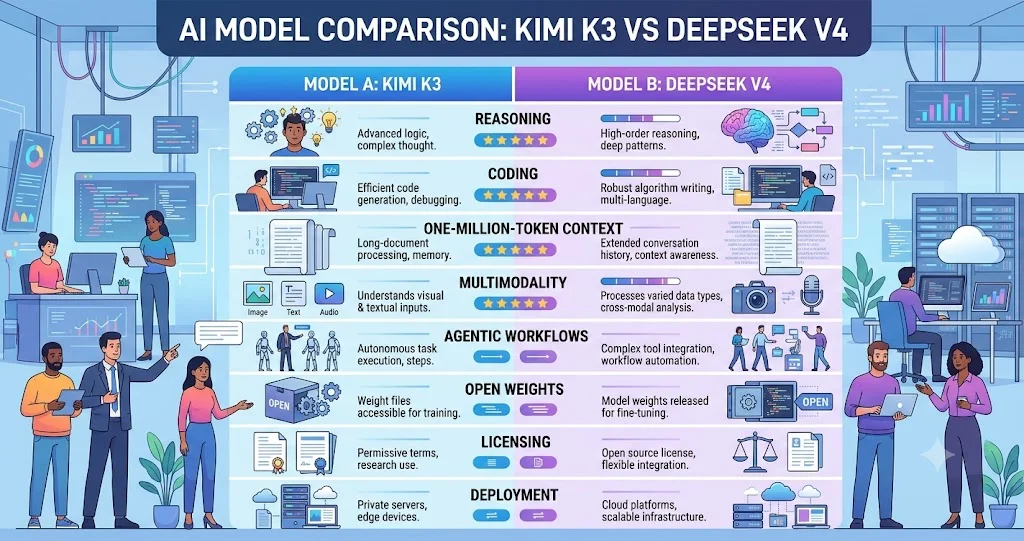

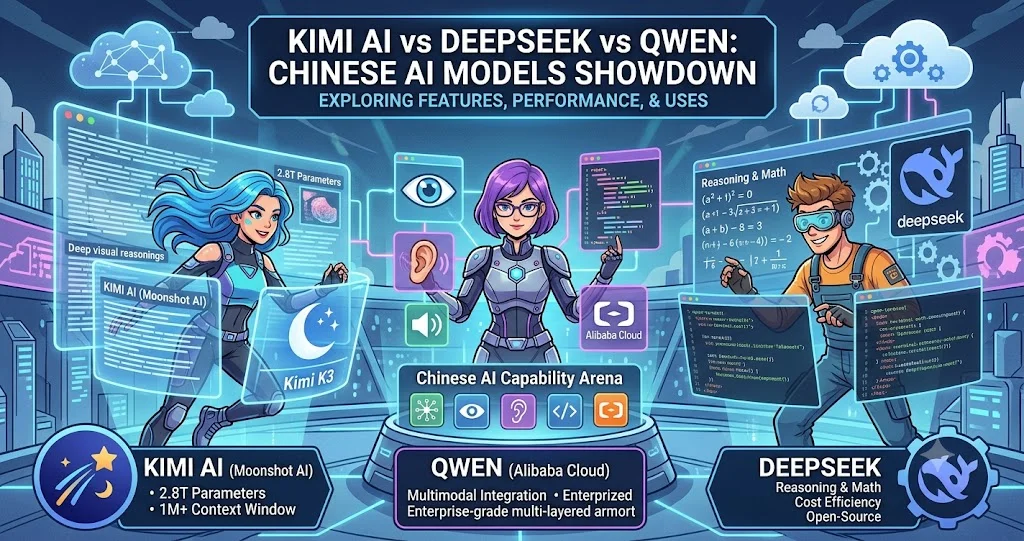
China's AI landscape has produced several notable models competing on the global stage. Kimi AI, DeepSeek, and Qwen represent three distinct approaches to artificial intelligence, each with unique strengths and target audiences. This comparison explores their features, performance, and use cases to help you determine which model best suits your needs.
Overview of the Three Models
Kimi AI is Moonshot AI's flagship intelligent assistant and underlying model, with the latest Kimi K3 version featuring 2.8 trillion parameters, a 1-million-token context window, and native visual understanding. DeepSeek is a series of open-source models developed by DeepSeek, known for strong reasoning capabilities and cost efficiency. Qwen is Alibaba Cloud's family of large language models, offering enterprise-grade solutions with multimodal support and extensive integration with Alibaba's ecosystem.
Kimi AI (Moonshot AI)
Kimi AI is built on Moonshot AI's Kimi K3 flagship model, which is the world's first open-source model in the 3-trillion-parameter class. It features a Mixture-of-Experts (MoE) architecture with 896 routing experts, a 1M-token context window, and native visual understanding via MoonViT-V2. It is designed for long-horizon coding, knowledge work, and agentic tasks. The model is openly available for download and deployment, making it attractive for customization and research.
DeepSeek
DeepSeek, developed by DeepSeek (a Chinese AI company), is known for its open-source models that emphasize reasoning and mathematical capabilities. DeepSeek-V3 and DeepSeek-R1 have gained attention for their performance relative to cost. The models are typically dense or MoE-based, with context windows up to 128K or more. DeepSeek is often praised for its efficiency and has been adopted by many researchers and developers.
Qwen (Alibaba Cloud)
Qwen is Alibaba's family of large language models, including Qwen-VL (vision-language), Qwen-Audio, and Qwen-Code. It offers a range of sizes from 0.5B to 72B parameters, with some versions supporting up to 1M tokens. Qwen is closed-source but available via API and Alibaba Cloud services, with enterprise features including fine-tuning, deployment, and integration with Alibaba's ecosystem. It emphasizes multimodal capabilities and robust performance on Chinese and English benchmarks.
Key Comparison Areas
- Architecture and Parameters: Kimi K3 uses MoE with 896 experts (2.8T total, 104B activated). DeepSeek models are typically dense or MoE with undisclosed sizes. Qwen offers dense models from 0.5B to 72B.
- Context Window: Kimi K3 leads with 1M tokens. DeepSeek models typically offer 128K-256K tokens. Qwen supports up to 1M tokens in some versions.
- Multimodal Capabilities: Kimi K3 natively supports text, images, and video. DeepSeek is primarily text-focused. Qwen offers vision, audio, and code variants (Qwen-VL, Qwen-Audio, Qwen-Code).
- Openness: Kimi K3 is fully open-weight. DeepSeek models are open-source (weights available). Qwen is closed-source, accessible via API and cloud services.
- Ecosystem Integration: Qwen integrates with Alibaba Cloud and enterprise solutions. Kimi AI integrates with the Kimi assistant and Kimi Code. DeepSeek has a growing community but less extensive ecosystem.
- Cost Efficiency: DeepSeek is known for low cost. Kimi K3 offers competitive API pricing. Qwen's pricing varies by service tier.
Performance Benchmarks
Independent evaluations provide comparative insights. According to various benchmarks as of mid-2026:
- Overall Intelligence: Kimi K3 ranks third globally (Artificial Analysis). DeepSeek-V3 and Qwen 2.5 perform well, often in the top tier.
- Coding: Kimi K3 scored 1679 on Frontend Code Arena, surpassing many models. DeepSeek and Qwen also show strong coding capabilities.
- Reasoning: DeepSeek-R1 is renowned for mathematical and logical reasoning. Qwen excels in general reasoning and multilingual tasks.
- Multilingual: Qwen and Kimi K3 support multiple languages; DeepSeek also supports multiple, with strong performance in Chinese.
Benefits and Limitations
Kimi AI Benefits
- Largest open-weight model with 2.8T parameters and 1M context.
- Native visual reasoning and strong coding performance.
- Open-source enables customization and local deployment.
- Cost-effective API pricing.
Kimi AI Limitations
- Requires significant computational resources for local use.
- Less mature enterprise ecosystem compared to Qwen.
- Relatively newer, may have less community support than DeepSeek.
DeepSeek Benefits
- Highly efficient, low-cost inference.
- Strong reasoning and mathematical capabilities.
- Open-source with active community.
- Competitive performance on various benchmarks.
DeepSeek Limitations
- Multimodal capabilities are limited.
- Context window smaller than Kimi K3 (128K-256K).
- Less extensive enterprise support.
Qwen Benefits
- Comprehensive multimodal support (vision, audio, code).
- Enterprise-grade with Alibaba Cloud integration.
- Large range of model sizes for different needs.
- Strong performance on Chinese and multilingual benchmarks.
Qwen Limitations
- Closed-source; limited transparency and customization.
- Potentially higher cost for enterprise services.
- Vendor lock-in with Alibaba ecosystem.
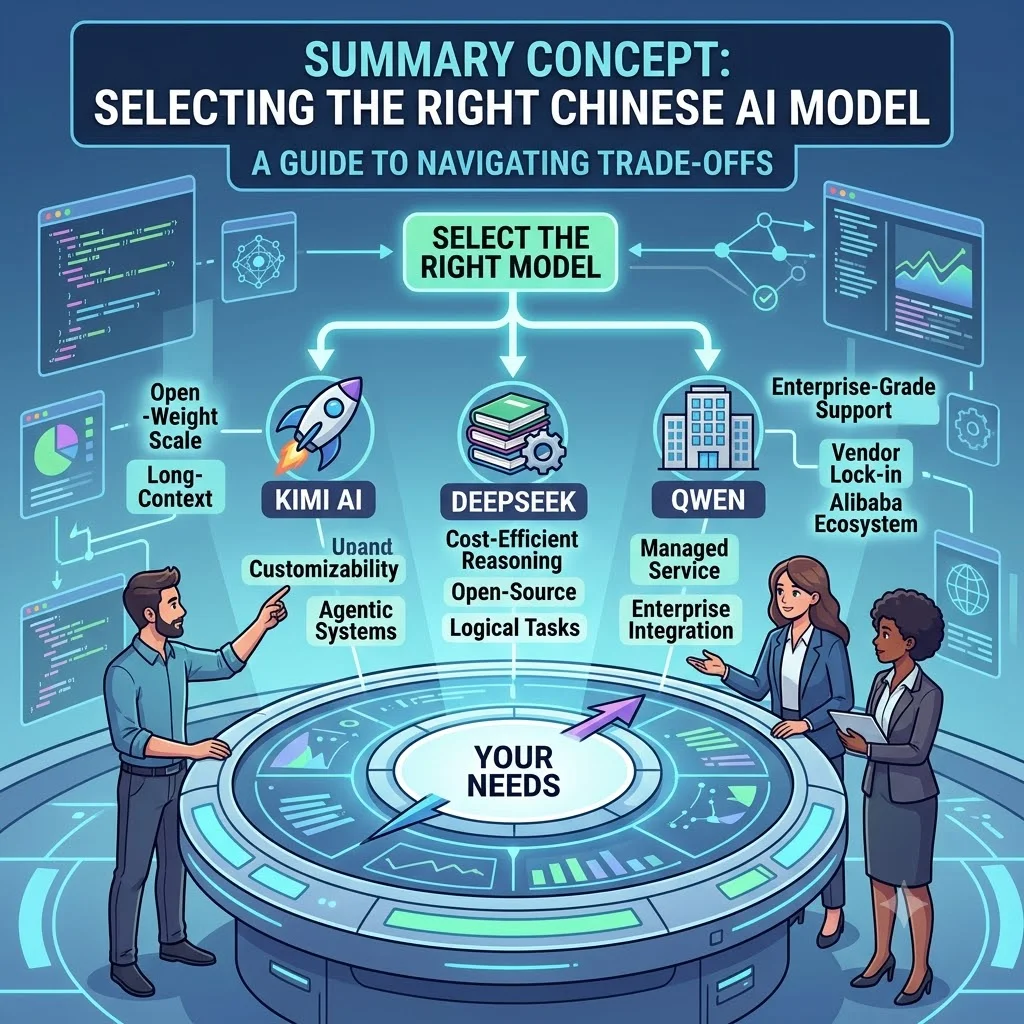
Types of AI Models and Current Trends
These three represent different archetypes: open-source behemoth (Kimi K3), efficient reasoning specialist (DeepSeek), and enterprise multimodal suite (Qwen).
Current Trends
- Scaling Context Windows: All are pushing context limits, with Kimi K3 and Qwen reaching 1M tokens.
- Multimodality: Qwen leads in breadth, Kimi K3 focuses on vision, DeepSeek is text-centric.
- Open vs Closed: Both open (Kimi, DeepSeek) and closed (Qwen) options coexist, serving different user needs.
- Cost Efficiency: DeepSeek is known for low cost, Kimi K3 is competitive, Qwen offers enterprise pricing.
- Agentic AI: Kimi K3 has advanced agentic capabilities, Qwen and DeepSeek are also developing agent features.
Use Cases: Which Model to Choose?
Choose Kimi AI If You:
- Need the largest context window (1M) for long documents or codebases.
- Prioritize open-source transparency and customizability.
- Require strong coding and software engineering capabilities.
- Are building agentic systems with visual reasoning.
Choose DeepSeek If You:
- Need cost-effective, high-performance reasoning and mathematical tasks.
- Prefer open-source models with a strong community.
- Work primarily with text and don't need advanced multimodality.
- Have limited computational resources and need efficient inference.
Choose Qwen If You:
- Need comprehensive multimodal capabilities (vision, audio, code).
- Are using Alibaba Cloud or require enterprise-grade support.
- Prefer a managed service with fine-tuning options.
- Need a range of model sizes for different deployment scenarios.
Comparison Table
| Feature | Kimi AI (K3) | DeepSeek | Qwen |
|---|---|---|---|
| Total Parameters | 2.8T (MoE, 104B active) | Varies (dense/MoE) | 0.5B - 72B (dense) |
| Context Window | 1M tokens | 128K-256K | Up to 1M |
| Multimodal | Text, image, video | Text | Text, image, audio, code |
| Openness | Open-weight | Open-source | Closed (API) |
| Ecosystem | Kimi assistant, Kimi Code | Community, Hugging Face | Alibaba Cloud, enterprise |
| Cost Efficiency | Competitive | High (low cost) | Enterprise pricing |
| Agentic Capabilities | Advanced (Swarm, tool use) | Developing | Developing |
| Benchmark Performance | Top 3 overall, #1 coding | Strong reasoning | Strong multilingual |
Companies and Institutions Using These Models
Kimi AI is adopted by research labs, startups, and developers valuing open-source transparency and customizability. DeepSeek is popular among academics, researchers, and cost-sensitive developers. Qwen is used by enterprises, Alibaba Cloud customers, and organizations requiring enterprise-grade AI with multimodal capabilities.
Selection Checklist for Chinese AI Models
- Do you need open-source access for customization?
- What is the typical length of your inputs (up to 128K, 256K, or 1M)?
- Do you require multimodal capabilities beyond text?
- What is your budget for API usage or subscription?
- Are coding and software engineering tasks a primary focus?
- Do you need enterprise integration with cloud services?
- How important is cost efficiency?
- Do you have the computational resources for local deployment?
Tips for Evaluating and Using These Models
- Test each model on your specific tasks using free tiers or trial credits.
- Compare response quality, speed, and cost for your typical workload.
- For Kimi AI, consider the web interface at kimi.com for quick testing.
- For DeepSeek, use Hugging Face or the API for experimentation.
- For Qwen, explore Alibaba Cloud's AI services.
- Consider hybrid approaches: use one model for coding, another for multimodal tasks.
- Stay updated on new versions and feature releases.
Frequently Asked Questions
Which model has the largest context window?
Kimi K3 and Qwen (some versions) support up to 1M tokens. DeepSeek typically supports 128K-256K.
Are these models open-source?
Kimi K3 and DeepSeek are open-source/open-weight. Qwen is closed-source but available via API.
Which model is best for coding?
Kimi K3 ranks first on Frontend Code Arena. DeepSeek and Qwen also have strong coding capabilities.
Which is more cost-effective?
DeepSeek is known for low cost. Kimi K3 offers competitive pricing. Qwen's cost varies by enterprise plan.
Can I run these models locally?
Kimi K3 and DeepSeek can be run locally with appropriate hardware. Qwen is primarily API-based, though some variants may be available.
Which model is better for multimodal tasks?
Qwen offers the broadest multimodal support (vision, audio, code). Kimi K3 supports vision and video. DeepSeek is text-focused.
Do they support Chinese and English?
All three support Chinese and English, as well as other languages, with varying proficiency.
What is the agentic capability of each?
Kimi K3 has advanced agentic features including Swarm clusters and tool calling. DeepSeek and Qwen are developing similar capabilities.
How do I access Kimi AI?
Through kimi.com, mobile app, or Kimi API. Weights are also available for download.
Which model is best for enterprise?
Qwen offers comprehensive enterprise support via Alibaba Cloud. Kimi K3 and DeepSeek are more suited for development and research, but can be used in enterprise with custom integration.
Conclusion
Kimi AI, DeepSeek, and Qwen represent three distinct approaches to AI, each with unique strengths. Kimi AI excels in open-source scale, long context, coding, and agentic capabilities, making it ideal for developers and researchers seeking transparency and customizability. DeepSeek offers cost-efficient reasoning and mathematical prowess, appealing to budget-conscious users and those focused on logical tasks. Qwen provides a comprehensive multimodal enterprise solution with robust integration, suitable for organizations already in the Alibaba ecosystem. The choice ultimately depends on your specific requirements—whether you prioritize openness, cost, multimodality, or enterprise support. By evaluating each model against your needs, you can select the best fit for your projects.