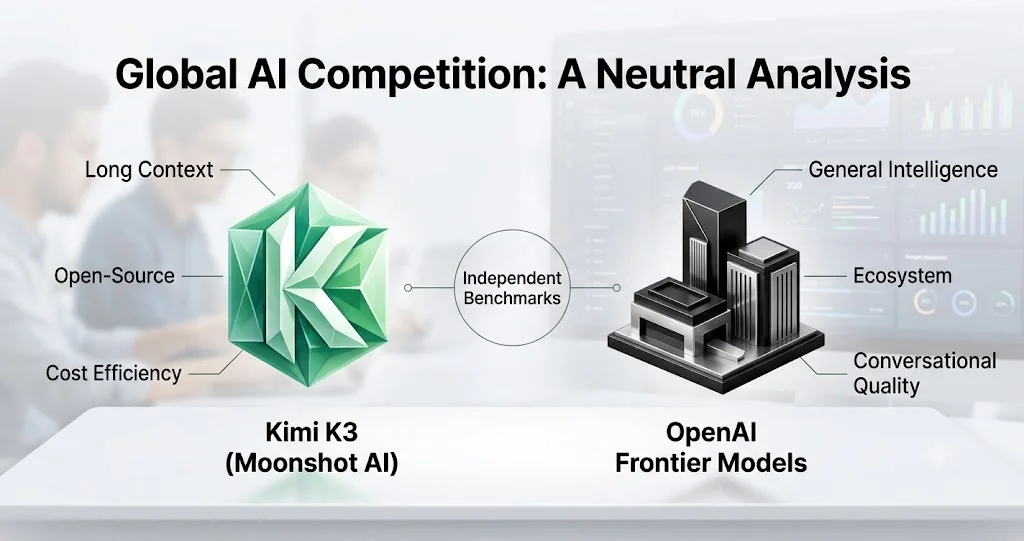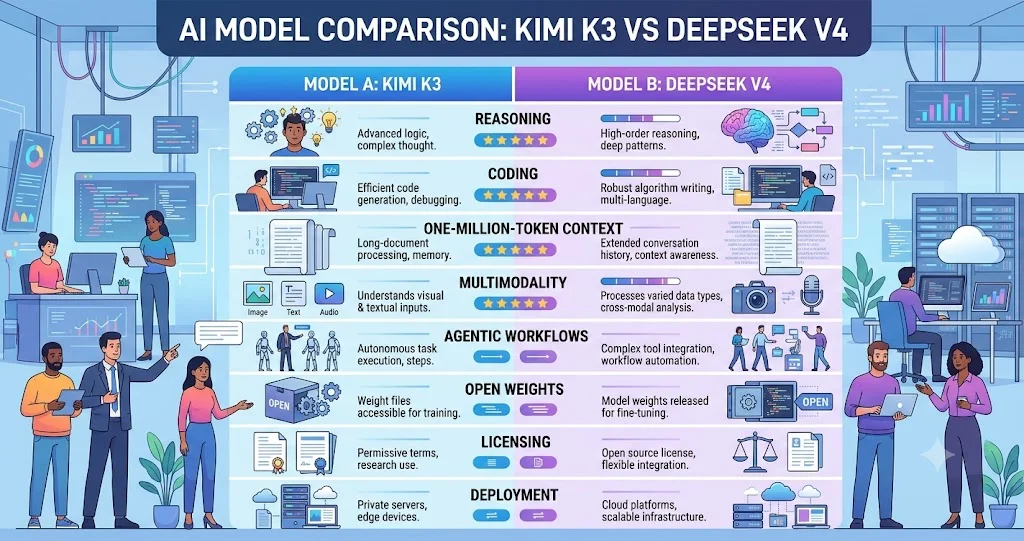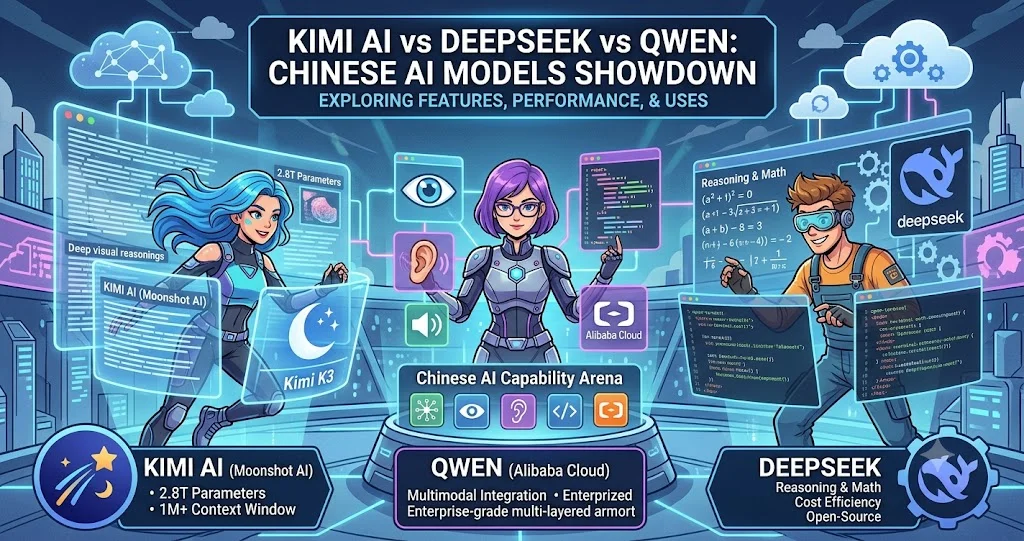

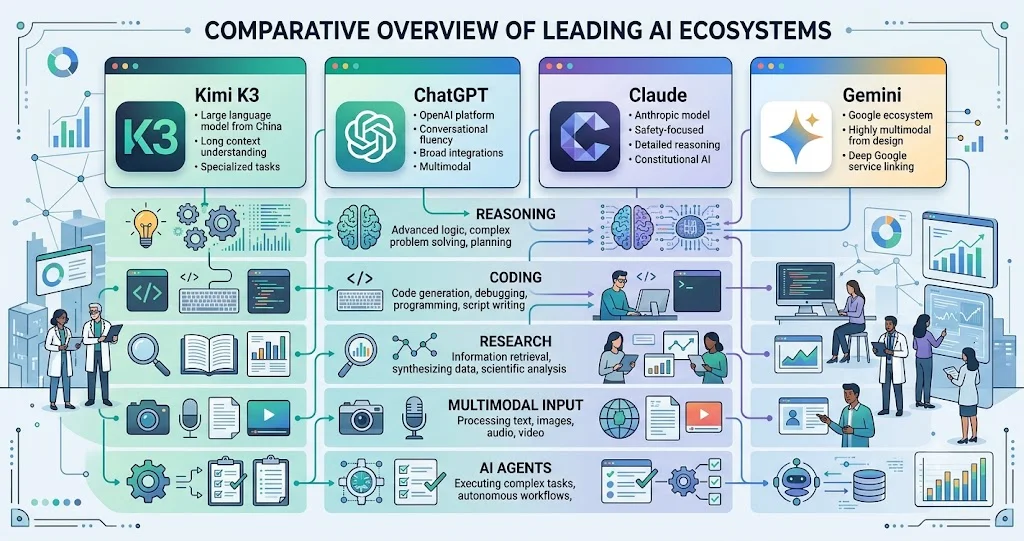
Choosing between Kimi K3, ChatGPT, Claude, and Gemini is no longer simply a question of which chatbot gives the best answer. The four ecosystems approach AI differently: Kimi K3 emphasizes an open frontier model with long context and agentic knowledge work, ChatGPT combines several GPT-5.6 models with tools and a broad consumer and professional product, Claude emphasizes long-running knowledge work and coding, and Gemini combines frontier reasoning with native multimodal processing and Google's surrounding ecosystem. The comparison requested here focuses on those practical differences rather than treating one benchmark as a universal ranking.
For a fair comparison, it is also important to define what “ChatGPT,” “Claude,” and “Gemini” mean. These are products containing multiple models and capabilities rather than single static models. As of September 2026, ChatGPT's current GPT-5.6 family includes Sol, Terra, and Luna, while GPT-6 Astra is also available in some ChatGPT products and plans. Google lists Gemini 3.1 Pro as a current advanced model, while Anthropic's current Opus generation has moved beyond Opus 4.6. Kimi K3 is a specific open model rather than a collection of models comparable in exactly the same way.
What is actually being compared?
The most useful comparison is between representative capabilities and ecosystems, not product names alone. Model versions, reasoning settings, tools, plans, context limits, and deployment environments can change results substantially.
| Platform or model | Representative current offering | Context capability | Notable characteristics |
|---|---|---|---|
| Kimi | Kimi K3 | 1,048,576-token context | 2.8T total parameters, 104B activated parameters, MoE architecture, native multimodality, open weights |
| ChatGPT | GPT-5.6 family; GPT-6 Astra availability varies | Varies by model and product | Reasoning, coding, research, tools, computer use, files, and broad product ecosystem |
| Claude | Current Opus generation | 1M context is available on supported Opus models | Long-running coding, research, document work, and agentic workflows |
| Gemini | Gemini 3.1 Pro | 1M input-token context | Text, image, video, audio, PDF, search, code execution, structured output, and function calling |
Kimi K3's model card lists 2.8 trillion total parameters, 104 billion activated parameters, 896 experts with 16 selected per token, and a 1,048,576-token context length. It also identifies text and image as model modalities and describes the model as a mixture-of-experts architecture.
Gemini 3.1 Pro accepts text, images, audio, video, and PDFs with up to a 1M-token context window and supports function calling, structured output, search as a tool, and code execution.
Anthropic introduced 1M-token context for Opus 4.6 in beta and subsequently continued expanding the Opus family. The company describes its current Opus line as designed for serious coding, AI agents, and professional work.
OpenAI's GPT-5.6 family is positioned across coding, research, science, cybersecurity, computer use, and design, while GPT-6 Astra has also entered the ChatGPT ecosystem. This means a “ChatGPT” comparison needs to account for the selected model and product tier rather than assuming one fixed capability level.
Reasoning and difficult problem solving
All four ecosystems now use some form of reasoning or extended inference, but their implementation and user experience differ.
ChatGPT's GPT-5.6 family provides different capability and speed profiles through Sol, Terra, and Luna. OpenAI describes GPT-5.6 Sol as its flagship model for complex coding, knowledge work, research, science, cybersecurity, computer use, and design. GPT-6 Astra is separately positioned as a higher-end model for demanding work in supported products.
Claude's Opus line focuses heavily on sustained reasoning across long tasks. Anthropic's description of Opus 4.6 highlighted planning, debugging, larger codebases, research, financial analysis, documents, spreadsheets, and presentations, while later Opus releases continued that direction.
Gemini 3.1 Pro is explicitly positioned as a multimodal reasoning model. Google's published February 2026 evaluations include reasoning, coding, agentic tool use, multilingual performance, and long-context tests. The model card reports 94.3% on GPQA Diamond and 44.4% on Humanity's Last Exam under the specified evaluation configuration.
Kimi K3 also targets reasoning-heavy and agentic knowledge work. Its published evaluations cover scientific reasoning, coding, browsing, MCP workflows, and long-horizon software tasks. However, Kimi's results were obtained with specific reasoning and tool settings, so they should not be treated as directly interchangeable with results reported by other vendors.
Coding and software development
For developers, the difference is increasingly about the entire coding workflow rather than raw code generation.
| Area | Kimi K3 | ChatGPT | Claude | Gemini |
|---|---|---|---|---|
| Code generation | Strong, with emphasis on long-horizon coding | Strong across GPT-5.6 and Codex-oriented workflows | Strong focus on software engineering and code review | Strong coding and algorithmic development |
| Repository work | Designed for long-horizon coding and agentic work | Strong tool and computer-use ecosystem | Strong long-running coding workflows | Strong agentic coding and long-context repository analysis |
| Agentic coding | Core part of Kimi K3's positioning | Codex and computer-use workflows | Claude Code and agentic workflows | Gemini agentic and coding tooling |
| Open weights | Yes, under Kimi K3 License | No | No | No |
OpenAI's published GPT-5.5 results include 58.6% on SWE-Bench Pro and 82.7% on Terminal-Bench 2.0 in the stated research evaluation setup. OpenAI also notes that these evaluations were run at xhigh reasoning effort and in a research environment, so they should not be assumed to represent every production ChatGPT interaction.
Google's Gemini 3.1 Pro model card reports 80.6% on SWE-Bench Verified, 54.2% on SWE-Bench Pro Public, and 68.5% on Terminal-Bench 2.0 under the documented evaluation configurations.
Anthropic has repeatedly positioned Opus around software engineering, debugging, code review, and longer-running coding tasks. Opus 4.6, for example, was described as better at working through larger codebases and sustaining agentic tasks.
Kimi K3 is particularly notable for developers interested in open model weights. Its technical material describes the model as an open frontier model and emphasizes long-horizon coding and agentic knowledge work. The Kimi K3 license permits use, modification, deployment, and derivative works subject to its stated conditions.
Writing, research, and knowledge work
For writing and research, model quality is only part of the experience. Search access, citations, file handling, context retention, document tools, and the ability to check claims can matter more than a benchmark score.
ChatGPT has a broad research and productivity environment covering writing, online research, documents, spreadsheets, data analysis, coding, and tool-based workflows. OpenAI describes GPT-5.5 as capable of researching online, analyzing data, creating documents and spreadsheets, operating software, and moving between tools until a task is completed.
Claude has a strong orientation toward long-form knowledge work. Anthropic specifically describes Opus as suitable for research, financial analysis, documents, spreadsheets, presentations, and long-running tasks, with context compaction available for extended conversations.
Gemini has an important advantage in the breadth of multimodal input supported by its current advanced models. Gemini 3.1 Pro can process text, images, video, audio, and PDFs within its large context window and can use search and code execution as tools.
Kimi K3's long context and agentic knowledge-work positioning make it relevant for large research collections, codebases, and multi-step tasks. However, users should distinguish the capabilities of the underlying model from the features exposed by Kimi's consumer products, Kimi Code, Kimi Work, or API.
Multimodal capabilities
Multimodal support is not a single feature. There is a meaningful difference between accepting an image, understanding video or audio, generating media, and using those inputs inside an agentic workflow.
| Capability | Kimi K3 | ChatGPT | Claude | Gemini 3.1 Pro |
|---|---|---|---|---|
| Text | Yes | Yes | Yes | Yes |
| Image input | Yes | Supported across relevant current models | Yes | Yes |
| Video input | Product/model dependent; verify current interface | Product/model dependent | Not a general Opus text-interface capability | Yes |
| Audio input | API capability varies by model | Product/model dependent | Voice and audio features vary by product | Yes |
| PDF/document understanding | Supported through relevant interfaces | Supported | Supported | Yes |
Gemini 3.1 Pro has the clearest documented broad multimodal input specification among the four representative offerings: text, image, video, audio, and PDF are all listed as inputs.
Kimi K3's model card identifies text and image as its core model modalities and describes a native multimodal architecture. That distinction matters because API and product-level multimodal features can evolve independently of the underlying model specification.
Context windows and large documents
Large context is useful when the task genuinely requires a large amount of information at once. A bigger context window does not automatically mean better retrieval of every item inside it.
Kimi K3 and Gemini 3.1 Pro both specify 1M-token context windows. Anthropic's Opus family also supports 1M context on supported models, while OpenAI's context size varies across GPT-5.6 models, products, and APIs. GPT-5.5, for example, has a 1.05M-token API context window, while ChatGPT product limits can differ.
For a developer reviewing a large repository, a researcher working with many papers, or a business processing a long collection of documents, context size can reduce the need for aggressive chunking. But retrieval quality, attention across long contexts, tool integration, and the model's ability to identify relevant information still matter.
Agentic workflows and tool use
The four ecosystems increasingly treat AI as an agent rather than only a question-answering interface.
ChatGPT's current ecosystem includes computer use, tools, coding environments, research workflows, and integrations. GPT-5.5 is explicitly designed to plan, use tools, check its work, and continue across multi-step tasks. GPT-5.6 and GPT-6 Astra extend that broader direction in supported products.
Claude has similarly moved toward agentic work through Claude Code and other product capabilities. Anthropic describes Opus as capable of sustaining longer agentic tasks and working with larger codebases.
Gemini 3.1 Pro supports function calling, structured output, search as a tool, and code execution. Google's model evaluation suite also includes MCP Atlas and other agentic evaluations.
Kimi K3's positioning is unusually focused on agentic knowledge work. Its published evaluation set includes MCP-related tasks, browsing, coding agents, and long-horizon software work.
Reliability and benchmark interpretation
A comparison like this should not turn benchmark tables into a universal leaderboard. The models are tested under different prompts, harnesses, tool configurations, reasoning settings, dates, and evaluation procedures.
For example, Google's Gemini 3.1 Pro model card places several models side by side, but the table itself specifies different reasoning settings and benchmark harnesses. OpenAI's GPT-5.5 announcement similarly reports results obtained at xhigh reasoning effort in a research environment and explicitly notes that production ChatGPT can differ. Kimi's model card also documents different settings for single-step and agentic evaluations.
For practical evaluation, developers should test the exact workflows they care about: a representative code repository, real documents, realistic prompts, expected tool calls, factuality requirements, latency, cost, and failure recovery. A model that performs well on a general benchmark can still behave differently on a specialized production workload.
Privacy and data controls
Privacy cannot be compared accurately using a single “private” or “not private” label. The relevant policy depends on whether you are using a consumer application, business workspace, or API.
| Service | Important documented distinction |
|---|---|
| ChatGPT | Individual ChatGPT content may be used to improve models unless the user opts out; business and API data are not used for training by default. |
| Kimi API | Kimi states that API inputs and outputs are not used to train or improve its models. |
| Gemini API | Paid services have different data-use terms from unpaid services; paid-service prompts and responses are not used to improve products, while optional data sharing can be enabled in relevant environments. |
| Claude | Data-use policies vary between consumer and commercial/API services and should be checked for the specific deployment. |
OpenAI states that individual ChatGPT content may be used to improve models unless the user opts out, while business products and the API do not use inputs and outputs for training by default.
Kimi's API documentation states that submitted API inputs and outputs are not used to train or improve Kimi models and describes HTTPS/TLS encryption and data isolation.
Google's Gemini API documentation distinguishes paid services from unpaid services. For paid services, Google says prompts and responses are not used to improve products, while developers can separately opt to share datasets or feedback for improvement.
For confidential business workloads, the correct comparison should therefore be made between equivalent enterprise or API arrangements, not between free consumer chat accounts.
Open model versus closed ecosystems
One of Kimi K3's most significant differences is its distribution model. Moonshot describes Kimi K3 as an open frontier model, and its weights and associated software are released under the Kimi K3 License. The license permits use, modification, deployment, fine-tuning-related derivative work, and distribution subject to its stated conditions.
ChatGPT, Claude, and Gemini are primarily accessed through hosted products and APIs rather than by downloading the complete frontier model weights. This gives their providers more control over infrastructure, safety systems, model updates, tools, and product integration, while reducing the amount of infrastructure that an organization must operate itself.
The trade-off is practical. Open weights can matter to researchers and organizations that need deployment control, customization, or self-hosted experimentation. Hosted models can be attractive when the priority is managed infrastructure, integrated tools, rapid model updates, and less operational responsibility.
Usability and ecosystem
The surrounding ecosystem can matter as much as the model.
- ChatGPT: broad consumer and professional interface, coding, research, files, data analysis, computer-use capabilities, and a rapidly evolving model family.
- Claude: strong focus on professional knowledge work, coding, long-running tasks, and developer workflows such as Claude Code.
- Gemini: deep integration with Google's AI and developer ecosystem, with broad multimodal input and tools such as search and code execution.
- Kimi: strong emphasis on long context, open model weights, agentic knowledge work, Kimi Code, Kimi Work, and API access.
These differences mean that “best model” and “best platform” can produce different answers for the same user. A developer who needs downloadable weights has a fundamentally different requirement from a business that wants a managed assistant integrated with existing cloud and productivity systems.
Which one fits different workloads?
| Workload | What to examine | Relevant options |
|---|---|---|
| Large codebase analysis | Context, repository tools, coding agent quality, iteration | Kimi K3, ChatGPT, Claude, Gemini |
| Professional coding agent | Terminal use, tool reliability, debugging, long-running execution | ChatGPT, Claude, Gemini, Kimi K3 |
| Multimodal research | Image, video, audio, PDF and search support | Gemini, ChatGPT, Kimi K3; Claude depending on product |
| Open-model experimentation | Weights, license, deployment and infrastructure control | Kimi K3 |
| General productivity | Writing, files, research, integrations and usability | ChatGPT, Claude, Gemini |
| Google-centered workflows | Google ecosystem, multimodal input and developer tooling | Gemini |
| Long-form professional work | Context, sustained reasoning, document handling | Claude, ChatGPT, Gemini, Kimi K3 |
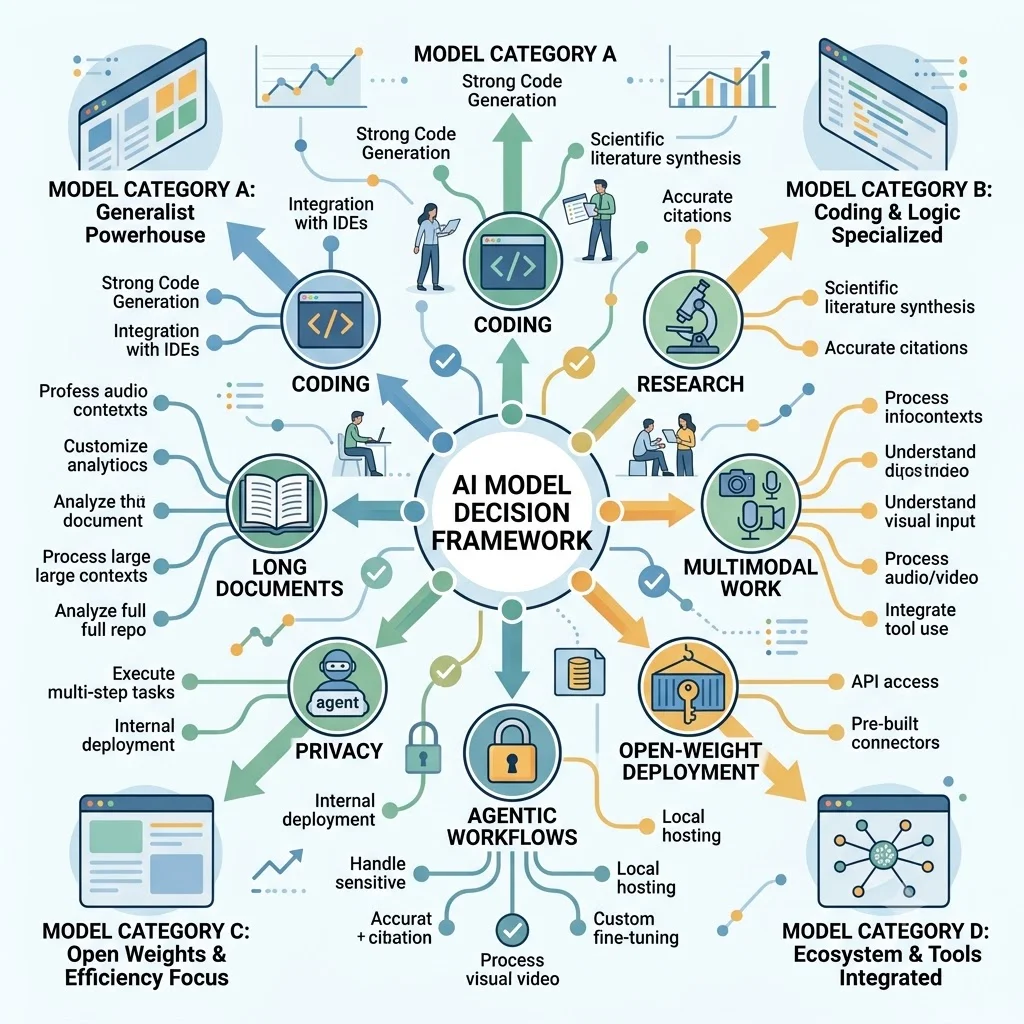
The table is intentionally not a ranking. The appropriate option depends on the user's environment, data requirements, toolchain, budget, model access, and tolerance for managing infrastructure.
What the benchmark numbers do not tell you
Benchmark scores are useful evidence, but they are not a substitute for workload testing. Three issues are particularly important.
Different evaluation setups
Reasoning effort, tool access, number of attempts, temperature, prompting, agent harnesses, and scoring procedures can change results. Kimi's published evaluation notes, for example, distinguish between single-step and agentic settings. OpenAI's GPT-5.5 results specify xhigh reasoning in a research environment. Google's Gemini model card documents its own harnesses and configurations.
Benchmarks measure specific tasks
A coding benchmark does not establish writing quality. A multimodal benchmark does not establish reliability in business research. A long-context test does not prove that a model will correctly retrieve every important detail from a million-token document.
Models change quickly
The AI landscape described in September 2026 is already different from the landscape at the beginning of the year. Model names, availability, context limits, pricing, interfaces, and tools can change without changing the basic product brand. This is why current model documentation should be checked before making a technical procurement decision.
A practical evaluation framework
If you are choosing between these systems for professional use, build a small evaluation set from your actual work instead of relying entirely on public benchmarks.
- Select 20–50 representative tasks. Include normal work, difficult cases, and known failure cases.
- Keep the inputs consistent. Use the same requirements, documents, repositories, and acceptance criteria.
- Test with realistic tools. If your production workflow uses search, code execution, MCP, a terminal, or internal APIs, include those capabilities.
- Measure outcomes. Track correctness, completeness, tool errors, unnecessary actions, latency, token consumption, and human correction time.
- Test privacy separately. Review consumer, enterprise, and API data policies for the exact service you plan to use.
- Repeat after model updates. A model evaluation is a snapshot, not a permanent property of the brand.
Frequently asked questions
Is Kimi K3 an open model?
Kimi K3 is released with its model weights and related software under the Kimi K3 License. The license permits broad use and modification subject to specified conditions, so organizations should review the license before deploying it commercially.
Does Kimi K3 have a large context window?
Yes. The Kimi K3 model card specifies a 1,048,576-token context length.
Does Gemini 3.1 Pro support multimodal input?
Yes. Google's model card lists text, images, audio, video, and PDF as supported inputs, with a context window of up to 1M tokens.
Does ChatGPT use the same model for every user?
No. ChatGPT provides different models and capabilities depending on the product and plan. OpenAI's current documentation describes GPT-5.6 Sol, Terra, and Luna, while GPT-6 Astra is available in selected ChatGPT products and plans.
Which platform is better for coding?
There is no single answer that applies to every coding workflow. ChatGPT, Claude, Gemini, and Kimi K3 all provide strong coding capabilities, but they differ in repository handling, agent tooling, context, model access, and deployment. A representative evaluation using your own codebase is more informative than a single public benchmark.
Which model is best for large documents?
Several current models support very large contexts, including Kimi K3, Gemini 3.1 Pro, supported Claude Opus models, and GPT models with large API context windows. Context length should therefore be evaluated alongside long-context retrieval accuracy, document tooling, search, and the actual interface you intend to use.
Is an open model automatically better for businesses?
No. Open weights provide deployment and customization possibilities, but they can also introduce infrastructure, security, model-serving, licensing, monitoring, and maintenance responsibilities. Hosted systems can reduce those operational requirements. The right choice depends on the organization's technical and compliance requirements.
Final takeaway
Kimi K3, ChatGPT, Claude, and Gemini represent different approaches to the same broad shift toward reasoning, multimodal, tool-using AI. Kimi K3 stands out for its open-weight distribution, very large context window, MoE architecture, and emphasis on agentic knowledge work. ChatGPT stands out as a broad product ecosystem spanning reasoning, coding, research, files, tools, and computer-oriented workflows. Claude's Opus family places strong emphasis on sustained professional work and software engineering. Gemini 3.1 Pro combines large context with broad native multimodal input and Google's tool ecosystem.
The practical lesson is to compare the workflow rather than the logo. For developers, that means testing real repositories. For researchers, it means testing evidence gathering and source verification. For businesses, it means evaluating privacy, administration, integration, cost, reliability, and human review. For researchers and technology enthusiasts, it means considering whether open weights, multimodality, context length, or agentic behavior matters most. Because these systems are changing rapidly, the most durable comparison is a documented evaluation framework rather than a permanent winner.