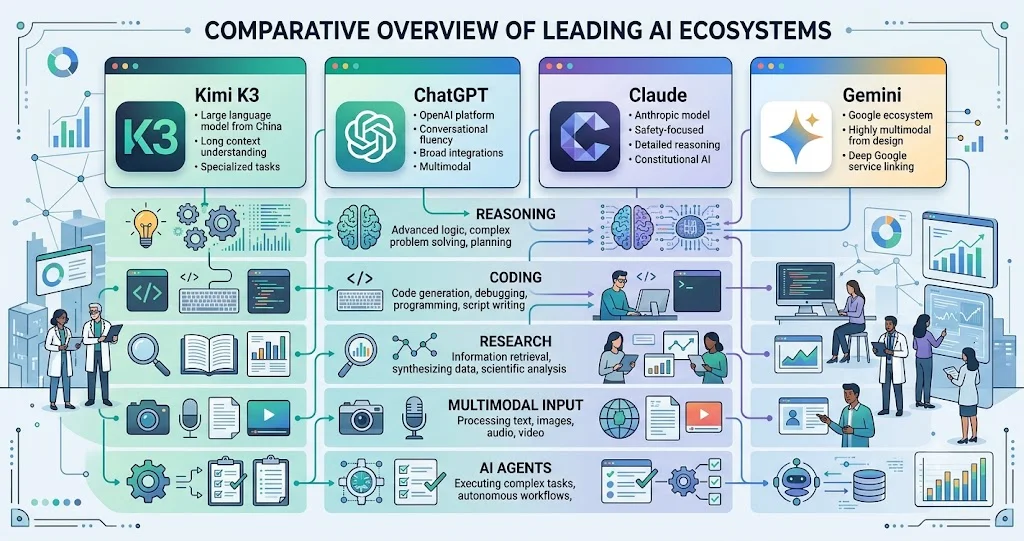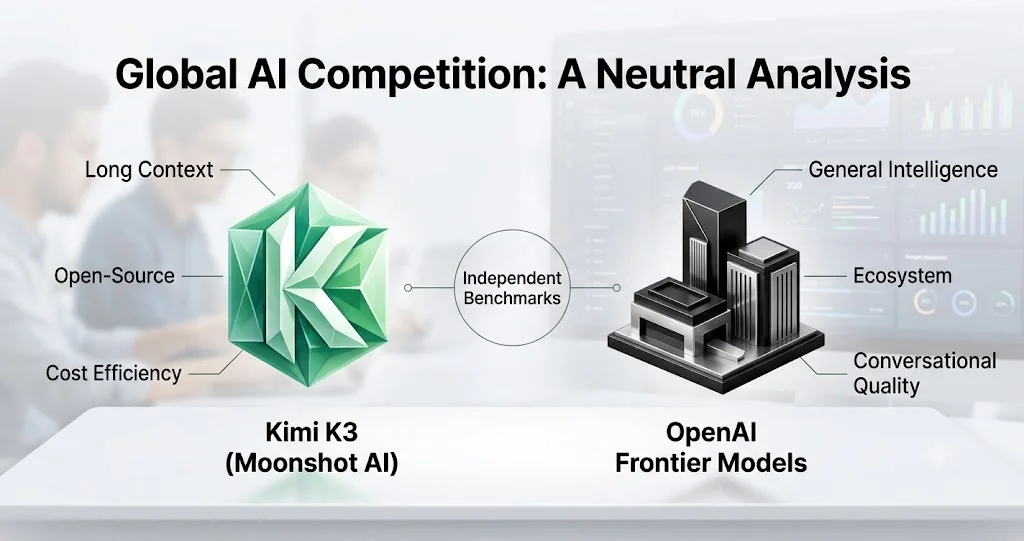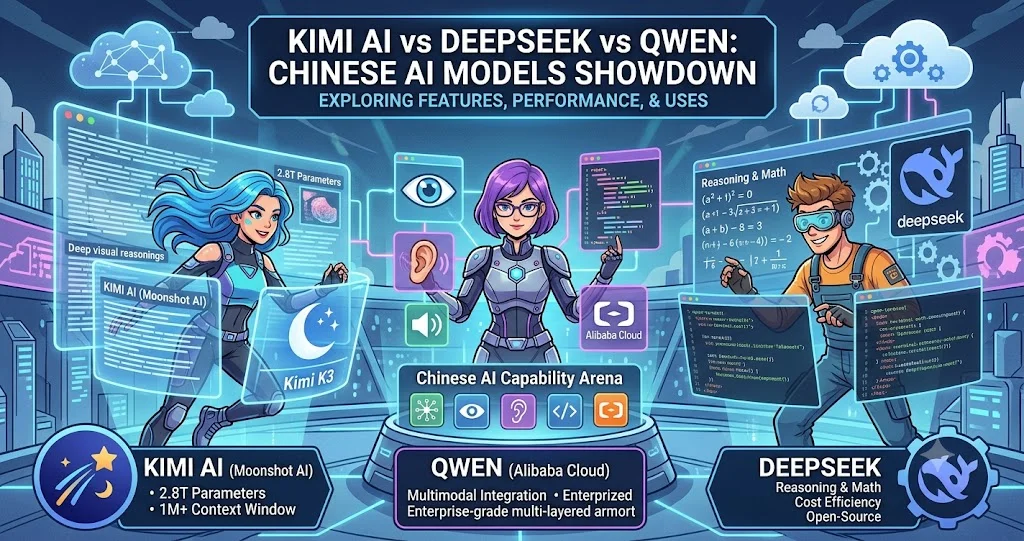

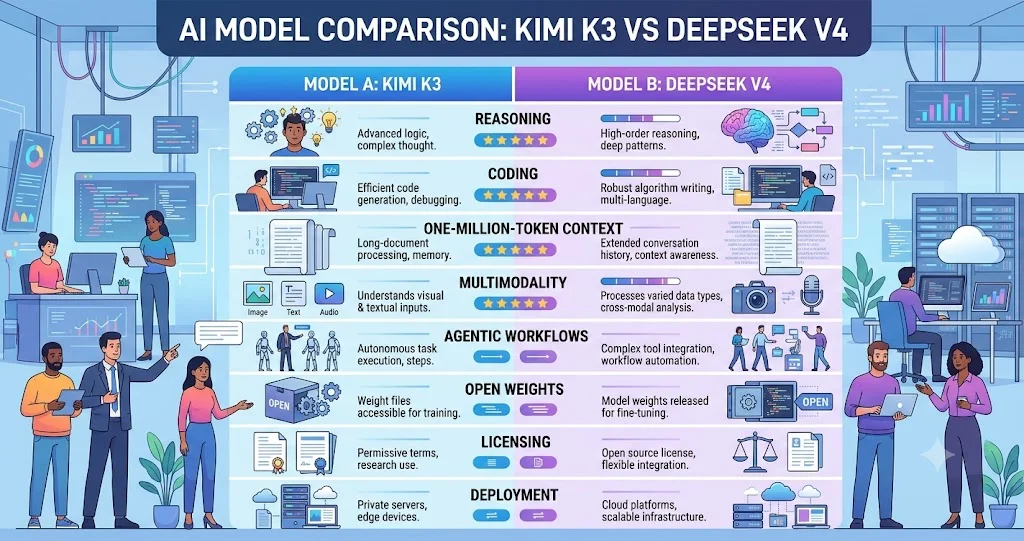
Kimi K3 vs DeepSeek is no longer a simple comparison between Kimi and the older DeepSeek R1 generation. As of 2026, DeepSeek's current flagship family is V4, with V4-Pro and V4-Flash available through its official services and APIs. Kimi K3 is also a current-generation model focused heavily on long-context reasoning, coding, multimodal input, and agentic work. Both are open-weight models, both support million-token context, and both publish strong results across coding and reasoning benchmarks. The meaningful differences appear when you look at architecture, deployment, tools, benchmark methodology, privacy, and the type of workload you actually need.
Kimi K3 vs DeepSeek: What Are We Actually Comparing?
The name DeepSeek can refer to several generations, including R1, V3, V3.2, and the newer V4 family. For a current 2026 comparison, this article uses Kimi K3 against DeepSeek V4, primarily V4-Pro, while also discussing V4-Flash where its efficiency characteristics matter.
DeepSeek released V4 on April 24, 2026. Its official announcement describes V4-Pro as a 1.6-trillion-parameter model with 49 billion active parameters and V4-Flash as a 284-billion-parameter model with 13 billion active parameters. Both are designed around a one-million-token context window and support thinking and non-thinking modes.
Kimi K3's model card describes it as a 2.8-trillion-parameter mixture-of-experts model with 104 billion activated parameters, native multimodality, and a one-million-token context window. Moonshot positions it specifically for long-horizon coding, knowledge work, and reasoning.
Quick Comparison
| Area | Kimi K3 | DeepSeek V4 |
|---|---|---|
| Current family | Kimi K3 | V4-Pro and V4-Flash |
| Architecture | Mixture of Experts with KDA and Attention Residuals | Mixture of Experts with DeepSeek Sparse Attention and token-wise compression |
| Total parameters | 2.8T | 1.6T V4-Pro; 284B V4-Flash |
| Activated parameters | 104B | 49B V4-Pro; 13B V4-Flash |
| Context | 1M tokens | 1M tokens |
| Multimodality | Native multimodal model | V4 family has multimodal/vision variants and evolving support across services |
| Reasoning | Maximum reasoning effort is available in published K3 evaluations | Thinking and non-thinking modes; V4-Pro supports high and maximum effort modes |
| Coding | Strong long-horizon and agentic coding focus | Strong software engineering and coding-agent focus |
| Open weights | Yes, under Kimi K3 License | Yes; DeepSeek V4 open-source assets use MIT licensing |
| Best comparison principle | Long-context multimodal and agentic workflows | Reasoning, coding, long-context and efficient deployment choices |
The table should be read as an architectural comparison, not as an overall ranking. Benchmark scores depend on model version, reasoning effort, tools, harnesses, prompts, and evaluation dates.
Architecture and Model Scale
Kimi K3 uses a mixture-of-experts architecture based on Kimi Delta Attention, Attention Residuals, and a Stable LatentMoE design. Its model card reports 2.8 trillion total parameters, 104 billion activated parameters, 896 experts, and 16 selected experts per token.
DeepSeek V4-Pro is smaller in total parameter count but also uses sparse activation. DeepSeek reports 1.6 trillion total parameters and 49 billion active parameters for V4-Pro. V4-Flash reduces the scale further to 284 billion total and 13 billion active parameters. DeepSeek says V4 uses token-wise compression and DeepSeek Sparse Attention to make million-token context more computationally efficient.
Total parameter count therefore should not be interpreted as a direct measure of practical quality. In a mixture-of-experts system, only a subset of parameters may be activated for each token, and inference performance also depends on attention design, hardware, quantization, serving software, and workload characteristics.
Reasoning and Knowledge Performance
Both model families are positioned for difficult reasoning tasks. Kimi K3's published evaluation table reports 93.5 on GPQA Diamond and 43.5 without tools or 56.0 with tools on HLE-Full under its stated evaluation configuration. It also reports 94.5 on MCPMark-Verified and 91.2 on BrowseComp.
DeepSeek V4-Pro's published evaluation results report 90.1 on GPQA Diamond, 37.7 on HLE, 57.9 on SimpleQA-Verified, and 87.5 on MMLU-Pro at maximum thinking effort. The same model reports 83.4 on BrowseComp and 48.2 on HLE with tools in the referenced evaluation table.
These figures illustrate why a single winner is difficult to establish. Kimi K3 has strong results on several reasoning and agent benchmarks, while DeepSeek V4-Pro has its own strong results across knowledge, mathematics, coding, and tool-use evaluations. The evaluations also use different configurations, and Kimi's published comparison table and DeepSeek's model-card tables are not a single controlled head-to-head experiment.
Coding: Kimi K3 vs DeepSeek V4
Coding is one of the most important areas in this comparison because both families are designed for agentic software development.
Kimi K3's published results include 67.5 on DeepSWE, 77.8 on ProgramBench, 88.3 on Terminal-Bench 2.1, 81.2 on FrontierSWE, and 72.9 on Kimi Code Bench 2.0. The K3 evaluation notes also explain that some results use the Kimi Code harness while other models in the same table use different coding harnesses.
DeepSeek V4-Pro reports 80.6 on SWE-bench Verified, 55.4 on SWE-bench Pro, 76.2 on SWE-bench Multilingual, 67.9 on Terminal-Bench 2.0, and 93.5 on LiveCodeBench in its published evaluation configuration. DeepSeek later reported a GA V4-Pro update with 87.9 on Terminal-Bench 2.1, 62.7 on DeepSWE, and 74.1 on Toolathlon-Verified.
The practical takeaway is that coding benchmark numbers should be compared only when the model version, benchmark version, harness, tools, and evaluation settings are aligned. A higher score from one model's own evaluation environment does not automatically establish that it will produce better results in your repository.
Long Context: Both Reach One Million Tokens
One of the most important similarities is context capacity. Kimi K3 supports a one-million-token context window. Its model card lists 1,048,576 tokens and describes long-horizon coding and large repository work as core use cases.
DeepSeek V4 also makes one-million-token context a central feature. DeepSeek states that 1M context is the default across its official services and highlights sparse attention and token compression as architectural mechanisms for reducing the cost of long-context processing.
This means the important question is no longer simply which model has the longer context. Both can accept very large inputs. The more useful questions are how accurately the model retrieves information from that context, how much performance degrades as the context grows, how much the workload costs, and how well the model uses long context during multi-step tasks.
Long-context benchmark evidence
DeepSeek V4-Pro's published results include 83.5 on MRCR 1M and 62.0 on CorpusQA 1M at maximum effort. A separate V4 comparison table reports these as long-context evaluations rather than simply claiming that a one-million-token window guarantees perfect retrieval.
Kimi K3's model documentation likewise emphasizes one-million-token context, but its published comparison table does not use exactly the same long-context benchmark configuration shown in the DeepSeek V4 table. This is another reason to avoid treating the context window itself as a quality ranking.
Multimodal Capabilities
Kimi K3 is explicitly described by Moonshot as a native multimodal model. Its model specification lists text and image modalities, with a MoonViT-V2 vision encoder, while Moonshot's product description also positions K3 for multimodal knowledge work.
DeepSeek's V4 family has also expanded beyond text-only reasoning. The V4 platform has introduced vision-oriented variants and agent capabilities, while the core V4 announcement focuses on coding, reasoning, long context, and agentic workloads. The exact multimodal experience depends on the V4 variant and service being used, so developers should check the API or model documentation for the specific deployment rather than treating every V4 endpoint as identical.
For developers processing screenshots, diagrams, PDFs, interfaces, or other visual inputs, this distinction matters. Native multimodal support can simplify an architecture that would otherwise require a separate vision model.
Agentic Work and Tool Use
Both models are moving beyond ordinary chat toward agentic workflows.
Kimi K3's documentation describes long engineering sessions, repository navigation, terminal tools, deep research, interactive visualizations, and other long-horizon tasks. Its published results include MCPMark-Verified, Toolathlon-Verified, AutomationBench, OSWorld, BrowseComp, and other agent-oriented evaluations.
DeepSeek V4 was explicitly developed for agentic use. DeepSeek says V4 supports tool use in its API environment, integrates with leading coding agents, and provides thinking and non-thinking modes. The August 2026 V4-Pro GA update also reports improvements on Terminal-Bench, DeepSWE, CyberGym, Toolathlon, and other agent benchmarks.
For an AI coding workflow, the model is only one part of the system. The agent harness, terminal permissions, repository indexing, context management, tool definitions, retry logic, test execution, and human approval can have as much practical impact as the underlying model.
Accessibility and Deployment
Kimi K3 is distributed as open weights through Hugging Face and can be served using tools such as Transformers, vLLM, SGLang, and Docker-based environments. Its published model card provides examples for local and hosted deployment.
DeepSeek V4-Pro and V4-Flash are also distributed through open repositories and APIs. DeepSeek's model card states that V4 assets distributed through open-source repositories, including model weights and code, use the MIT License.
There is therefore a meaningful licensing distinction: DeepSeek V4's open-source assets are explicitly described under the MIT License, while Kimi K3 uses the Kimi K3 License. Organizations considering redistribution, commercial deployment, fine-tuning, or integration should read the current license terms rather than assuming that every open-weight model has identical permissions.
Privacy and Data Handling
Privacy should be evaluated at the service level rather than inferred from whether model weights are available.
DeepSeek's February 2026 privacy policy says that it may collect prompts, uploaded files, photos, chat history, and other user-provided content when using its services. It also states that DeepSeek directly collects, processes, and stores personal data in the People's Republic of China.
Kimi provides separate policies for its products and API. Its current API security documentation states that API input and output data are not used to train or improve Kimi models and describes encrypted transmission and data isolation.
These statements apply to particular services and policies, not automatically to every third-party provider hosting the models. A company evaluating either model should review the exact API, hosting provider, retention terms, regional processing requirements, and enterprise agreement it plans to use.
For sensitive source code, customer records, credentials, proprietary documents, or regulated information, an open-weight model can provide deployment flexibility, but open weights do not by themselves guarantee privacy. Data handling depends on where and how the model is deployed.
Kimi K3 vs DeepSeek V4: Which Is Better for Coding?
For coding, both are credible choices. Kimi K3 is particularly interesting for developers who want a large-context, multimodal model with strong long-horizon coding and agentic capabilities. Its published results show strong performance across several software-engineering and agent benchmarks.
DeepSeek V4-Pro is also strongly positioned for coding agents, with current results covering SWE-bench, Terminal-Bench, LiveCodeBench, DeepSWE, and related evaluations. Its August 2026 GA update indicates that agentic coding performance continued to improve after the original V4 preview.
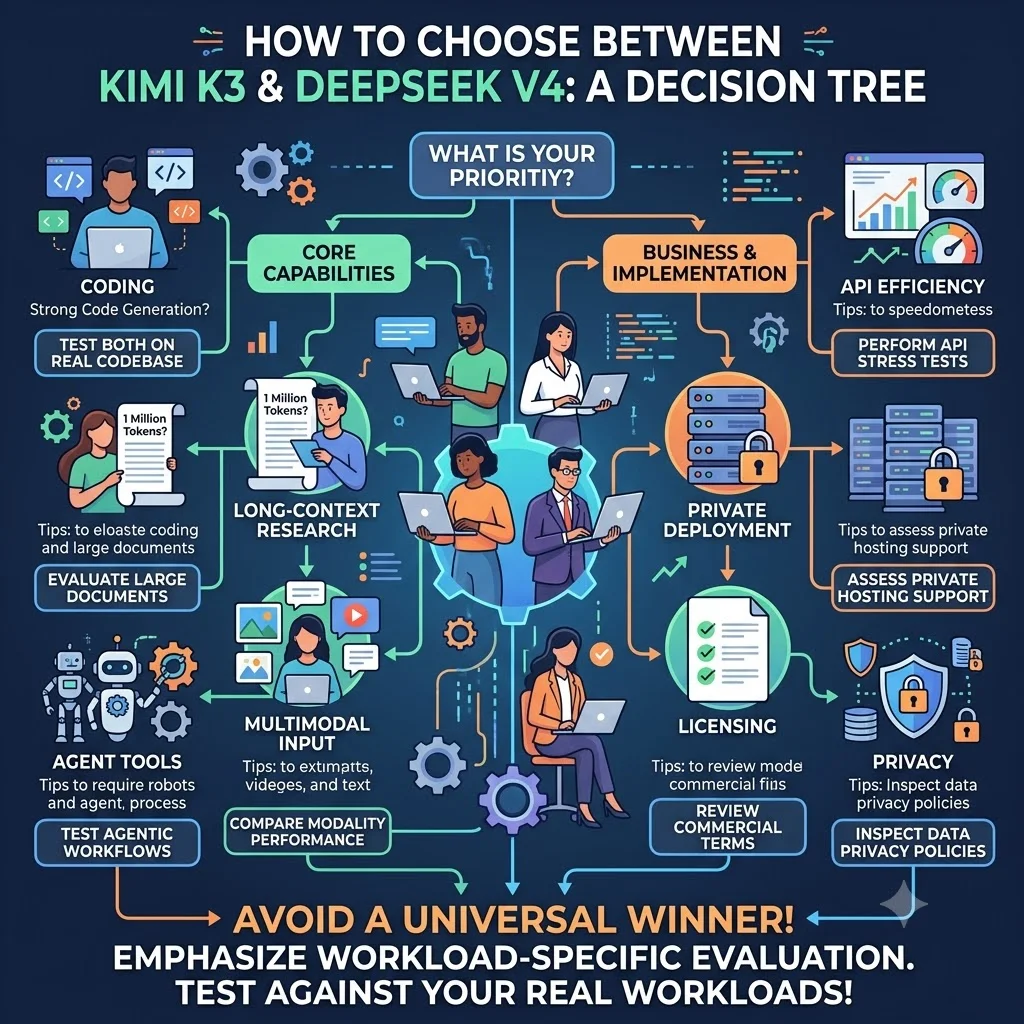
For a real development team, the better test is not a generic coding benchmark. Run both models against a representative private evaluation set containing your actual languages, framework conventions, database patterns, test requirements, repository size, and expected code-review standards.
Which Is Better for Long Documents and Research?
Both models are suitable candidates because both support million-token context. Kimi K3 emphasizes knowledge work and multimodal input, while DeepSeek V4 emphasizes efficient million-token processing and reasoning.
For research, however, context size is only one factor. Source retrieval, citation quality, browsing tools, evidence verification, and the ability to distinguish retrieved evidence from model-generated assumptions are equally important. A model that can technically accept a million tokens does not automatically understand every part of a million-token corpus equally well.
Which Is Better for Businesses?
Businesses should compare the models using operational criteria rather than benchmark scores alone.
| Business requirement | What to evaluate |
|---|---|
| Private deployment | Weights, hardware requirements, licensing, security controls, and data residency |
| Coding agents | Repository performance, tool calling, test execution, agent harness compatibility |
| Large documents | Long-context retrieval accuracy, latency, memory requirements, and cost |
| Multimodal workflows | Image/document understanding and required vision capabilities |
| API workloads | Availability, latency, rate limits, pricing, retention, and regional processing |
| Compliance | Current privacy policy, contractual terms, data residency, audit requirements |
| Open-source integration | Model license and restrictions on redistribution or commercial use |
Why Benchmark Rankings Need Careful Interpretation
Published benchmark tables are useful evidence, but they are not equivalent to an independent universal leaderboard.
Kimi K3's model card notes that different benchmarks can use different harnesses, tools, evaluation dates, and configurations. For example, some coding results use Kimi Code, while comparison results for other models can come from Claude Code, Codex, Terminus, or other harnesses.
DeepSeek's own published tables likewise distinguish thinking effort levels and model variants. V4-Pro's performance can change significantly between non-thinking, high, and maximum reasoning settings.
Therefore, statements such as “Model A is 10% better than Model B” are only meaningful when the underlying evaluation is directly comparable. A benchmark result should be treated as evidence about a particular task under a particular configuration, not as a universal measure of model intelligence.
Which Model Fits Which Workload?
| Workload | Relevant model characteristics | What to test before choosing |
|---|---|---|
| Long-horizon coding | Large context, reasoning, terminal/tool use | Repository completion rate, test success, context retention |
| Multimodal development | Native or integrated visual understanding | Screenshot, diagram, PDF, and UI accuracy |
| Research | Long context, browsing, evidence handling | Source accuracy, citation support, retrieval quality |
| High-volume API work | Efficient model variant and serving infrastructure | Latency, throughput, cost, and quality at production load |
| Private deployment | Open weights, licensing, hardware requirements | License compatibility and total infrastructure cost |
| Complex reasoning | Thinking modes and reasoning effort | Accuracy at the reasoning budget you can afford |
What Should Developers Test Before Choosing?
- Create a representative test set. Include real tasks from your intended workload rather than relying only on public benchmarks.
- Keep the environment identical. Use the same prompts, tools, repository snapshots, time limits, and evaluation criteria.
- Measure task success. For coding, compile and run tests instead of judging code from appearance alone.
- Measure reliability. Track factual errors, failed tool calls, unnecessary retries, and cases where the model confidently chooses the wrong approach.
- Measure operational cost. Include input tokens, output tokens, reasoning effort, tool calls, hardware, and engineering overhead.
- Test long-context behavior. Increase context size gradually and measure retrieval accuracy rather than assuming a one-million-token window means uniform performance.
- Review data handling. Confirm retention, training-use policies, residency, encryption, and contractual requirements for the exact service you will use.
Frequently Asked Questions
Is Kimi K3 better than DeepSeek V4?
There is no universal answer supported by the available benchmark evidence. Kimi K3 and DeepSeek V4 perform strongly across different reasoning, coding, agentic, and long-context evaluations, but their published tests use different configurations and sometimes different harnesses. The appropriate choice depends on the workload.
Is Kimi K3 larger than DeepSeek V4?
By total parameter count, Kimi K3 is larger: its model card reports 2.8 trillion total parameters compared with 1.6 trillion for DeepSeek V4-Pro. However, Kimi K3 activates about 104 billion parameters while V4-Pro activates 49 billion, so total size and active computation should not be treated as the same metric.
Do Kimi K3 and DeepSeek V4 both support one million tokens?
Yes. Kimi K3 lists a 1,048,576-token context length, and DeepSeek says one-million-token context is the standard across its official V4 services.
Which is better for coding?
Both are strong coding candidates. Kimi K3 publishes strong results on DeepSWE, Terminal-Bench, FrontierSWE, and its own coding benchmark, while DeepSeek V4-Pro publishes strong SWE-bench, LiveCodeBench, Terminal-Bench, and DeepSWE results. Because the evaluation harnesses and versions differ, developers should run both against their own repository and test suite before making a production decision.
Which is more suitable for private deployment?
Both offer open-weight deployment options, but licensing and infrastructure requirements differ. DeepSeek states that V4 open-source assets use the MIT License, while Kimi K3 is distributed under the Kimi K3 License. Organizations should review the exact license and deployment requirements before selecting either model.
Does open source mean my data is private?
No. Open model weights and hosted-service data handling are separate issues. A self-hosted model can provide stronger control over data flows, but a hosted API can have different retention and processing policies. DeepSeek's consumer privacy policy, for example, describes collection and processing of user inputs and storage in China, while Kimi's API documentation states that API data is not used for model training. Always evaluate the exact service and contract you plan to use.
Final Takeaway
Kimi K3 and DeepSeek V4 are not simply two versions of the same idea. Kimi K3 emphasizes a very large multimodal model, long-horizon coding, knowledge work, and agentic workflows. DeepSeek V4 offers a family approach, with V4-Pro targeting high-end reasoning and agentic performance and V4-Flash providing a smaller, efficiency-oriented option. Both support million-token context and open-weight deployment, but their architectures, licenses, service policies, and evaluation configurations differ.
For developers, the most reliable way to choose between them is to treat public benchmarks as starting evidence and then run a controlled evaluation using your own workload. Compare code correctness, reasoning accuracy, long-context retrieval, tool use, latency, cost, deployment requirements, privacy, and licensing together. The better model is the one that satisfies those requirements under the conditions in which you will actually operate it.