

If you have used an AI system recently that could both read a question and analyze an image you uploaded, you have experienced multimodal AI. It is one of the most significant shifts in artificial intelligence since the rise of large language models.
For most of AI's history, models specialized in one kind of data. Computer vision models processed images. Language models processed text. Speech recognition models processed audio. They got better at their narrow domains, but they did not talk to each other. That changed between 2023 and 2025 with the release of GPT-4o, Google's Gemini, and Anthropic's Claude 3—models built to handle multiple modalities within a single architecture.
Gartner predicts that 80% of enterprise software will be multimodal by 2030, up from under 10% in 2024. The multimodal AI market is projected to grow from $1.6 billion in 2024 to $27 billion in 2034. This guide explains what multimodal AI is, how it works, where it delivers value, and what its real limitations are.
What Is Multimodal AI?
Multimodal AI refers to artificial intelligence systems that can process, understand, and generate information from more than one type of data, or modality, within a single unified framework. These modalities can include text, images, audio, video, structured data, sensor signals, and 3D spatial data.
The defining characteristic of multimodal AI is not simply that it can handle multiple input types—it is that it integrates them. The model reasons across modalities simultaneously rather than chaining together separate specialized models. A question like "is the bird in this photo singing the right call for its species?" gets answered by the same neural network that processed both the image and the audio clip.
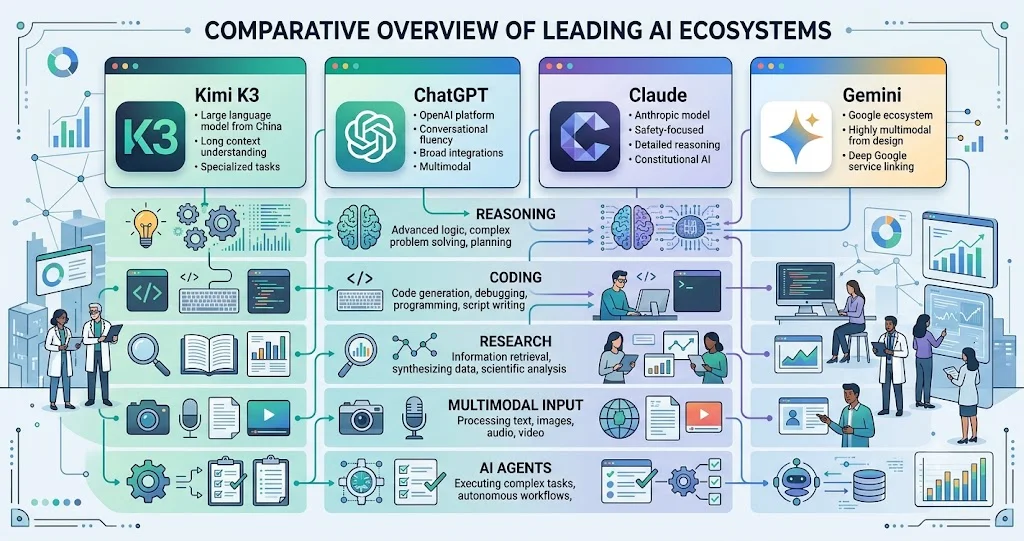
The major multimodal AI systems in 2026 include GPT-4o, GPT-5, Gemini 2.x, Claude 3, and Llama 3.2, all natively handling multiple modalities.
Multimodal vs Unimodal: What's the Difference?
Unimodal AI systems process only one type of data. A traditional chatbot can analyze and generate text but cannot interpret images or audio cues. An image classifier can identify objects but cannot explain them in language. Each model operates in isolation.
Multimodal AI changes this by integrating multiple data types within a single model. This leads to several key advantages:
| Attribute | Unimodal AI | Multimodal AI |
|---|---|---|
| Inputs | One data type (e.g., text only) | Multiple data types (text, image, audio, video) |
| Context capture | Limited to one channel | Cross-modal context, fewer ambiguities |
| Typical use | Chatbots, text classification | Document understanding, visual Q&A, voice+vision assistants |
| Data needs | Modality-specific | Larger, paired datasets across modalities |
As one analyst put it, think of unimodal AI as a great pianist; multimodal AI is the full band. Each instrument matters—but it is the fusion that makes the music.
How Multimodal AI Works: Core Architecture
Multimodal AI systems are composed of three primary components that process, align, and interpret diverse data types.
1. Input Encoders
This component ingests raw data from various sources and converts it into numerical representations called embeddings. Specialized encoders extract features from each modality: convolutional neural networks for images, transformer-based models for text, and similar architectures for audio and video.
The embeddings project text, images, audio, and video into a shared semantic space, transforming unstructured data from a passive liability into a queryable asset.
2. Fusion Module
The fusion layer combines modality-specific embeddings into a shared space where the model can find and learn relationships across all data types. Fusion can occur early (at the feature level), late (at the decision level), or through hybrid methods.
Early fusion combines data before any significant processing, allowing the model to learn cross-modal patterns from the start. Late fusion processes each modality independently and combines decisions at the end. Hybrid approaches attempt to get the best of both.
3. Output Generation
The final component generates responses or actions based on the fused representation. This could be a text answer, an image description, a video caption, or a combination of outputs.
Native Multimodal vs Stitched Architectures
A critical distinction in 2026 is between native multimodal models and stitched architectures. Stitched architectures combine separate pre-trained unimodal models with adapter layers—they are effectively multiple models glued together. Native multimodal models are trained end-to-end from the start across all modalities within a single architecture.
The current frontier is native multimodality—integrating disparate data types into a single system. These systems are called omnimodels, defined as unified architectures capable of natively ingesting and generating multiple modalities within the same processing window.
Native architectures offer several advantages: fewer glue layers mean lower latency and better alignment across modalities, and the model can learn cross-modal relationships more naturally. However, they also present significant engineering challenges.
The Engineering Challenge: Discrete vs Continuous Data
One of the fundamental difficulties in multimodal AI is the tension between discrete and continuous data. Language is highly compressed, discrete, and symbolic. Physical image data is continuous, dense, and constitutes a passive observation of the world rather than an abstraction of it.
Early attempts at omnimodels tried forcing physical image data through the same tokenizer funnels used for text. This created catastrophic information loss—the resulting tokens lacked the fidelity required for complex visual understanding tasks.
Research suggests we cannot simply brute force continuous physical data into architectures optimized for discrete language. To maintain performance, these systems must bifurcate their training objectives to handle different data densities and decouple their internal network parameters. Without this separation, the density of visual data tends to overwhelm the capacity needed for language processing.
Transitioning to native multimodality requires moving away from unified parameter networks and towards specialized, modality-specific routing.
Transfusion Architectures
One promising approach is the transfusion architecture, which addresses the discretization problem by moving away from a unified cross-entropy objective. Transfusion maintains an interleaved sequence of text and images but processes the physical data using different mechanisms—combining discrete text prediction with continuous image representations via diffusion.
Mixture of Transformers (MoT)
Mixture of Transformers uses deterministic routing to process different modalities without capacity competition or catastrophic forgetting. This allows the model to allocate specialized capacity to each modality while still operating within a unified architecture.
Advantages of Multimodal AI Over Text-Only Systems
Multimodal AI offers several significant advantages over text-only or unimodal systems:
Richer context awareness. A multimodal model can analyze an image along with its caption to provide more accurate descriptions or insights. It can understand that a product photo shows a defect that the text description does not mention.
Reduced ambiguity. By integrating multiple data types, multimodal AI reduces ambiguity and improves decision-making. A voice command combined with a visual context is far less ambiguous than either alone.
More natural interaction. Applications such as automated assistants benefit from more natural, human-like interactions. A multimodal assistant can process a spoken request, interpret visual content from a camera feed, and respond accordingly.
Better generalization. Multimodal models tend to generalize better across domains because they learn patterns that are invariant across modalities.
Faster decision-making. By processing multiple inputs simultaneously, multimodal systems can make decisions faster than systems that process each modality sequentially.
Practical Applications in 2026
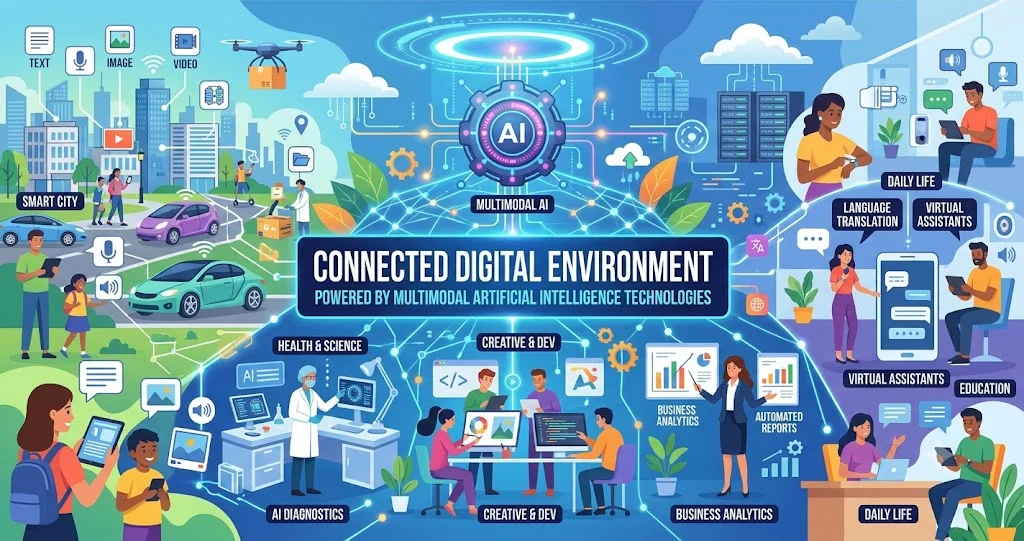
Multimodal AI is being deployed across a wide range of industries.
Healthcare and Medical Imaging
Multimodal AI combines medical imaging (CT scans, X-rays, MRIs) with electronic health records, clinical notes, and genomic data to improve diagnosis and treatment planning. Applications include:
- Parkinson's disease screening: Multimodal fusion produces accurate, well-calibrated, and interpretable risk estimates for PD screening
- Cancer care: Real-time multimodal AI generates individualized risk insights to enable earlier cancer care
- Coronary artery disease diagnosis: Medi-Agent integrates multi-source evidence across heterogeneous modalities within a multi-agent workflow
- Clinical documentation: Vision-enabled AI scribes process both audio and visual inputs to document medication histories
Autonomous Driving
Self-driving cars must process road signs, spoken instructions from passengers, and real-time sensor data all at once. Vision-language models are emerging as a unified paradigm for perception, prediction, and planning in autonomous driving. NVIDIA's Cosmos 3 combines vision reasoning, world generation, and action prediction in a single system.
Customer Service and Virtual Assistants
Multimodal AI is enhancing digital assistants such as Siri, Google Assistant, and Alexa. These assistants can now process both spoken language and visual inputs. Customer support copilots allow agents to upload screenshots, error logs, and user voicemails, with the copilot aligning signals to suggest fixes and draft responses.
Document Understanding and Insurance
Automate insurance claims by reading scanned PDFs, photos, and handwritten notes together. A claims bot that sees the dent, reads the adjuster note, and checks the VIN reduces manual review.
Retail Visual Search
Users snap a photo and describe preferences—"like this jacket but waterproof." The system blends vision with text preferences to rank products.
Creative and Generative AI
Multimodal models power text-to-image, text-to-video, and image-to-text applications, enabling content creation across formats.
Education and Accessibility
Multimodal AI supports interactive learning experiences and accessibility tools that combine text, audio, and visual information.
Technical Challenges
Despite rapid progress, multimodal AI faces several significant challenges.
Modality Dominance
Current multimodal large language models (MLLMs) can process diverse sensory inputs, yet their reasoning remains heavily biased toward a dominant modality, resulting in brittle cross-modal reasoning. Through attention probes, researchers found that 86–95% of failures stem from modality dominance. Current MLLMs struggle under misaligned audio-visual pairs and simple misleading text, lacking robust multi-modal reasoning.
Evaluation Difficulties
Most existing evaluation benchmarks are limited to isolated tasks and reveal little about whether a model integrates information across modalities. Key gaps include temporal-spatial coherence, physical world understanding, multimodal consistency, and selective attention.
Multimodal AI fails when the model reads the wrong signal from the input and still produces a confident answer. A support agent may miss the cracked part in a product photo, a finance copilot may misread a receipt total, or a voice workflow may trust a transcript that dropped the word "not." These are not cosmetic errors—they create silent hallucinations downstream of a faulty visual, audio, or document interpretation step.
Data Requirements
Multimodal systems need paired and high-variety data: picture-caption pairs, video-audio-text alignments, and other cross-modal datasets. These are more expensive and difficult to collect than single-modality data.
Computational Cost and Latency
Multimodal models are computationally expensive. Latency climbs when image or audio payloads push larger model routes. Cost, latency, and reliability all degrade across modalities compared to single-modality systems.
Interpretability and Governance
Multimodal models are harder to interpret than unimodal systems. Understanding why a model made a particular decision across multiple modalities is more complex. Screenshots and transcripts can contain PII that must be redacted before logs or evaluator datasets are shared.
Evaluation: How Do We Measure Multimodal AI?
Evaluating multimodal AI requires going beyond simple accuracy metrics. Key evaluation dimensions include:
- Accuracy: Does the model complete the task correctly?
- Robustness: Does the model maintain performance under perturbations (blurry images, noisy audio, misaligned inputs)?
- Grounding: Are the model's outputs supported by the evidence provided?
- Cross-modal consistency: Does the model integrate information coherently across modalities?
- Selective attention: Can the model focus on relevant information and ignore distractions?
Comprehensive benchmarks are emerging. The ALL Bench Leaderboard aggregates and cross-verifies 91 AI models across 6 modalities—LLM, VLM, Agent, Image, Video, and Music—in a single unified view.
Research has found that evaluation methods often overlook robustness, attribution fidelity, and reasoning under controlled perturbations. Models may show progress on benchmarks that does not reflect genuine visual grounding, instead relying on internet-scale textual world knowledge.
The Future of Multimodal AI
Several trends are shaping the future of multimodal AI.
Multimodal becomes the default. Gartner predicts that 80% of enterprise software will be multimodal by 2030, up from under 10% in 2024. The question is shifting from "can AI handle multiple modalities?" to "which system does it best?".
Native architectures replace stitched systems. The shift from "stitching systems together" to "unified native architecture" represents a fundamental rethinking of how multimodal AI is built. Models like SenseTime's SenseNova U1 represent a paradigm shift—unifying understanding and generation in a single representation space.
Physical AI and world modeling. Multimodal models will further evolve toward interactive world modeling, becoming a key technological pathway for AI to gain environmental perception, long-term planning, and large-scale deployment in the physical world.
Agentic integration. Multimodal AI is increasingly integrated with agentic systems. NVIDIA's Nemotron 3 Nano Omni is built for agentic computer use, document analysis, and general reasoning. The combination of multimodal perception and autonomous action is a key frontier.
Evaluation matures. As multimodal systems enter production, evaluation frameworks are becoming more sophisticated—moving from task accuracy to robustness, grounding, and cross-modal consistency.
Frequently Asked Questions
What is multimodal AI in simple terms?
Multimodal AI is AI that can process and understand more than one type of data at the same time—like text, images, audio, and video—within a single system.
How is multimodal AI different from generative AI?
Multimodal AI emphasizes understanding and reasoning across multiple data types, while generative AI focuses on creating new content. They overlap—many multimodal models are also generative—but they are not the same thing.
What are examples of multimodal AI?
GPT-4o, Google Gemini, Claude 3, and Llama 3.2 are all multimodal models. Applications include visual question answering, document understanding with images and text, and voice assistants that can also see.
What is the difference between multimodal and agentic AI?
Multimodal AI focuses on perception—understanding multiple data types. Agentic AI focuses on action—autonomously completing tasks. They are complementary: agentic systems increasingly use multimodal perception to understand their environment.
What are the main challenges of multimodal AI?
Key challenges include modality dominance (one modality overriding others), evaluation difficulties, high computational costs, data requirements for paired cross-modal datasets, and interpretability.
What is a vision-language model?
A vision-language model (VLM) is a multimodal model that connects images, screenshots, charts, or video frames with natural-language tasks such as captioning, OCR, visual question answering, and reasoning.
How big is the multimodal AI market?
The multimodal AI market is projected to grow from $1.6 billion in 2024 to $27 billion in 2034, driven by machine learning, natural language processing, and computer vision.
When will most enterprise software be multimodal?
Gartner predicts that 80% of enterprise software will be multimodal by 2030, up from under 10% in 2024.
Conclusion
Multimodal AI represents a fundamental shift from systems that process one type of data to systems that integrate multiple types within a unified architecture. It moves AI closer to how humans actually perceive the world—through a combination of visual, auditory, and textual information.
The technology is already delivering value across healthcare, autonomous systems, customer service, and creative applications. But it is not without challenges. Modality dominance, evaluation difficulties, computational costs, and data requirements all remain significant barriers.
The trend is clear: multimodal AI is becoming the default. Gartner predicts 80% of enterprise software will be multimodal by 2030. The question is no longer whether AI will handle multiple modalities, but which systems will do it best, most reliably, and most cost-effectively.
For developers, product managers, and technology professionals, understanding multimodal AI—what it can do, how it works, and where it falls short—is essential for building the next generation of intelligent systems.