
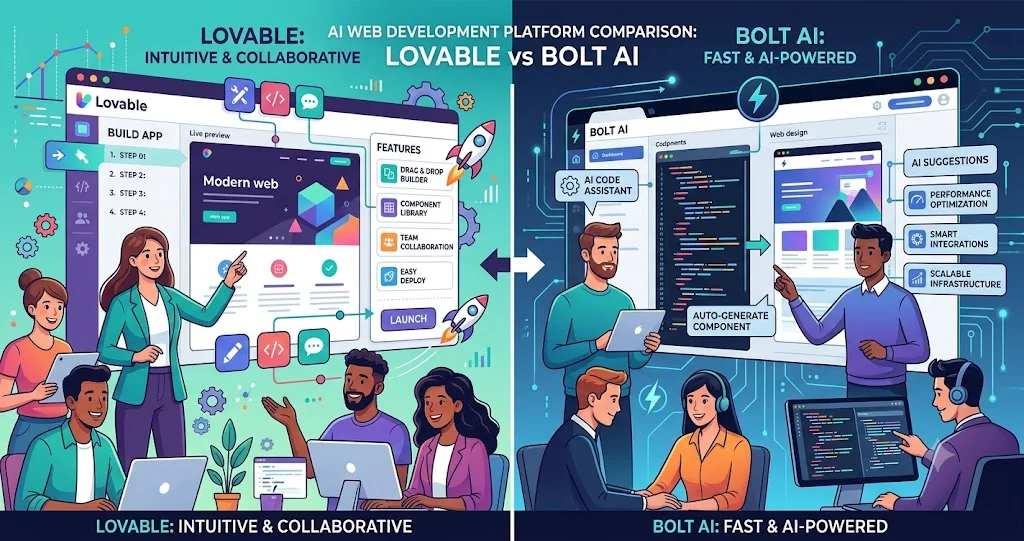
Lovable and Bolt both promise a shorter path from an idea to a working web application: describe what you want, let an AI coding agent generate the project, and then refine the result through conversation and code. The important difference appears after the first prototype. A useful comparison needs to ask how each platform handles databases, authentication, backend logic, deployment, GitHub, customization, debugging, collaboration, and the transition from prototype to software that developers actually maintain.
Lovable vs Bolt at a Glance
Both platforms are capable of generating more than static landing pages. They can be used for interactive websites, dashboards, internal tools, SaaS-style applications, authentication flows, database-backed applications, and other web products. Their current product positioning also shows a strong emphasis on moving from natural-language prompts toward deployable software.
| Area | Lovable | Bolt |
|---|---|---|
| Natural-language development | Conversational AI development with visual editing and project context | Prompt-driven application and website development with an in-browser coding workflow |
| Frontend | Modern web applications with React-based projects and visual refinement | AI-generated responsive websites and applications with browser-based code editing |
| Backend | Lovable Cloud and Supabase provide database, authentication, storage, server-side functionality, and related services | Bolt Cloud provides database, authentication, server functions, storage, and hosting; Supabase is also supported |
| Database | PostgreSQL through Supabase plus Lovable Cloud capabilities | Bolt Database with support for Supabase on eligible workflows |
| Authentication | Can generate authentication flows using its backend integrations | Bolt Database and Supabase provide authentication capabilities |
| Deployment | Lovable Cloud plus GitHub-based external deployment and self-hosting options | Bolt Cloud hosting plus external deployment options such as Netlify |
| Code ownership | Users own their generated code and can sync projects to GitHub | Projects are editable as code and can integrate with GitHub and external infrastructure |
| Primary strength | Fast product development with a strong path from AI generation to developer-controlled code | All-in-one prompt-to-production workflow with integrated hosting and backend services |
What Is Lovable?
Lovable describes itself as an AI software engineer for building websites and web applications through conversation. Its current product experience combines natural-language generation with visual editing, project context, integrations, GitHub synchronization, and managed infrastructure.
A notable part of Lovable's approach is its emphasis on standard development technologies. Lovable states that applications use industry-standard frameworks and can be synchronized with GitHub. Its current platform also supports Lovable Cloud and Supabase for backend functionality. That combination gives non-technical users a relatively guided development experience while leaving experienced developers with a conventional codebase they can continue working on.
What Is Bolt?
Bolt is an AI-powered website and application builder focused on taking a natural-language description and turning it into a working product. Its current platform combines AI coding, an in-browser development environment, hosting, databases, authentication, server functions, integrations, and custom domains.
Bolt's current product documentation emphasizes Bolt Cloud as an integrated infrastructure layer. According to Bolt, its cloud platform can handle hosting, databases, authentication, server functions, file storage, secrets, analytics, and related deployment requirements. Bolt also supports external infrastructure and integrations including Supabase, Netlify, GitHub, and Stripe.
Natural-Language Development
Both platforms are designed around a conversational development loop. Instead of starting by manually creating a project, installing dependencies, configuring a framework, and writing the first components, users can describe the application they want and then iterate through additional instructions.
Lovable is particularly suited to prompts that combine product requirements and interface requirements. A user can describe screens, workflows, authentication, data requirements, and integrations and then refine the generated application through subsequent prompts.
Bolt follows a similar model but places strong emphasis on getting the generated application live inside its own environment. Its current product positioning describes a flow from prompt to working application to deployment, with code editing available directly in the browser.
For beginners, the difference may be small at first. For experienced developers, the more important question is how much control the platform provides after the initial generation.
Frontend Generation and Design
Both platforms can generate responsive web interfaces from natural-language instructions. They can create pages, forms, dashboards, navigation, layouts, components, and application-specific interfaces.
Lovable provides direct visual refinement alongside conversational development. This can be useful for designers and founders who want to adjust layouts, colors, typography, content, and other interface details without translating every design request into code instructions.
Bolt similarly supports visual application generation and iterative changes, while also allowing users to edit generated code in the browser. Its current platform supports importing design systems and working with sources such as GitHub repositories, private NPM packages, and Storybook for team-oriented workflows.
Neither platform should be treated as a substitute for design judgment. AI-generated interfaces can be visually convincing while still having problems with information hierarchy, accessibility, responsive behavior, consistency, or edge cases. Human review remains necessary for production interfaces.
Backend Capabilities
This is where both products have moved beyond the traditional no-code website builder.
Lovable can connect frontend applications to Supabase, providing PostgreSQL databases, authentication, file storage, real-time functionality, and serverless Edge Functions. Lovable's documentation describes the integration as a way to generate frontend and backend functionality through the same conversational workflow.
Lovable also provides Lovable Cloud, which brings managed application infrastructure closer to the building workflow. Its current billing documentation says Cloud functionality can include databases, authentication, file storage, server functions, and AI features, with these services incorporated into its unified credit system.
Bolt takes a similarly integrated approach through Bolt Cloud. Its current product pages describe built-in databases, user management and authentication, server functions, file storage, hosting, custom domains, and analytics. Bolt also supports Supabase when developers prefer that backend option.
The practical distinction is therefore not that one platform has a backend and the other does not. Both do. The better question is whether you want a managed backend inside the platform or prefer to connect the project to infrastructure you control.
Database and Authentication
Database-backed applications are a major dividing line between simple AI website generators and application development platforms.
Lovable's Supabase integration provides PostgreSQL, authentication, file storage, real-time updates, and Edge Functions. Lovable can generate database schemas and authentication flows from natural-language requests, while developers can use Supabase's underlying capabilities directly when more control is required.
Bolt now provides its own database option as well as Supabase integration. Its documentation explains that new projects can use Bolt Database by default, while Supabase can be selected when a developer wants Supabase's capabilities or tighter control over the data layer.
Both platforms can therefore support common application requirements such as user registration, login, protected application areas, database records, and file uploads. The challenge is not creating the first authentication screen. The challenge is correctly designing permissions, authorization rules, validation, secrets, database policies, and error handling.
Deployment and Hosting
Lovable supports publishing through its own infrastructure while also providing a path toward developer-controlled deployment. Its GitHub documentation explains that projects can be synchronized to GitHub, cloned locally, modified outside Lovable, and deployed to other infrastructure or self-hosted.
Bolt emphasizes an all-in-one deployment experience through Bolt Cloud. Its current platform includes hosting, custom domains, SSL/HTTPS management, databases, and other infrastructure components. Bolt also states that developers can use external infrastructure such as Netlify and connect services such as Supabase.
This produces two slightly different mental models. Lovable is attractive when the AI builder is the starting point but GitHub and conventional development workflows are expected to remain important. Bolt is particularly attractive when a user wants the builder and deployment environment to feel like one product.
Code Ownership and Portability
Code portability becomes important as soon as a prototype becomes valuable.
Lovable explicitly states that users own the code they create. Its GitHub integration supports two-way synchronization, allowing developers to work locally, collaborate through GitHub, create branches, review changes, and deploy outside Lovable. Lovable also states that its applications use standard web technologies rather than a proprietary framework.
Bolt similarly positions generated projects as real applications rather than locked visual mockups. Its platform provides browser-based code editing, GitHub integration, and external deployment options. This gives developers a path to continue development outside the initial AI-building interface.
However, code ownership and practical maintainability are not exactly the same thing. A developer may technically own a codebase while still inheriting AI-generated architecture, dependencies, configuration, database policies, and application logic that require substantial cleanup. Before adopting either platform for a critical application, inspect the generated repository rather than assuming portability automatically means maintainability.
Customization and Developer Control
Beginners often care about how quickly they can make a requested change. Experienced developers care about whether they can make a change the AI does not understand correctly.
Lovable's GitHub workflow gives developers the option to clone the project and continue working in a conventional IDE. That matters for custom business logic, advanced integrations, dependency changes, CI/CD, testing, and architectural refactoring.
Bolt also exposes the generated code and provides an in-browser development workflow. Its support for GitHub, external hosting, Supabase, private NPM registries on its Teams plan, and design-system integrations provides additional options for developers who need more control.
For simple applications, both platforms can hide a large amount of infrastructure. For complex systems, the ability to leave the AI builder and work directly with the source code becomes increasingly important.
Debugging and Iteration
AI-generated code rarely becomes production-ready in one prompt. Debugging is therefore one of the most important criteria in an AI development platform.
With Lovable, developers can describe an error, ask the agent to investigate the relevant code, and iterate on the implementation. The GitHub connection also provides a conventional workflow for reviewing changes outside the platform.
Bolt similarly allows users to describe problems conversationally and make changes to the generated application. Its platform is designed to test, refactor, and iterate as part of the AI development workflow.
The important limitation is that neither platform makes generated software automatically correct. Authentication bugs, incorrect database relationships, missing authorization checks, race conditions, dependency issues, and business-logic mistakes can survive a visually successful prototype. For serious applications, debugging should include automated tests, code review, logs, database inspection, and security testing rather than relying only on another AI prompt.
Collaboration
For a solo founder or indie hacker, collaboration may simply mean sharing the application with another person. For a development team, it includes source control, permissions, environments, code review, security, billing, and administrative controls.
Lovable workspaces use shared credit pools rather than charging separately for each workspace member. Its current pricing documentation says workspaces support unlimited members and that administrators can configure default and per-member credit limits.
Bolt provides Teams and Enterprise plans with centralized billing, team-level access management, granular administrative controls, user provisioning, and additional enterprise capabilities.
For a team, the correct comparison should therefore include more than whether two people can edit an application. Review how source control, permissions, authentication, billing, security requirements, and deployment environments fit the team's existing engineering process.
Lovable vs Bolt Pricing
Pricing and usage systems change frequently, so current official pricing should be checked before purchasing. The current public plans show a meaningful difference in how the platforms meter AI development.
| Platform | Current published individual pricing | Usage model |
|---|---|---|
| Lovable | Free plan available; paid Pro and Business plans are available | Credits are used across building, Cloud, and AI features; usage depends on the task and plan |
| Bolt | Free; Pro $25/month; Teams $30/month per member; Enterprise custom | Free and paid plans use token allocations, with higher plans providing substantially more usage |
Bolt's current pricing page lists a free plan with a 300,000-token daily limit and 1 million-token monthly limit, while Pro starts at $25 per month and includes 10 million tokens per month. Teams is listed at $30 per member per month.
Lovable's current pricing page uses credits rather than a simple message count. The company says credits can cover building, hosting through Cloud, and AI features in applications, and that consumption varies by task complexity and mode.
Because the platforms measure usage differently, comparing $25 versus a Lovable plan price in isolation is not enough. A fair test should measure how much work your typical application requires, how frequently you regenerate or modify code, whether you use hosted backend services, and how quickly the included allowance is consumed.
Where Lovable May Be the Better Fit
Founders building a product with a developer handoff
Lovable can be attractive when a founder wants to move quickly from an idea to a functional application while preserving a conventional codebase for later developer work. GitHub synchronization and the ability to continue development outside the platform make this workflow particularly relevant.
Teams already comfortable with Supabase
If your preferred architecture uses PostgreSQL, Supabase authentication, storage, real-time functionality, and Edge Functions, Lovable's native Supabase integration provides a direct route from natural-language requirements to that stack.
Users who want visual refinement plus code
Lovable's combination of conversational development, visual editing, and source-code ownership can suit designers and developers who want to move between visual decisions and implementation details.
Where Bolt May Be the Better Fit
Users who want an integrated build-to-host workflow
Bolt is particularly compelling when the goal is to describe an application, generate it, configure backend functionality, and publish it without assembling a separate hosting stack. Bolt Cloud brings several infrastructure components into the same environment.
Rapid prototypes and internal applications
For a founder, marketer, consultant, or developer validating an idea, the ability to generate a working application and publish it quickly can matter more than having a highly customized architecture from day one.
Teams using existing design systems
Bolt's current platform supports importing design systems from sources such as GitHub, private NPM registries, and Storybook. This can make it more relevant for organizations that want AI-generated work to follow an existing component and package ecosystem.
Beginners vs Experienced Developers
| User type | What matters most | Likely consideration |
|---|---|---|
| Beginner | Ease of prompting, visual feedback, hosting, and backend setup | Both are approachable; Bolt's integrated infrastructure and Lovable's guided application workflow are both strong starting points |
| Startup founder | Speed, authentication, database, deployment, and ability to iterate | Both can work; choose based on preferred backend and how much developer control you expect later |
| Designer | Visual control and rapid UI iteration | Lovable can be attractive for combining visual refinement with generated application code |
| Indie hacker | Speed, cost, integrations, and ownership | Both are worth testing with the same MVP before committing to one workflow |
| Experienced developer | Code quality, architecture, Git, testing, debugging, and portability | Evaluate the generated repository and external development workflow rather than judging only the prompt interface |
| Development team | Collaboration, governance, security, billing, source control, and infrastructure | Compare team administration and deployment requirements in addition to AI generation |
Technical Limitations to Consider
The biggest limitation of both platforms is not the ability to generate a first version. It is the growing complexity of maintaining software after many rounds of AI-generated changes.
A simple application may have a small number of pages, tables, API calls, and authentication rules. As features accumulate, the application can develop duplicated logic, inconsistent components, unnecessary dependencies, weak error handling, unclear data relationships, and difficult-to-test code.
AI builders can also make incorrect assumptions when requirements are ambiguous. A prompt such as “add admin access” does not define the complete authorization model. A production implementation may require role hierarchies, permission checks, audit logs, database policies, protected server functions, and rules for edge cases.
For that reason, experienced teams should treat Lovable and Bolt as development accelerators rather than replacements for architecture, testing, security review, and source-control discipline.
A Practical Way to Choose Between Lovable and Bolt
- Build the same application twice. Use the same requirements, screenshots, database entities, and authentication rules.
- Measure the first working version. Record how much manual work is required after the initial prompts.
- Test a non-trivial feature. Add something involving several screens, database tables, authentication, and backend logic.
- Test failure recovery. Introduce a known bug and see how effectively each platform can diagnose and fix it.
- Inspect the repository. Look for unnecessary dependencies, duplicated code, poor component boundaries, hard-coded secrets, weak authorization, and unclear database logic.
- Test external development. Clone or synchronize the project and determine how comfortably an experienced developer can continue work outside the builder.
- Calculate real cost. Include AI usage, hosting, database usage, external services, developer cleanup time, and the cost of moving away from the platform if requirements change.
Lovable vs Bolt: Final Verdict
Lovable and Bolt have become much more than AI landing-page generators. Both can help create full web applications with frontend interfaces, backend functionality, databases, authentication, integrations, and deployment workflows.
Lovable is a strong fit for users who want conversational application development combined with visual refinement, GitHub synchronization, Supabase integration, and a clear path toward conventional developer ownership of the resulting code. Bolt is particularly attractive for users who want a highly integrated prompt-to-production workflow with built-in hosting, databases, authentication, and infrastructure.
For beginners, either platform can dramatically reduce the amount of setup required to build a first application. For experienced developers, the decision should be based less on how impressive the first generated screen looks and more on what happens after the tenth, fiftieth, or hundredth change.
The most reliable way to choose is to build the same realistic project on both platforms. Compare implementation quality, debugging effort, code maintainability, deployment flexibility, database control, AI usage, and total cost. If one platform consistently reduces work without creating more technical debt, that is the better fit for your workflow.
Frequently Asked Questions
Is Lovable better than Bolt?
Neither is universally better. Lovable can be particularly attractive for users who value GitHub-based development, visual refinement, and Supabase integration. Bolt can be attractive for users who want an integrated prompt-to-production workflow with built-in hosting and backend services.
Can Lovable and Bolt build full-stack applications?
Yes. Both platforms can generate applications that include frontend interfaces, backend logic, databases, authentication, and deployment-related functionality. The exact architecture depends on the services and project configuration selected.
Can I use a real database with Lovable?
Yes. Lovable supports Supabase and PostgreSQL-based application development, including authentication, storage, real-time features, and server-side functions through the integration.
Does Bolt have its own database?
Yes. Bolt currently provides Bolt Database and also supports Supabase for projects where developers prefer that backend option.
Can I export Lovable code to GitHub?
Yes. Lovable provides GitHub synchronization that allows projects to be stored in a GitHub repository, worked on locally, collaborated on through Git workflows, and deployed outside Lovable.
Can developers customize code generated by Lovable and Bolt?
Yes. Both platforms expose the underlying application code. Developers can modify generated code and use external development workflows, although the exact integration and synchronization experience differs between the platforms.
Which platform is better for beginners?
Both are designed to reduce the technical barrier to building web applications. Beginners should choose based on which interface feels easier to understand and which backend and deployment workflow matches the type of application they want to build.
Which platform is better for experienced developers?
Experienced developers should evaluate code quality, architecture, Git workflows, testing, debugging, backend control, deployment portability, and security rather than simply comparing how quickly each platform generates an interface.