
The evolution of artificial intelligence is accelerating toward a future where autonomous agents perform complex tasks with minimal human oversight. Kimi K3, Moonshot AI's flagship model with 2.8 trillion parameters and a 1-million-token context window, represents a significant milestone in this journey. This article explores how Kimi K3 is shaping the future of AI agents and what lies ahead.
The Evolution from Chatbots to Agents
AI systems have progressed from simple rule-based chatbots to sophisticated agents capable of planning, reasoning, and executing tasks autonomously. Traditional chatbots respond to individual prompts but lack memory, goal-directed behavior, and tool use. AI agents, in contrast, maintain long-term objectives, break tasks into sub-steps, use external tools, and adapt based on feedback.
Kimi K3 is designed from the ground up to support agentic workflows. Its 1M-token context enables it to retain the entire history of a complex task, while its native visual understanding and tool-calling capabilities allow it to interact with the real world. This positions Kimi K3 at the forefront of the agentic AI revolution.
Key Capabilities Driving the Future of Agents
Several features of Kimi K3 are particularly relevant to the future of AI agents.
Unprecedented Context Window
The 1-million-token context window allows Kimi K3 to maintain awareness of massive amounts of information—entire codebases, lengthy research papers, or multi-day interaction logs. This enables long-horizon planning where the agent can refer back to earlier decisions, iterate on outputs, and maintain coherence over extended periods.
Native Visual Reasoning
Kimi K3's MoonViT-V2 architecture provides native understanding of images, diagrams, and screenshots. This allows agents to interpret visual feedback—for example, analyzing UI screenshots to debug frontend issues or reading engineering diagrams to assist in design workflows. Visual reasoning expands the scope of what agents can perceive and act upon.
Swarm Agent Coordination
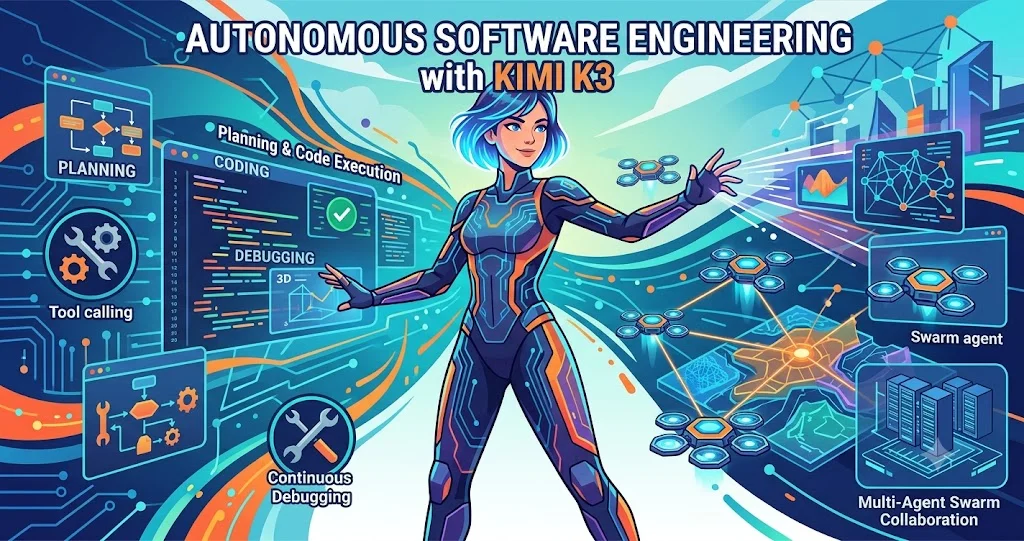
Kimi K3 supports parallel execution through Swarm agent clusters, where it coordinates multiple sub-agents working on different parts of a problem simultaneously. This capability mirrors the future of agent systems where a central orchestrator manages a fleet of specialized agents, dramatically accelerating complex projects.
Tool Calling and Code Execution
Through Kimi Code and the Kimi API, Kimi K3 can execute terminal commands, read and write files, run tests, and integrate with external services. This tool-use capability is essential for agents that need to interact with real systems—from software development to data analysis and system administration.
Current Trends in AI Agent Development
Kimi K3 exemplifies several broader trends shaping the future of AI agents.
- Long-Context Agents: Models with large context windows enable agents to maintain extensive working memory, crucial for tasks that span hours or days.
- Self-Correction and Iteration: Agents that can detect errors, adjust plans, and retry tasks without human intervention increase reliability and autonomy.
- Multi-Agent Systems: Coordinating multiple specialized agents to solve problems in parallel is becoming a key paradigm for tackling complex challenges.
- Open-Source Agent Frameworks: Open-weight models like Kimi K3 democratize agent development, allowing organizations to build custom agents without vendor lock-in.
- Human-AI Collaboration: Future agents will work alongside humans, with clear handoffs and shared decision-making, rather than replacing human judgment entirely.
Practical Applications of Future Agents
The agentic capabilities of Kimi K3 point toward transformative applications across industries.
Autonomous Software Engineering
Agents like Kimi K3 can analyze repositories, plan refactorings, write tests, and debug code across entire projects. With 1M context, they can understand the full structure of a codebase, enabling comprehensive changes that span multiple modules. This reduces developer workload and accelerates delivery.
Intelligent Research Assistants
Future agents will synthesize information from thousands of papers, extract key findings, generate hypotheses, and even design experiments. Kimi K3's ability to process multiple documents simultaneously and maintain context makes it ideal for such research synthesis.
Autonomous Financial Analysis
Agents can parse earnings reports, market data, and news in real time, generate investment theses, and execute trades based on predefined strategies. Kimi K3's tool calling and visual reasoning enable it to analyze charts and financial documents with high accuracy.
Dynamic Legal and Compliance
In legal domains, agents can review contracts, flag risks, and suggest revisions autonomously. With Kimi K3's long context, entire case files or regulatory frameworks can be processed in one session, ensuring comprehensive analysis.
Comparison: Kimi K3's Role in the Agentic Future
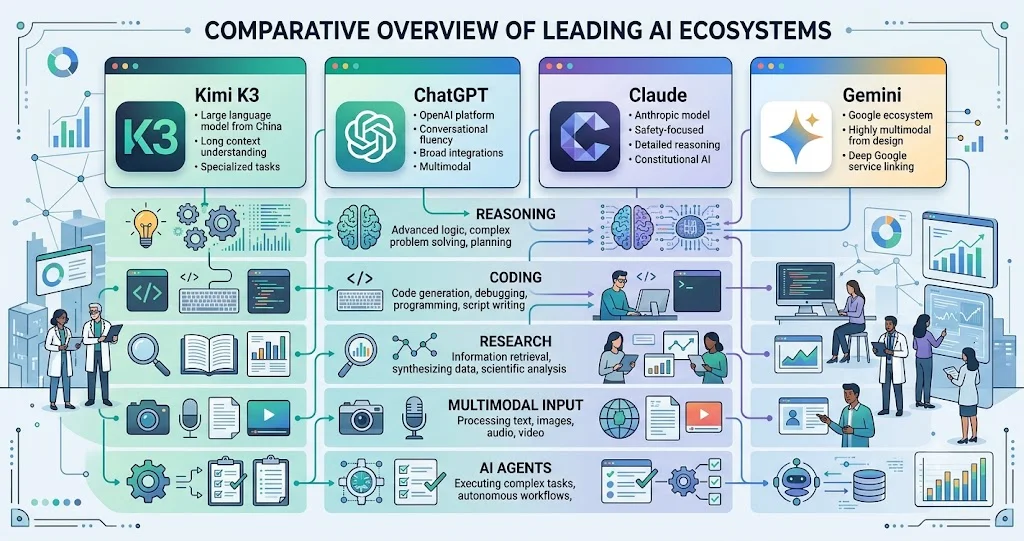
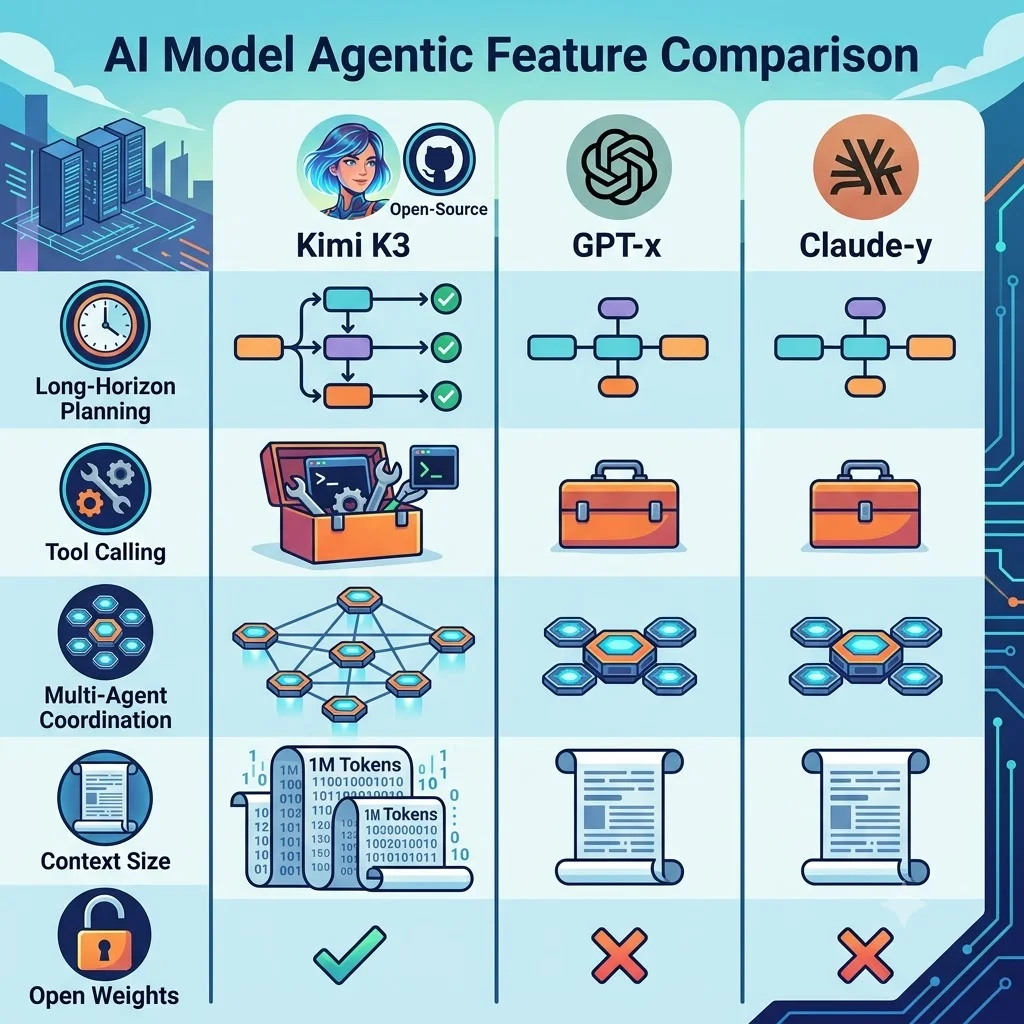
The table below compares Kimi K3's agentic features with other models and highlights its unique position for future agent development.
| Feature | Kimi K3 | Claude (latest) | GPT-5.5+ |
|---|---|---|---|
| Context Window | 1M tokens | 200K tokens | 128-200K tokens |
| Visual Reasoning | Native (MoonViT-V2) | Yes | Yes |
| Tool Calling | Integrated (Kimi Code) | Limited | Extensive |
| Multi-Agent Swarm | Supported | Not native | Limited |
| Open-Source | Full open-weight | Closed | Closed |
| Agentic Programming Rank | #1 (SuperCLUE) | Varies | Varies |
| Cost Efficiency | High | Moderate | Lower |
Benefits and Limitations of Agentic Futures with Kimi K3
Benefits
- Autonomous task execution reduces manual effort and accelerates workflows.
- Large context enables deep understanding of complex, multi-step projects.
- Open-source nature allows customization for specific industry needs.
- Multi-agent coordination enables parallel processing of subtasks.
- Visual reasoning expands the range of perceptible inputs (screenshots, diagrams).
Limitations and Challenges
- Autonomous agents may make errors or take unintended actions; human oversight remains crucial.
- Computational resources for running large-scale agents can be significant.
- Security and safety concerns require robust sandboxing and controls.
- Integration with legacy systems may require additional tool development.
- Ethical considerations around autonomy and accountability need to be addressed.
Types of Future AI Agents
The future will see diverse agent archetypes:
- Orchestrator Agents: Coordinate multiple specialized sub-agents to complete complex tasks.
- Domain Expert Agents: Focused on specific fields (e.g., legal, medical, financial) with deep knowledge.
- Interactive Assistants: Collaborate with humans, providing suggestions and executing delegated tasks.
- Autonomous Creators: Generate content, design products, or write code independently.
- Monitoring Agents: Observe systems, detect anomalies, and trigger corrective actions.
Companies Pioneering Agentic AI
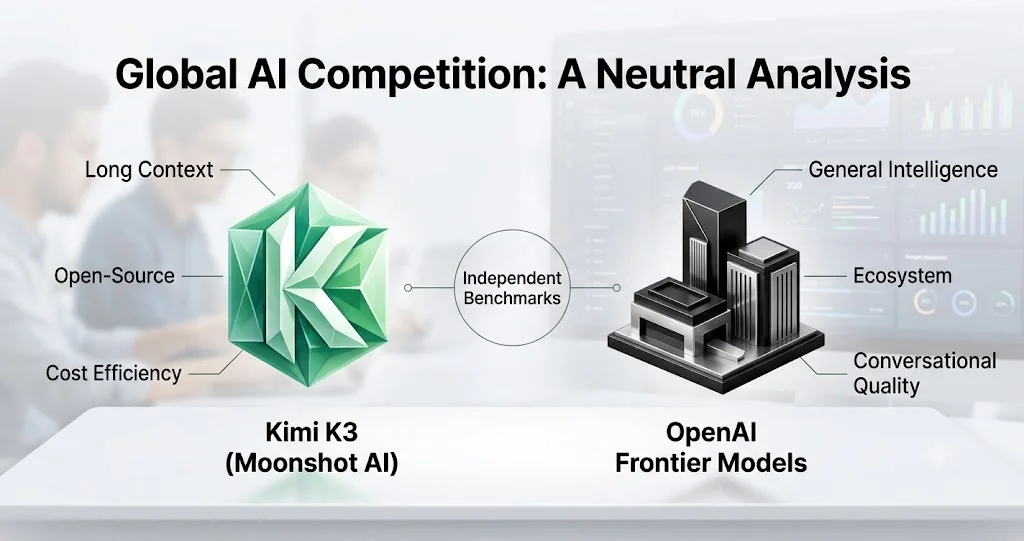
Organizations across sectors are investing in agentic AI. Tech giants like Google and Microsoft are building agent ecosystems. Startups are developing specialized agents for verticals. Kimi K3's open-source model empowers smaller players and research institutions to innovate without prohibitive costs. This democratization is a key driver of the future agent landscape.
Selection Checklist for Building Agentic Systems
When planning agentic systems with models like Kimi K3, consider the following:
- What is the typical duration and complexity of tasks (do you need long context)?
- Does the agent need multimodal inputs (visual, audio, etc.)?
- What tools and APIs will the agent need to call?
- Will you need multi-agent coordination or swarm execution?
- Is open-source customization required for your use case?
- What are the computational and cost constraints?
- What security and safety measures are needed for autonomous operation?
- How will you handle error detection and human escalation?
Tips for Adopting Kimi K3 for Agentic Applications
- Start with well-scoped pilot projects to understand the agent's behavior.
- Use the 1M context to maintain comprehensive task history.
- Leverage Kimi Code for development-focused agentic workflows.
- Implement human-in-the-loop checkpoints for critical decisions.
- Build robust logging and monitoring to audit agent actions.
- Engage with the open-source community to share and learn best practices.
Frequently Asked Questions About Kimi K3 and the Future of AI Agents
What makes Kimi K3 significant for the future of AI agents?
Kimi K3's 1M-token context, native visual reasoning, Swarm agent coordination, and open-source availability provide a powerful foundation for building autonomous, long-horizon agents.
Will AI agents replace human workers?
AI agents are more likely to augment human capabilities, handling repetitive and complex tasks while humans focus on strategic oversight, creativity, and ethical judgment.
How does Kimi K3 compare to other models for agentic tasks?
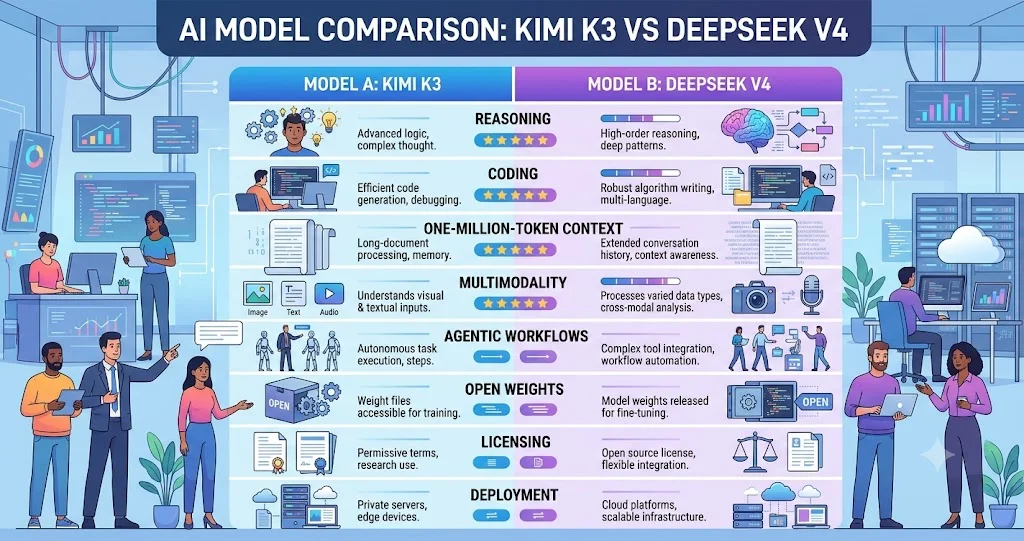
Kimi K3 ranks first in agentic programming benchmarks and offers the largest context window among open models, giving it advantages in long-horizon tasks.
Can I build custom agents with Kimi K3?
Yes, because it is open-weight, you can fine-tune and customize it for specific domains and integrate custom tools.
What are the main challenges with agentic AI?
Challenges include reliability, safety, computational cost, integration complexity, and ethical considerations around autonomy.
Will Kimi K3 continue to be open-source?
Moonshot AI released the full weights of Kimi K3 as open-source; future updates may follow a similar model, but confirm with official announcements.
How do Swarm agents work with Kimi K3?
Kimi K3 coordinates multiple sub-agents that work on different parts of a task in parallel, orchestrated by the central model for efficiency and speed.
Is visual reasoning important for agents?
Yes, it enables agents to interpret screenshots, diagrams, and real-world visual data, expanding their usability in design, debugging, and monitoring tasks.
What industries will benefit most from agentic AI?
Software development, finance, healthcare, legal, research, and any field with complex, data-intensive workflows.
How do I get started with Kimi K3 agents?
Begin with the web interface at kimi.com for testing, then use the Kimi API or Kimi Code for development, and consider local deployment for advanced customization.
Conclusion
Kimi K3 is a landmark model that embodies many of the features that will define the future of AI agents: massive context, native multimodality, tool integration, and open-source accessibility. As agentic systems evolve, they will become more autonomous, collaborative, and capable of tackling increasingly complex challenges. Kimi K3 provides a robust platform for researchers, developers, and enterprises to experiment with and deploy agentic AI. The future of AI agents is not just about automation—it's about intelligent, adaptive systems that work alongside humans to solve problems at scale. With models like Kimi K3 leading the way, that future is closer than ever.