
Artificial intelligence is evolving beyond simple question-answering into systems that can act independently to achieve complex goals. This is agentic AI—AI that plans, executes, and adapts with minimal human oversight. Kimi K3, Moonshot AI's flagship model with 2.8 trillion parameters and a 1-million-token context window, represents a significant leap in agentic capabilities. This article explains what agentic AI means, how Kimi K3 enables it, and what it means for developers and users.
What Is Agentic AI?
Agentic AI refers to artificial intelligence systems that can autonomously perform tasks by planning sequences of actions, executing them, and adjusting based on feedback. Unlike traditional AI that responds to single prompts, agentic AI maintains a goal, breaks it into sub-tasks, uses tools, interacts with environments, and iterates until completion. Key characteristics include:
- Goal-Directed Behavior: The system works toward a specific objective.
- Planning and Decomposition: It breaks complex tasks into manageable steps.
- Tool Use: It can call external functions, APIs, or execute code.
- Adaptability: It adjusts plans based on intermediate results.
- Autonomy: It operates with minimal human intervention.
Kimi K3's Agentic Capabilities
Kimi K3 is designed from the ground up to support agentic workflows. Its combination of large context, native vision, and efficient architecture enables several agentic features.
Long-Horizon Planning and Execution
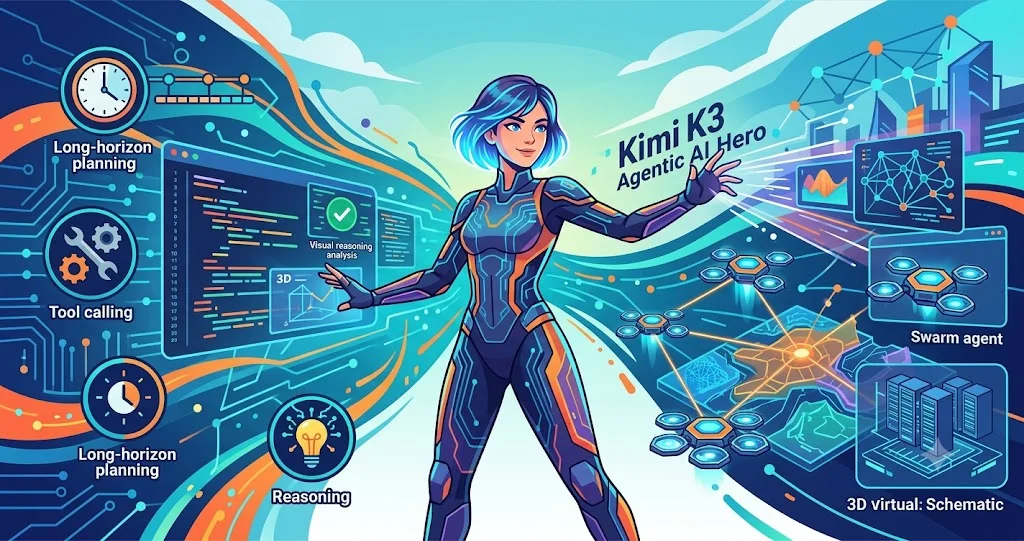
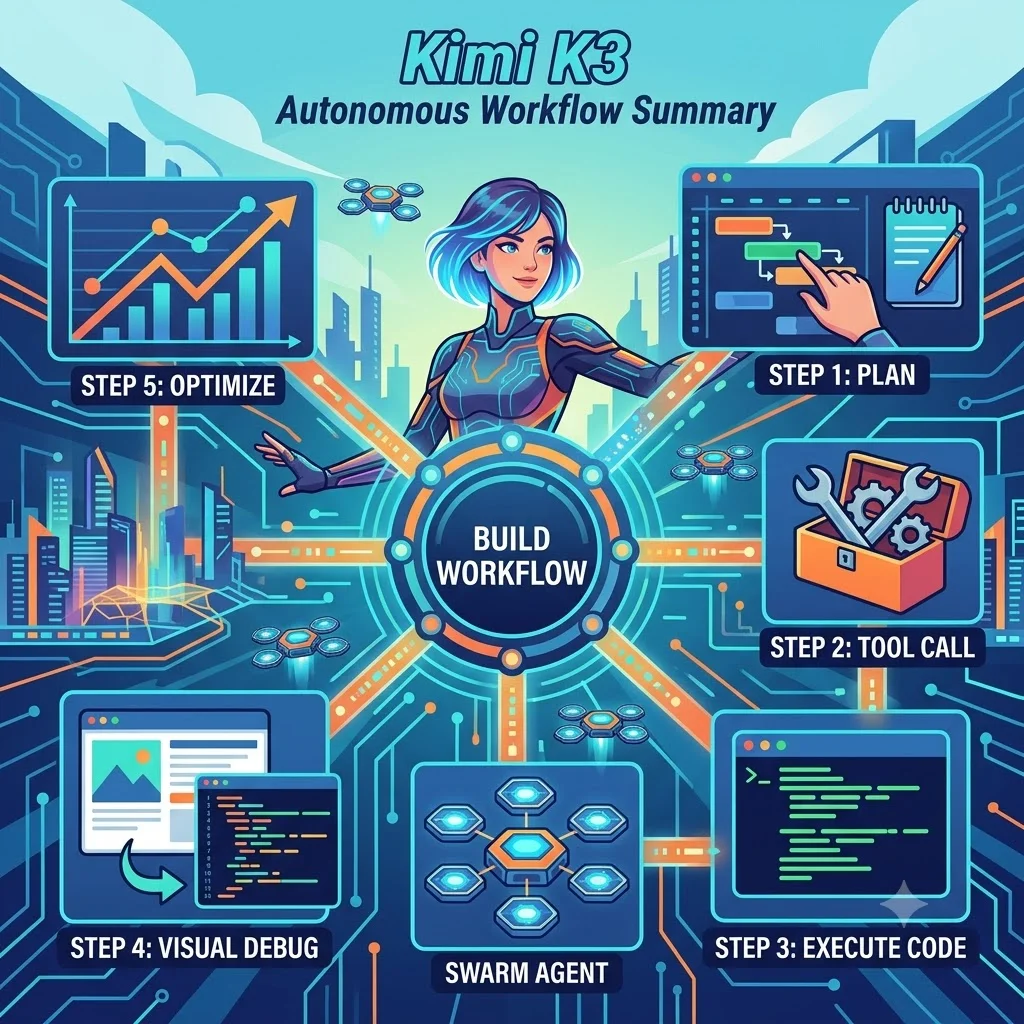
With a 1-million-token context window, Kimi K3 can maintain awareness of an entire project—from initial requirements to multiple iterations of code, logs, and outputs. This allows it to plan and execute tasks that span hours or days of work. For example, Kimi K3 can independently optimize GPU operators, develop compilers, and even complete the design and verification of a small chip in a continuous 48-hour run.
Tool Calling and Integration
Kimi K3 supports a wide range of tool calls, enabling it to interact with external systems. Through the Kimi API and Kimi Code, the model can execute terminal commands, read and write files, run test suites, and process logs. This tool-use capability is essential for agentic tasks like software development, data analysis, and system administration.
Visual Reasoning for Autonomous Debugging
Kimi K3's native visual understanding (via MoonViT-V2) allows it to interpret screenshots, error logs, UI elements, and diagrams. In agentic mode, it can use visual feedback to diagnose issues—for example, looking at a failed game render and adjusting code accordingly. This combines software engineering with visual reasoning, enabling tasks like game development, frontend engineering, and CAD workflow automation.
Swarm Agent Clusters
Kimi K3 supports parallel task execution using Swarm agent clusters. It can coordinate multiple sub-agents to work on different parts of a problem simultaneously, dramatically accelerating complex projects. For instance, it can spin up agents to handle different modules of a codebase, each agent working independently while Kimi K3 orchestrates the overall effort.
Practical Applications of Kimi K3's Agentic AI
Kimi K3's agentic capabilities translate into real-world applications across industries.
- Autonomous Software Development: Kimi K3 can analyze a repository, plan refactoring, write tests, and debug—all with minimal human intervention. Through Kimi Code, it can execute terminal commands, process logs, and iterate until completion.
- Game Creation: The model can design and build playable multiplayer and 3D games, using visual feedback to adjust assets, physics, and interactions.
- Financial Analysis: Kimi K3 can parse earnings reports, market data, and news, then generate investment theses or risk assessments, all within a single context.
- Research Synthesis: It can aggregate multiple research papers, extract key findings, and produce illustrated, in-depth analytical reports.
- Legal Document Review: The model can autonomously review contracts, highlight potential issues, and suggest revisions.
Underlying Technologies Enabling Agentic AI in Kimi K3
Several architectural innovations make agentic behavior possible at scale.
Kimi Delta Attention (KDA)
Agentic tasks often involve long sequences of actions, logs, and context. KDA reduces the computational cost of processing long contexts from near-quadratic to near-linear, making the 1M-token window practical. Without KDA, agentic workflows with thousands of steps would be prohibitively expensive.
Attention Residuals (AttnRes)
In deep models, information can degrade across layers. AttnRes stabilizes signal flow, ensuring that the model can maintain consistent reasoning across long agentic sequences. This is crucial for tasks that require hundreds of steps of planning and execution.
Stable LatentMoE Framework
Kimi K3's Mixture-of-Experts architecture with 896 experts and 56x sparsity allows it to be both powerful and efficient. The Stable LatentMoE framework enables stable training and inference at this sparsity, which is essential for agentic workloads that may run for hours.
Native Multimodality
Kimi K3's MoonViT-V2 architecture provides native visual understanding, enabling the model to reason about images, diagrams, and screenshots. This is critical for agentic tasks in design, debugging, and UI/UX work.
Performance in Agentic Benchmarks
Kimi K3 has demonstrated leading performance in agentic evaluations. In SuperCLUE's agentic programming dimension, it achieved 75.79 points, ranking first. It can independently optimize GPU operators, develop compilers, and even complete chip design verification over 48 hours. On the Frontend Code Arena, Kimi K3 scored 1679, surpassing other models—a testament to its ability to handle complex, multi-step coding tasks.
Comparison of Agentic Capabilities
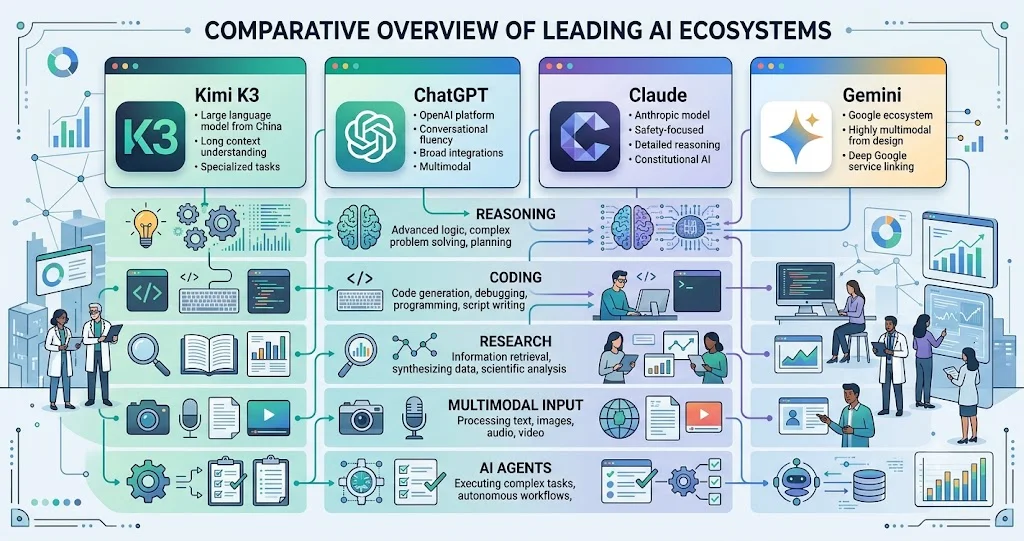
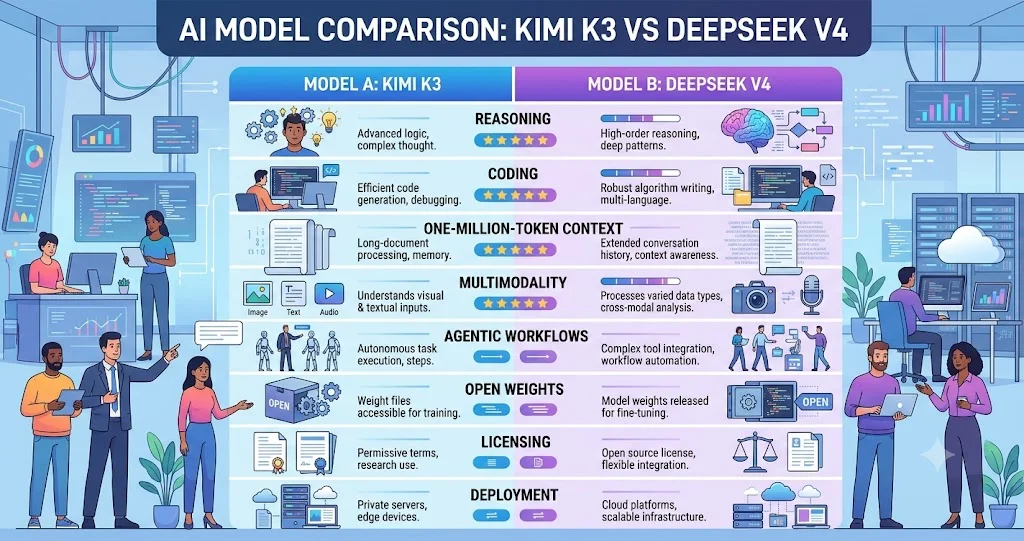
The table below compares Kimi K3's agentic features with other leading models.
| Feature | Kimi K3 | Claude Fable 5 | GPT-5.6 Sol |
|---|---|---|---|
| Context Window | 1M tokens | Up to 200K | Up to 200K |
| Long-Horizon Planning | Excellent (48+ hours) | Good | Good |
| Tool Calling | Integrated (Kimi Code) | Limited | Extensive |
| Visual Reasoning | Native (MoonViT-V2) | Available | Available |
| Swarm Agent Coordination | Supported | Not native | Not native |
| Agentic Programming Rank | #1 (SuperCLUE) | Not reported | Not reported |
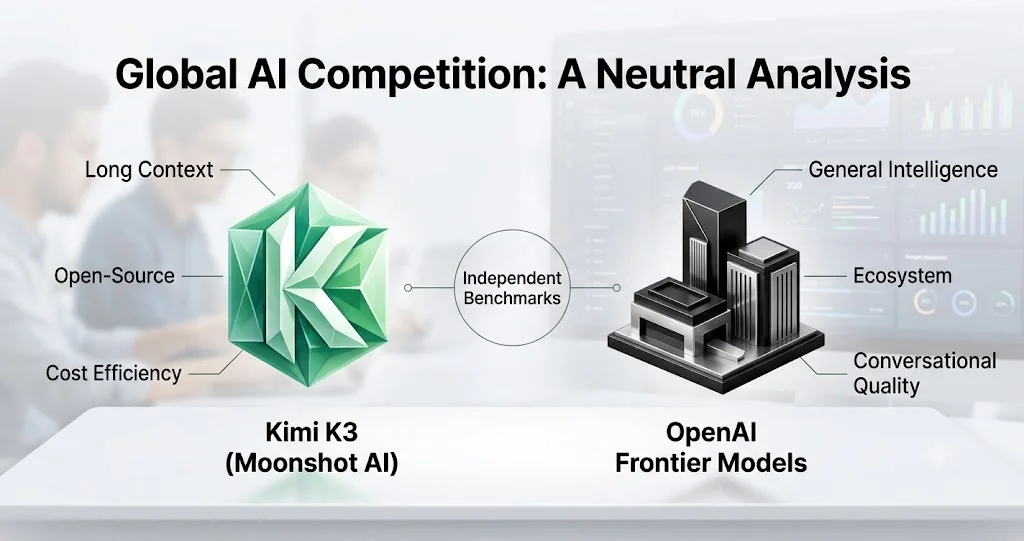
| Openness | Open-weight | Closed | Closed |
Benefits and Limitations of Kimi K3's Agentic Capabilities
Benefits
- Autonomous execution reduces the need for constant human oversight.
- 1M-token context enables end-to-end project understanding.
- Native vision allows debugging and design using visual feedback.
- Swarm clusters accelerate parallel subtasks.
- Open-source weights allow customization for specific agentic workflows.
Limitations
- Autonomous behavior may introduce risks; human verification is still recommended.
- Complex agentic tasks can be computationally expensive.
- Tool calling may have security implications; proper sandboxing is needed.
- Performance can vary based on task complexity and prompt clarity.
Types of Agentic AI Systems
Agentic AI can be categorized by autonomy level and domain. Kimi K3 supports multiple types:
- Reactive Agents: Respond to immediate inputs without planning (limited autonomy).
- Deliberative Agents: Plan actions based on a model of the world (Kimi K3 excels here).
- Hybrid Agents: Combine reactive and deliberative approaches.
- Multi-Agent Systems: Coordinate multiple agents (Kimi K3's Swarm clusters).
Current Trends in Agentic AI
Agentic AI is a rapidly evolving field. Trends include:
- Long-Context Agents: Models with large context windows like Kimi K3 can maintain task history for extended periods.
- Tool-Augmented Agents: Integration with APIs, code execution, and databases.
- Self-Correction: Agents that can detect and fix their own errors.
- Multi-Agent Orchestration: Coordination of multiple specialized sub-agents.
- Open Agent Frameworks: Open-source models enabling custom agent development.
Companies Adopting Agentic AI
Organizations across sectors are exploring agentic AI. Technology companies use it for automated coding and testing. Financial firms employ it for market analysis and trading strategy development. Healthcare institutions leverage it for patient data analysis and research. Kimi K3's open-source nature makes it attractive for organizations that want to build proprietary agentic systems without vendor lock-in.
Selection Checklist for Agentic AI Systems
When evaluating Kimi K3 or other agentic AI, consider:
- Does the model support long-horizon planning and large context?
- What tool-calling capabilities does it offer?
- Does it support multimodal input for visual tasks?
- Can it coordinate multiple sub-agents or parallel tasks?
- Is it open-source for customization?
- What are the computational and cost requirements?
- Are there safety and security mechanisms for autonomous execution?
- Does it have proven performance on relevant agentic benchmarks?
Tips for Building Agentic Workflows with Kimi K3
- Start with well-defined tasks and clear success criteria.
- Use the 1M-token context to maintain full history for complex tasks.
- Leverage Kimi Code for terminal and IDE integration.
- Provide visual feedback (screenshots) for debugging and design tasks.
- Break large tasks into sub-goals and use Swarm clusters for parallelization.
- Implement human checkpoints for critical decisions.
- Regularly review logs to understand the agent's decision process.
Frequently Asked Questions About Kimi K3's Agentic Capabilities
What is agentic AI in the context of Kimi K3?
Agentic AI refers to Kimi K3's ability to autonomously plan, execute, and adapt to achieve complex goals with minimal human supervision using its long context, tool calling, and visual reasoning.
Can Kimi K3 write and execute code autonomously?
Yes, through Kimi Code, Kimi K3 can read, write, and execute code, run tests, process logs, and iterate on software development tasks without human intervention.
Does Kimi K3 support multi-agent coordination?
Yes, Kimi K3 can orchestrate Swarm agent clusters, where multiple sub-agents work on different parts of a problem in parallel, coordinated by the main model.
What is the role of the 1M context window in agentic tasks?
The large context allows Kimi K3 to retain the entire history of a complex task—including multiple iterations, logs, and outputs—enabling coherent long-horizon planning and execution.
Can Kimi K3 use visual feedback in agentic workflows?
Yes, its native visual understanding allows it to interpret screenshots, diagrams, and error logs, which is valuable for debugging, game development, and UI design.
Is Kimi K3 safe for autonomous execution?
While Kimi K3 includes safety measures, users should implement proper sandboxing and human oversight, especially for tasks with significant impact. The model's open nature allows for custom safety layers.
How does Kimi K3 compare to other models for agentic tasks?
Kimi K3 ranks first in SuperCLUE's agentic programming dimension and has a larger context window (1M) than most models, giving it an advantage in long-horizon tasks. It is also open-source, enabling customization.
What hardware is needed to run Kimi K3 agentic workflows?
Running large-scale agentic tasks with Kimi K3 may require powerful GPUs or cloud instances. The API option provides a convenient alternative without hardware investment.
Can I build custom agents with Kimi K3?
Yes, because Kimi K3 is open-weight, you can fine-tune it for specific agentic domains and integrate custom tools and APIs.
What are the main use cases for Kimi K3's agentic AI?
Software development, game creation, financial analysis, research synthesis, legal document review, and any domain requiring complex, multi-step reasoning and action.
Conclusion
Kimi K3's agentic AI capabilities represent a significant advancement in autonomous systems. Its combination of a 1-million-token context window, native visual reasoning, efficient attention, and tool-calling infrastructure enables long-horizon planning, multi-agent coordination, and practical applications across industries. As the first open-source model with this level of agentic functionality, Kimi K3 democratizes access to cutting-edge AI autonomy. For developers, researchers, and enterprises, understanding these capabilities is the first step toward building intelligent agents that can tackle complex, real-world problems with minimal human oversight.