
How Search Engines Like Google Actually Work: A Guide
Search engines are the gateway to the internet, helping us find information, products, services, and answers in seconds. Yet the technology that powers these systems is complex and often misunderstood. This guide explains how search engines like Google actually work, breaking down the key processes into understandable steps and offering insights into the algorithms that shape our online experience.
Introduction: The Role of Search Engines
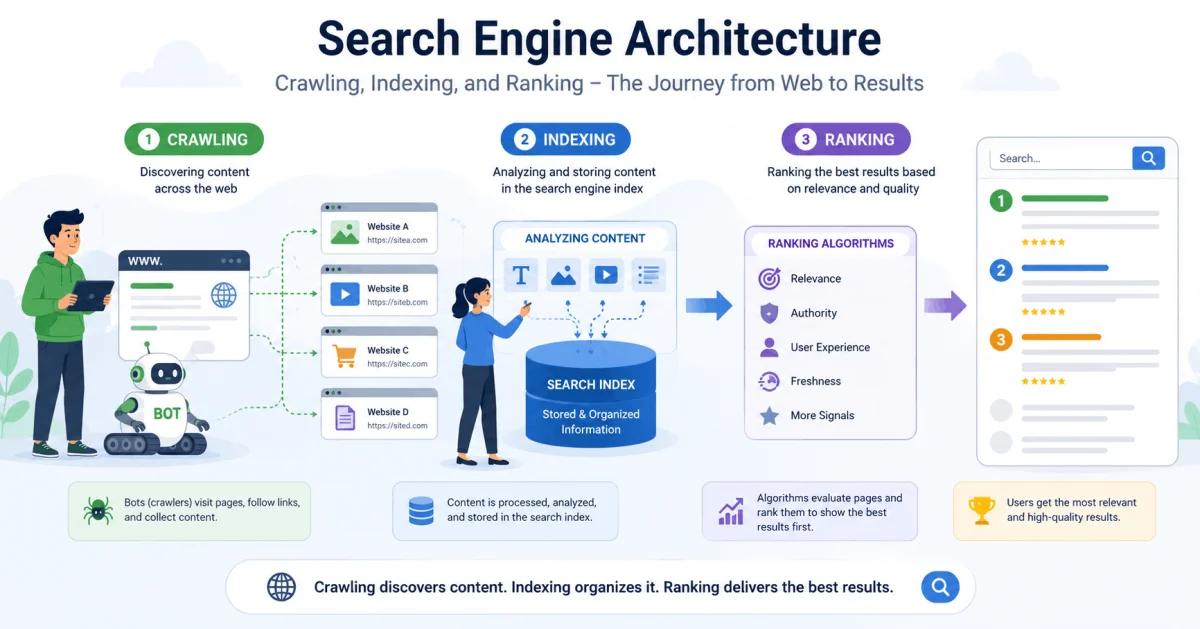
Search engines are software systems designed to search for and retrieve information from the vast repository of the World Wide Web. Their primary goal is to provide users with the most relevant and useful results for their queries as quickly as possible. The process involves several interconnected stages: crawling, indexing, and ranking. Understanding these stages reveals why some content appears at the top of search results while other content is less visible. While the details of search algorithms are proprietary and constantly evolving, the foundational principles are well-understood and form the basis of search engine optimization (SEO) and online content strategy.
Stage 1: Crawling
Crawling is the first step in the search engine process. It involves discovering new and updated content on the web. Search engines use automated programs called crawlers, spiders, or bots to systematically browse the internet.
- How Crawling Works: Crawlers start from a list of known web pages and follow hyperlinks from those pages to discover new content. This process continues recursively, allowing the crawlers to traverse billions of pages across the internet.
- What Crawlers Look For: Crawlers are designed to find new content, detect changes to existing content, and gather information about the structure and content of each page. They also look for robots.txt files, which guide them on what to crawl and what to avoid.
- Limitations of Crawling: Crawlers cannot index all content due to limitations like paywalls, private networks, or pages that are blocked by the website owner. They also have constraints on the frequency and volume of crawling to avoid overloading websites.
Stage 2: Indexing
Once a page is crawled, the search engine must process and store the information in a way that enables fast and accurate retrieval. This is the indexing stage.
- What is Indexing: Indexing is the process of organizing and storing the content discovered during crawling. The search engine analyzes the content, metadata, images, and structural elements of a page and adds it to a massive database called the index.
- How Indexing Works: The search engine extracts key information from the page, such as the title, headings, keywords, and other relevant elements. It also considers factors like page quality, relevance, and authority to help determine future rankings.
- What is in the Index: The index is a vast, continuously updated database containing information about billions of web pages. It is optimized for quick retrieval, allowing the search engine to respond to user queries in milliseconds.
Stage 3: Ranking
Ranking is the most visible and complex stage of the search engine process. It involves determining the order in which indexed pages appear in search results for a given query. This is the stage that search engine algorithms are designed to optimize.
- How Ranking Works: When a user enters a query, the search engine's algorithm analyzes the index to find pages that are most relevant to that query. It then applies a complex set of ranking factors to determine which pages should appear at the top.
- Key Ranking Factors: While the exact details are proprietary, known ranking factors include relevance (how well the content matches the search query), authority (the perceived trustworthiness and credibility of a page), user experience (page load speed, mobile responsiveness), and backlinks (links from other reputable websites).
- The Role of AI and Machine Learning: Increasingly, search engines use AI and machine learning models to understand search intent, interpret natural language queries, and improve the ranking process. These models help search engines understand context, synonyms, and user intent in ways that traditional algorithms could not.
Key Search Engine Algorithms and Updates
Search engines continuously refine their algorithms to improve the quality and relevance of their results. Here are some of the major updates that have shaped how search results are ranked.
- Keyword-Focused Updates: Early search engines relied heavily on keyword matching. Over time, algorithms evolved to consider the context, intent, and quality of content beyond just keyword frequency.
- Quality and Authority Updates: Updates like Google's Panda and Penguin targeted low-quality content and spammy link-building practices, emphasizing the importance of high-quality, authoritative content.
- User Experience Updates: Updates like Page Experience introduced user-centered metrics such as load time, interactivity, and visual stability as ranking factors.
- AI-Driven Updates: The introduction of RankBrain and BERT represented major shifts toward AI-powered search, focusing on understanding natural language and user intent.
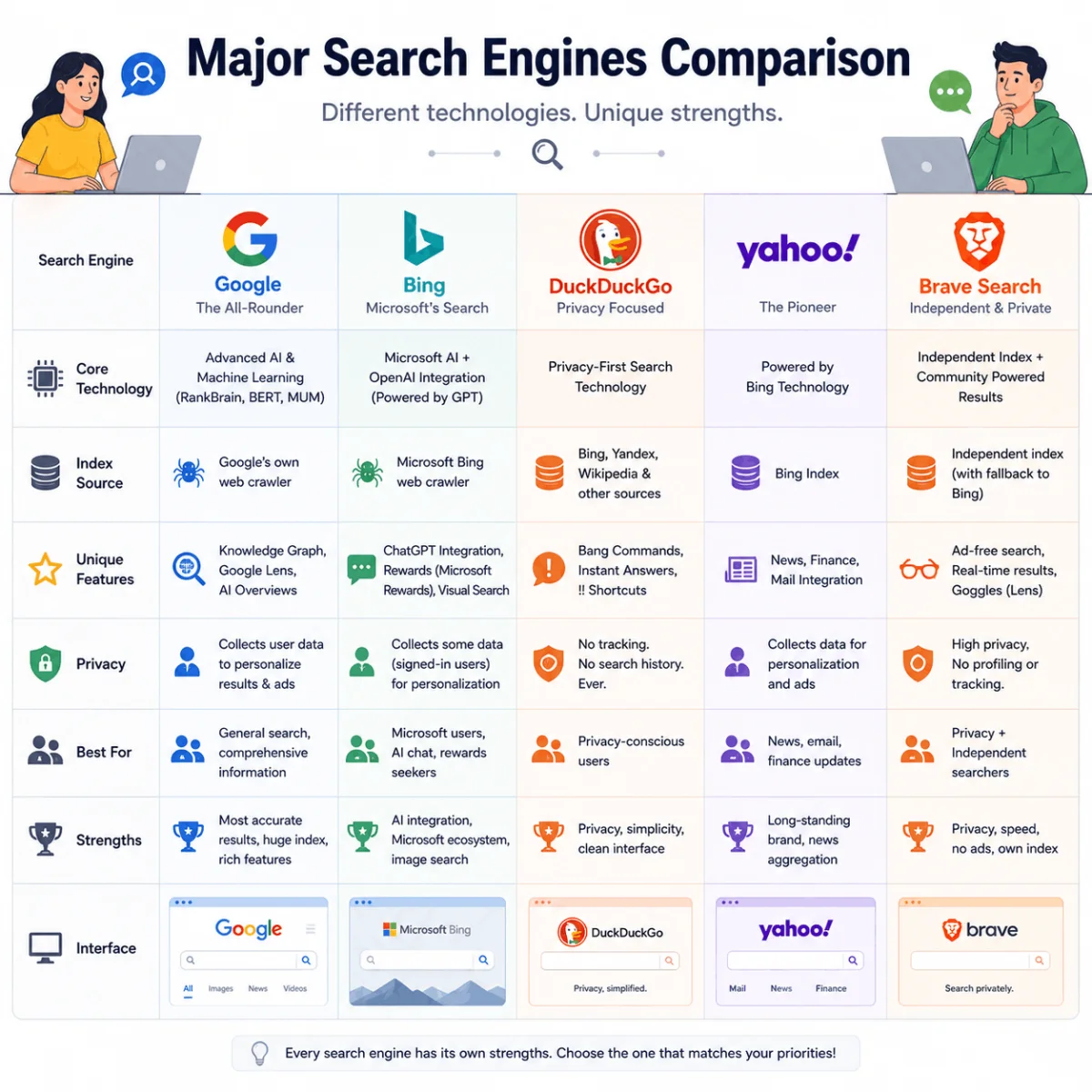
Comparison of Major Search Engines
The following table compares some of the major search engines, highlighting their primary strengths, technology, and unique features.
| Search Engine | Market Share (approx.) | Key Technology | Unique Features |
|---|---|---|---|
| ~91% | RankBrain, BERT, MUM | AI-driven, rich snippets, knowledge panels | |
| Bing | ~3% | AI, integration with Microsoft | Visual search, integration with Windows |
| Yandex | ~1% | Proprietary AI | Strong in Russian-speaking regions |
| Baidu | ~1% | Proprietary AI | Strong in China, multimedia integration |
| DuckDuckGo | ~1% | Privacy-focused, uses Bing API | No tracking, emphasis on privacy |
Checklist: Understanding Search Engine Ranking Factors
Use this checklist to understand the key factors that can influence how search engines rank your content.
- Relevance: Does your content directly answer the user's query? Is it well-structured and easy to read?
- Authority: Does your site have high-quality backlinks from other reputable websites? Is it considered a trusted source in its industry?
- User Experience: Is your site mobile-friendly? Does it load quickly? Is it easy to navigate?
- Content Quality: Is your content original, comprehensive, and valuable to the user? Does it cover the topic in depth?
- Technical SEO: Is your site structured effectively for crawlers? Do you use appropriate meta tags, sitemaps, and schema markup?
Tips for Creating Search-Engine-Friendly Content
These practical tips can help you create content that is more likely to rank well in search engine results.
- Focus on User Intent: Understand what users are truly looking for and create content that meets those needs.
- Provide Value: Create content that is informative, comprehensive, and helpful to your audience.
- Use Clear Headings and Structure: Organize your content with clear headings and subheadings for readability and SEO.
- Optimize for Keywords, but Naturally: Use keywords naturally throughout your content, avoiding keyword stuffing.
- Build High-Quality Backlinks: Seek links from reputable, relevant websites to improve your site's authority.
- Optimize for Mobile and Speed: Ensure your website is mobile-friendly and loads quickly for a better user experience.
Frequently Asked Questions About Search Engines
How does Google rank pages?
Google uses a complex algorithm involving over 200 ranking factors, including relevance, authority, user experience, and content quality. The algorithm is constantly updated to improve search quality.
What is the difference between crawling and indexing?
Crawling is the discovery of content on the web, while indexing is the organization and storage of that content in the search engine's database. A page must be both crawled and indexed to appear in search results.
How often do search engines update their algorithms?
Search engines make thousands of small updates each year, as well as occasional large-scale updates that can significantly change how results are ranked.
Why do some pages appear at the top of search results?
Pages at the top have been identified by the search engine's algorithm as being the most relevant and authoritative for that particular query, based on a combination of ranking factors.
Can I pay to be at the top of search results?
You can pay for advertising to appear at the top of sponsored search results, but organic rankings are earned through relevance and quality, not payment.
What is the role of AI in search engines?
AI helps search engines understand user intent, process natural language queries, and improve the accuracy and relevance of ranking, particularly for complex or ambiguous queries.
Is search engine ranking the same for everyone?
No, search results can be personalized based on factors like location, search history, and device. Different users may see different results for the same query.
How can I improve my site's search ranking?
Focus on creating high-quality, relevant content, improving user experience, building authority through backlinks, and staying up to date with search engine guidelines.
What is a sitemap and why is it important?
A sitemap is a file that lists the pages on your website, helping search engines discover and index your content more efficiently.
Conclusion
Understanding how search engines like Google actually work is essential for anyone creating content for the web, managing a website, or simply curious about the technology behind online search. The process involves crawling to discover content, indexing to organize it, and ranking to determine relevance. While search algorithms are complex and always changing, the fundamentals remain grounded in providing the most useful and relevant results to users. This guide has explored these stages in detail, offering practical insights and tips for navigating the search engine landscape.