
When a user asks ChatGPT for the best project management tool or prompts Google's AI Mode for a breakdown of marketing attribution models, the content that informs those answers may be yours. But unless your brand is explicitly cited, you are invisible in that interaction: no click, no impression, no awareness.
That is the gap Generative Engine Optimization (GEO) fills. Not by chasing AI rankings—there are none—but by structuring content and building authority so that AI-powered platforms cite your brand when generating answers.
In May 2024, 56% of news-related Google searches resolved without a single click. By May 2025, that number had climbed to 69%.68% of Google searches now end without a click.AI Overviews reduce the click-through rate for position 1 by approximately 58%.ChatGPT serves 800 million users each week, and Google's AI Mode has crossed one billion monthly active users.
This guide explains what GEO is, how it differs from traditional SEO, the strategies that work in 2026, and how to measure success.
What Is Generative Engine Optimization (GEO)?
Generative Engine Optimization is the practice of structuring content and building brand authority so that AI-powered platforms select, cite, and surface your brand in their responses to user queries.Unlike traditional search, where the goal is a ranked link, GEO targets inclusion inside the synthesized answer itself.
GEO is the discipline of ensuring that digital content is retrieved, recognized, and cited by generative AI systems.If traditional SEO was about earning a spot among 10 blue links, GEO is about earning a place among the two to seven domains large language models typically cite in a single response.
How AI Engines Actually Work
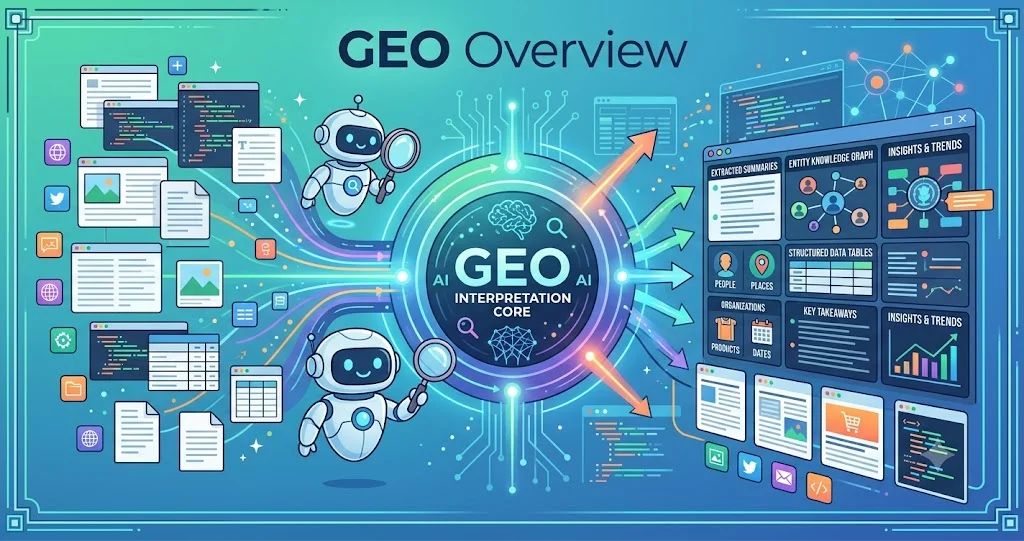
To optimize for GEO, you need to understand the mechanism behind it. Most modern AI search engines use a process called Retrieval-Augmented Generation (RAG), which works in two stages.
First, retrieval: when a user submits a query, the AI system searches an index to find relevant documents. The system retrieves a set of candidate documents.
Second, generation: a large language model synthesizes those retrieved documents into a single, coherent response. It selects which sources to cite, how prominently to feature them, and what to say about them.
The output is not a list of links. It is a composed answer, with your content woven in or left out. The practical implication of RAG is this: being indexed is necessary, but not sufficient.
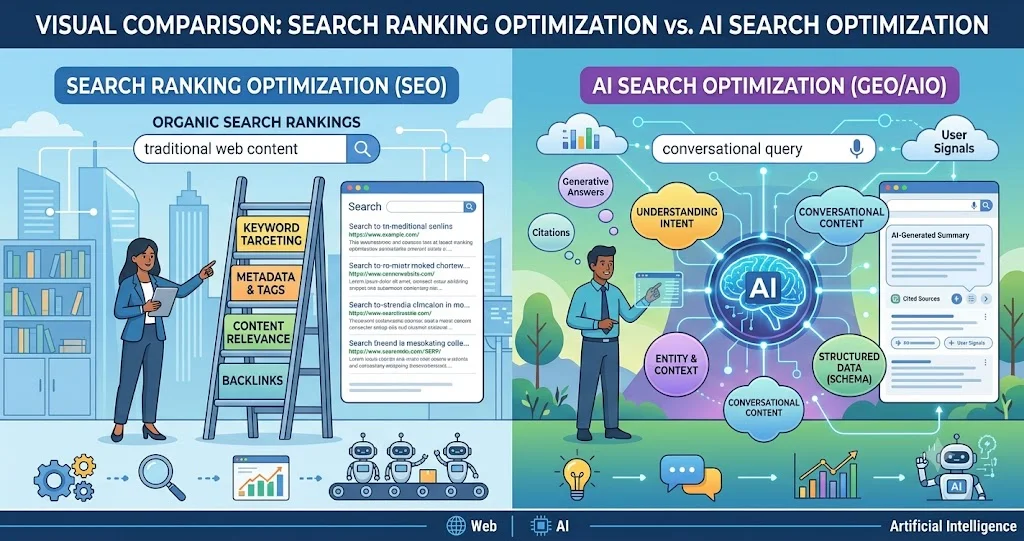
GEO vs SEO: The Fundamental Difference
SEO optimizes for ranking algorithms. GEO optimizes for language models.A ranking algorithm decides where your page appears in a sorted list. A language model decides whether to cite your page inside a synthesized answer.These are fundamentally different selection mechanisms, and they reward different content qualities.
SEO rewards keyword relevance, backlink authority, and click-through signals. GEO rewards quotability, entity clarity, structural parsability, and source credibility.A page can rank #1 in Google organic results and still never get cited in an AI Overview, or vice versa.
| Factor | SEO | GEO |
|---|---|---|
| What you're optimizing for | Position in a ranked list of links | Inclusion and citation inside AI-generated text |
| How content is surfaced | User clicks a link and visits your page | AI quotes or paraphrases your content directly in the answer |
| Content style that wins | Keyword-rich, long-form, comprehensive | Quotable, structured, data-backed, entity-clear |
| Key signals | Backlinks, keyword density, page speed, UX | Source authority, freshness, structural clarity, entity signals |
| Traffic model | Click-through from search results | Referral from citation links, brand recognition from mentions |
| Measurement | Rankings, organic traffic, CTR | Citation frequency, AI referral traffic, brand mention rate |
Where SEO rewarded broad keyword coverage, GEO rewards concentrated expertise.
Key GEO Strategies for 2026
A practical GEO strategy focuses on four areas: content structure, entity authority, technical foundations, and content freshness.
1. Answer-First Content
AI engines don't read content the way people do. They break pages into individual passages and evaluate each one for relevance, clarity, and factual density.LLMs use RAG to find answers. If your page takes 500 words to get to the point, the AI will skip you for a competitor who defines the solution in the first paragraph.
Start each section with a clear, direct answer of 40-60 words. Then expand with context.Use a clean heading structure, bulleted lists, and comparison tables.About 80% of AI-cited pages use lists, tables, or other scannable structure.
Place 40-60 word answer blocks, bullet lists, and comparison tables at the top of each section so AI can extract information easily.
2. Entity Clarity and Structured Data
Entity optimization is how you make AI search engines recognize, trust, and cite your brand.AI systems don't simply reward repetition—they need clear entity signals.
Use advanced JSON-LD schema to help LLMs understand your brand. This isn't just for "Product" or "Price"—it's for defining your Brand Entity. Tell the AI exactly what category you lead, who your experts are, and what problems you solve in a machine-readable format.
Implement FAQPage, Article, HowTo, Product, and Organization schema types.Schema encodes locale and entity relationships, making your content more discoverable by AI retrieval systems.
3. Earned Media and Authority
Generative engines prioritize earned media and journalistic sources over paid or promotional content.Large Language Models and RAG systems are biased toward authoritative, third-party sources.
Muck Rack's analysis of more than one million AI citations found that over 95% come from non-paid media, and more than 27% are journalistic content.If you want to be the answer, you need to be in the news.
To execute this, teams must map the "source ecosystem" for their industry. Run queries relevant to your brand in ChatGPT, Claude, and Google's AI Overviews. Note which publications appear most frequently in the citations. These outlets are your high-value pitch targets.
AI models look for patterns of trust. Secure mentions in authoritative industry publications and encourage detailed, specific reviews on third-party platforms.When the AI sees the same positive "Entity Relationship" across five different trusted domains, it solidifies that fact.
4. Content Freshness
Recency is a major signal for AI, meaning static "evergreen" content must be refreshed frequently to remain citable.In traditional SEO, a ten-year-old URL with massive backlink accumulation could hold the top spot indefinitely. In GEO, that same page might be ignored if the model perceives the information as stale.
AI models often prioritize the most current data to avoid hallucinations or outdated advice.ChatGPT prioritizes content from the last 6-12 months.Content has a one-year half-life in AI search: each year of age cuts retrieval visibility by roughly 40-60%.
Update your content regularly, add new data points, and refresh statistics to maintain citation-worthiness.
5. Technical Foundations
Technical SEO remains the eligibility layer, but structured data and entity clarity are what allow models to connect your brand to specific topics.GEO focuses more on chunks of information, or fragments, to provide precise answers.
If your content isn't technically sound and high-quality enough to rank in traditional search, it won't perform in AI-generated answers either.High-quality content is the foundation—our generative AI features depend on both quality and technical accessibility.
Don't block bots from crawling your content. Allow AI crawlers to read and understand your structured data.
Measuring GEO: Share of Model and Citation Rate
Traditional SEO metrics—rankings, organic traffic, click-through rate—no longer tell the full story. GEO requires new measurement approaches.
Share of Model (SoM) measures how often your brand appears in AI-generated answers compared to your competitors.It's the AI-era successor to share of voice. If engines mention brands 1,000 times across your category prompts and 180 of those mentions are yours, your Share of Model is 18%.
Citation rate measures how often your content is cited by AI platforms. Citation rates vary significantly by platform:
- Perplexity: 97% citation rate
- Google AI Overviews: 34% citation rate
- ChatGPT: 16% citation rate
A 2026 study analyzing 34,234 AI responses found that ChatGPT cited brands in just 0.59% of answers versus 13.05% for Perplexity.Platforms have different citation behaviors, and a GEO strategy must account for this variation.
Other key GEO metrics include:
- Citation rate by platform: How often your brand is cited on each AI platform
- Citation sources: Which types of sources (owned content, earned media) generate citations
- Recommendation rate: How often your brand is recommended as the best option
- Citation drift: How your citation rate changes over time
- Sentiment analysis: Whether your brand is mentioned positively, neutrally, or negatively in AI responses
Just 16% of brands systematically track their AI search performance today, according to McKinsey.While most of the market is still optimizing for a world that's fading, teams that move now have a real chance to build an advantage.
GEO, SEO, and AEO: The Triple Threat
GEO is not a replacement for SEO. It is the discipline that ensures your brand remains visible inside AI-generated answers as traditional organic clicks decline.Together with SEO and AEO (Answer Engine Optimization), they form a triple-threat approach to visibility in the AI era.
SEO determines how you get ranked in traditional search results.AEO focuses on becoming the source for direct answers in featured snippets, knowledge panels, and AI Overviews.GEO determines how AI systems interpret your content, ensure brand accuracy, and position you as a possible choice for an answer.
GEO is 80% strategic (positioning, ecosystem presence, brand authority) and only 20% technical.It spans content, technology, data, brand governance, and public relations, making cross-functional coordination essential.
Sustained AI visibility demands embedding GEO into editorial cycles, product release processes, and brand governance frameworks.
The 2026 Tipping Point
Several forces make 2026 the tipping point for GEO. AI search adoption is moving beyond experimentation as users form platform loyalty, choosing their preferred AI engine the way they once chose between Google and Bing.GEO has gone mainstream at the enterprise level, with dedicated conferences, agency specializations, and a growing ecosystem of purpose-built tools.
Gartner predicted traditional search volume would drop 25% in 2026 as users shift to AI-powered answer engines.Google's AI Overviews now reach more than 2 billion monthly users.ChatGPT serves 800 million users each week.
35% of US consumers now use AI at the product discovery stage compared to 13.6% who use search.The shortlist is set before a user ever opens a search bar.
Academic research reinforces this shift. A Princeton study that coined the term shows that AI engines strongly favor earned media—authoritative third-party sources—over brand-owned content.
Frequently Asked Questions
What is Generative Engine Optimization (GEO)?
GEO is the practice of structuring content and building brand authority so that AI-powered platforms like ChatGPT, Perplexity, Google AI Overviews, and Claude cite your brand in their answers.
How does GEO differ from SEO?
SEO optimizes for ranking in search results. GEO optimizes for being cited in AI-generated answers.SEO rewards keywords and backlinks. GEO rewards quotability, entity clarity, and source credibility.
Is GEO replacing SEO?
No. GEO is a complementary discipline. SEO remains the foundation that allows AI bots to find your site. GEO ensures the AI chooses and cites your content once it finds it.You need both to survive the 2026 search landscape.
What are the key GEO strategies for 2026?
Key strategies include answer-first content (40-60 word direct answers), entity clarity and structured data (JSON-LD schema), earned media and authority (PR-driven citations), content freshness (regular updates), and strong technical foundations.
How do you measure GEO success?
Key metrics include Share of Model (SoM)—how often your brand appears in AI answers compared to competitors—and citation rate by platform. Citation rates vary: Perplexity 97%, Google AI Overviews 34%, ChatGPT 16%.
What is Share of Model (SoM)?
Share of Model measures how often your brand appears in AI-generated answers compared to your competitors.It's the AI-era successor to share of voice.
Why does earned media matter for GEO?
Over 95% of AI citations come from non-paid media, and more than 27% are journalistic content.AI systems are biased toward authoritative third-party sources over brand-owned content.
How does content freshness affect GEO?
Recency is a major signal for AI. Static evergreen content must be refreshed frequently to remain citable.ChatGPT prioritizes content from the last 6-12 months.
Conclusion
Generative Engine Optimization represents a fundamental shift in how brands achieve visibility online. The old model—rank higher, drive clicks, measure traffic—is giving way to a new reality where being cited in AI answers is the primary conversion event.
68% of Google searches now end without a click.AI Overviews reduce CTR for position 1 by 58%.ChatGPT and AI Mode have reached billions of users.The search results page that defined a decade of marketing strategy is no longer where the journey begins.
GEO is not a replacement for SEO—it is the discipline that ensures your brand remains visible inside AI-generated answers.Together with SEO and AEO, it forms a triple-threat approach to visibility in the AI era.
For organizations willing to invest in GEO, the opportunity is significant. Just 16% of brands systematically track their AI search performance today.Teams that move now have a real chance to build an advantage—not just catching up, but helping define what visibility means in the AI era.
The question is no longer whether to invest in GEO. The question is whether to start now—or wait until the competitive advantage has already been claimed.