

AI Search and Google Search are no longer two completely separate experiences. Google increasingly combines conventional web results with AI-generated answers, while standalone AI platforms have made conversational discovery a mainstream way to find information. The important question for marketers, publishers, and researchers is therefore not simply which one will win, but how the underlying discovery model is changing.
Traditional Google Search primarily helps users locate relevant pages, products, videos, images, businesses, and other resources. AI Search can go a step further by interpreting a complex request, combining information from multiple sources, and presenting a synthesized response. Google's AI Overviews and AI Mode illustrate this convergence: AI Overviews provide an AI-generated snapshot with links, while AI Mode supports follow-up questions and can break a question into multiple related searches.
AI Search vs Google Search: The Core Difference
The clearest distinction is the unit of value delivered to the user. Traditional search generally presents a ranked set of possible destinations. AI Search increasingly attempts to provide an answer, explanation, comparison, or starting point before the user visits another website.
| Area | Traditional Google Search | AI Search |
|---|---|---|
| Primary output | Ranked links and search features | Synthesized answer with supporting sources |
| Query style | Keywords, phrases, and questions | Natural-language questions and multi-part requests |
| Interaction | Often query-by-query | Conversational and iterative |
| Discovery | User evaluates individual results | System summarizes information before deeper exploration |
| Source visibility | Individual pages are prominently presented | Sources may appear as citations or supporting links |
| Best suited to | Finding specific websites, products, local services, and fresh resources | Synthesis, exploration, comparisons, explanations, and complex questions |
This is not a strict divide. Google Search still uses automated crawling, indexing, and ranking systems to identify relevant pages, while Google's AI experiences use information retrieved from the Search index. Google says AI Overviews and AI Mode continue to rely on core Search systems and relevant web content.
How Traditional Google Search Works
Google's conventional search process can be understood through three broad stages: crawling, indexing, and serving results. Googlebot discovers and fetches pages, Google's systems analyze and store information in the index, and ranking systems determine which results are most relevant to a particular query. Google's ranking systems consider many signals, including relevance, language, location, device, freshness, links, and other page-level or site-level signals.
The user then receives a search results page containing some combination of organic results and specialized features such as images, videos, local results, shopping information, knowledge panels, or other search features. The exact composition depends on the query.
This model gives users substantial control. A person researching a topic can compare several pages, choose a government source, read a publisher's article, watch a video, inspect product listings, or search again with a different phrase.
How AI Search Changes the Interaction
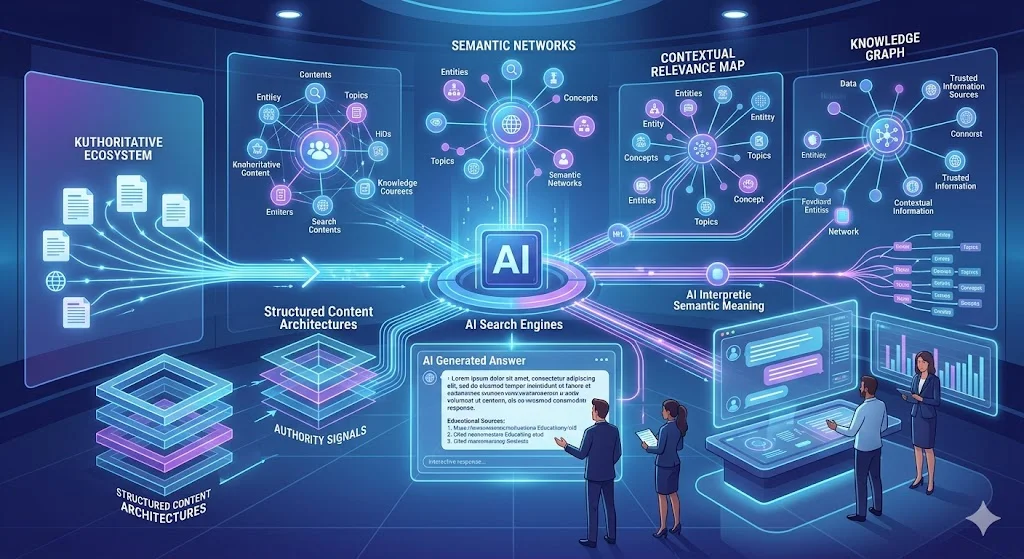
AI Search changes the interaction from retrieval first toward interpretation first. Instead of asking the user to inspect multiple results and construct an answer, the system attempts to perform part of that synthesis.
Google's current AI Mode is a useful example. Google says AI Mode can handle text, voice, images, and files, support follow-up questions, and use a query-fan-out approach in which the original question is divided into related subtopics and searched simultaneously. The resulting information is then assembled into an AI-generated response with links for further exploration.
This approach is particularly useful for questions such as:
- Comparing several technologies against different requirements.
- Understanding a complicated subject through follow-up questions.
- Combining several related questions into one research task.
- Exploring unfamiliar subjects before deciding which sources to read.
However, synthesis introduces a new failure mode: the answer can be fluent and useful-looking while still containing an incorrect interpretation or factual mistake. Google explicitly warns that AI Mode and AI Overviews can make mistakes and recommends checking important information against multiple sources.
Search Behavior Is Becoming More Conversational
One of the most important changes is not simply the appearance of AI answers but the changing shape of queries. Google reported in 2025 that AI Overviews were associated with people asking more complex and longer questions, while Similarweb's 2026 generative-AI research reports a 5.4% increase in Google search length alongside the growth of AI Mode. These findings point toward a gradual move from short keyword combinations toward more natural-language requests.
Google's own research also shows that longer searches are more likely to trigger AI-generated summaries. In a Pew Research Center analysis of 68,879 Google searches from March 2025, AI summaries appeared for 18% of searches overall. They appeared for 53% of searches containing 10 or more words, compared with 8% of searches containing only one or two words.
The implication for marketers is significant: search intent is becoming more detailed. Instead of optimizing only for short phrases such as “best CRM,” content may increasingly need to address the underlying questions a user asks around implementation, suitability, limitations, integrations, cost considerations, and alternatives.
AI Search Does Not Automatically Mean Less Web Search
It is tempting to describe AI Search as a replacement for the web, but current evidence is more complicated.
Google reported in August 2025 that total organic click volume from Google Search to websites was relatively stable year over year and that its internal data showed slightly more quality clicks. Google also says AI Overviews and AI Mode are intended to provide links that help users continue exploring the web.
Independent research, however, shows that the experience can reduce outbound clicking in some circumstances. Pew Research Center found that users who encountered an AI summary clicked a traditional search result in 8% of visits, compared with 15% when no AI summary appeared. Only 1% of visits to pages with an AI summary resulted in a click on a link inside the summary itself in that study.
These findings are not necessarily contradictory. AI may generate more searches and more opportunities for discovery while simultaneously satisfying some individual questions without requiring a website visit. For publishers, that means search visibility and website traffic can no longer be treated as exactly the same metric.
What AI Search Means for Publishers
Publishers face a particularly important change because their content can serve two purposes: it can be the destination that a user visits, or it can become part of the evidence used to construct an AI-generated answer.
This creates a new visibility problem. A publisher may receive recognition through a citation or brand mention without receiving a conventional pageview. At the same time, being absent from AI-generated answers can mean losing exposure during a discovery stage that previously occurred almost entirely through ranked search results.
Google's current guidance does not say that publishers need a separate technical form of “AI SEO.” Google states that the existing fundamentals of SEO remain relevant to AI Overviews and AI Mode. Pages must be accessible, indexable, eligible for Search, and supported by useful, reliable, people-first content. Google also says there is no special schema markup or AI-specific file required for inclusion in these features.
That makes the strategic shift less about chasing a secret AI ranking factor and more about producing content that is genuinely useful, distinctive, technically accessible, and easy for both people and search systems to understand.
Information Reliability: Different Risks, Not No Risk
Traditional search has a familiar reliability problem: the user may encounter outdated, misleading, low-quality, or biased pages. The advantage is that the user can inspect the source directly and compare multiple results.
AI Search adds a different risk. The system may correctly retrieve useful sources but incorrectly summarize, combine, or interpret them. This means an AI answer can reduce the amount of work required to find information while increasing the importance of verification for high-stakes claims.
For medical, legal, financial, security, scientific, or rapidly changing technical information, a sensible workflow is to use AI Search as an exploration and synthesis layer, then inspect authoritative primary sources before relying on an important claim. Google's own guidance recommends checking important information in more than one place.
SEO Is Changing, but It Is Not Disappearing
The rise of AI Search has encouraged terms such as answer engine optimization, generative engine optimization, and AI search optimization. These concepts can be useful as strategic descriptions, but they should not obscure an important reality: AI search systems often depend on the same underlying web ecosystem that traditional search depends on.
Google's 2026 guidance explicitly states that SEO remains relevant because its generative AI features are rooted in core Search ranking and quality systems. Google recommends making content valuable and unique, ensuring important information is available in text, maintaining good page experience, and keeping content accessible to crawling and indexing systems.
For SEO teams, the practical change is therefore broader than “rank at position one.” A useful content strategy should consider several forms of visibility:
- Traditional rankings: Can the page appear prominently for relevant searches?
- AI citations: Can the page become a supporting source in AI-generated answers?
- Brand mentions: Is the organization recognized as a useful entity within the topic?
- Direct traffic: Does the content give users a reason to visit the website?
- Conversion value: Does the resulting visitor have meaningful intent?
Monetization Is Also Moving Into the AI Layer
Search has historically been a major advertising environment because users often express clear intent through their queries. AI does not remove that commercial intent; it changes where it can be presented.
Google has been expanding advertising opportunities around its AI Search experiences. Google announced ads within AI Overviews and AI Mode as part of its broader Search advertising strategy, while its India-focused marketing announcements described opportunities for Search and Shopping ads to appear within AI-generated experiences when relevant.
This matters because an AI answer can influence the user's consideration set before the user reaches a conventional results page. Advertising may therefore become increasingly integrated with discovery, comparison, and action rather than existing only as a separate block above organic results.
Strengths of Traditional Google Search
- Source choice: Users can inspect several independent results rather than relying on one synthesized answer.
- Strong navigational intent: Search is efficient when someone knows the website, product, business, or resource they want.
- Fresh web discovery: Search can surface newly published pages and changing information.
- Rich search formats: Results can include local listings, images, videos, shopping results, news, and other specialized features.
- User control: The searcher can choose which sources to trust and how deeply to investigate.
Strengths of AI Search
- Synthesis: Multiple pieces of information can be combined into one response.
- Conversational exploration: Follow-up questions can preserve context instead of requiring a completely new search.
- Complex questions: Multi-part requests can be broken into related searches and explored together.
- Lower research friction: Users can obtain an initial explanation without opening numerous pages.
- Multimodal interaction: Modern AI search experiences increasingly support text, images, voice, and files.
Limitations of Both Approaches
| Approach | Important limitation |
|---|---|
| Traditional Search | Users may need to evaluate several pages before reaching a reliable answer. |
| Traditional Search | Rankings do not automatically guarantee that every result is accurate or authoritative. |
| AI Search | Generated answers can contain factual errors or misinterpret context. |
| AI Search | Synthesis can reduce the visibility of individual publishers and direct website visits. |
| Both | Commercial incentives, ranking systems, personalization, and source selection can influence what users see. |
What Digital Marketers Should Measure
The old SEO dashboard often emphasized impressions, rankings, clicks, and organic sessions. Those metrics remain useful, but an AI-mediated search environment makes measurement more complicated.
Marketers should increasingly distinguish between visibility and traffic. A brand can appear in an AI response without receiving a click. Conversely, a visitor referred through an AI system may have stronger intent because the AI interaction has already narrowed the user's question.
Google has begun adding dedicated Search Console reporting for visibility within generative AI features. Google announced in June 2026 that Search Console would provide views for impressions from experiences such as AI Overviews and AI Mode, with the rollout reaching all websites worldwide by August 31, 2026.
This suggests that AI visibility is becoming measurable rather than remaining purely theoretical. Organizations should monitor it alongside traditional organic performance instead of replacing established SEO reporting overnight.
What the Future May Look Like
Some developments are already observable; others remain predictions.
Already happening
- AI-generated summaries are integrated into mainstream search experiences.
- Search queries are becoming more conversational and complex.
- AI Search can combine multiple searches and sources into a single response.
- Advertising is expanding into AI-mediated search experiences.
- Search platforms are developing measurement tools for generative AI visibility.
Likely directions, but not guarantees
- Search may become increasingly conversational rather than query-by-query.
- More searches may begin with a complex goal instead of a short keyword.
- Discovery could become more multimodal, combining text, images, voice, video, and files.
- Search may increasingly connect research with actions such as shopping, booking, planning, or completing tasks.
- Brand recognition may become important alongside conventional ranking position.
These future developments should be treated as possibilities rather than guaranteed outcomes. The technology, business models, regulations, user behavior, and publisher ecosystem are still changing.
Which Search Approach Should You Use?
The practical answer is: use both, depending on the task.
| If your goal is... | A useful starting point |
|---|---|
| Find a specific website | Traditional Google Search |
| Find a nearby business | Google Search and Maps-oriented results |
| Compare several options | AI Search followed by source verification |
| Understand a complicated concept | AI Search followed by authoritative reading |
| Find the latest primary source | Traditional Search and the source's official website |
| Research an important legal, medical, financial, or scientific claim | AI for exploration, authoritative sources for verification |
| Explore an unfamiliar topic | AI Search for orientation, then traditional Search for deeper research |
What This Means for the Future of SEO
The biggest change may be that search visibility is becoming less synonymous with the blue-link click.
In traditional search, a successful piece of content generally tries to earn a prominent position and persuade the user to click. In AI-mediated search, the same content may instead contribute evidence to a generated answer, earn a citation, establish brand recognition, or eventually receive a click after the user has already understood the basic answer.
That makes original expertise, clear explanations, authoritative sourcing, useful data, strong topical relevance, and distinctive insights increasingly valuable. Commodity content that simply repeats information available across dozens of pages has less reason to be selected as a destination or cited as meaningful evidence.
Conclusion
AI Search is not simply “better Google” and Google Search is not simply an outdated version of search. They represent two different ways of organizing discovery: one emphasizes retrieving and ranking resources, while the other emphasizes interpreting questions and synthesizing information.
The boundary between them is already disappearing. Google is incorporating AI Overviews and AI Mode into its core Search experience, while AI systems increasingly depend on web retrieval and citations.
For users, the most effective approach is likely to be hybrid: use AI to accelerate exploration and synthesis, then use direct sources when accuracy, freshness, or accountability matters. For publishers and marketers, the strategic priority is broader: create content that deserves to be discovered, cited, trusted, and visited rather than content designed only to occupy a ranking position.
The future of search therefore looks less like a simple replacement of Google by AI and more like a gradual transformation from searching for documents toward interacting with information systems that retrieve, interpret, summarize, and increasingly help users act on information.