
Can AI Replace Programmers? What Developers Should Learn Instead
The rise of AI code generation tools has ignited a fierce debate about the future of programming. Some predict that AI will soon make programmers obsolete, while others argue that human developers will always be essential. This guide provides a balanced exploration of AI's impact on programming and identifies the skills developers should cultivate to stay relevant and thrive in an AI-assisted world.
Introduction: The AI and Programming Debate
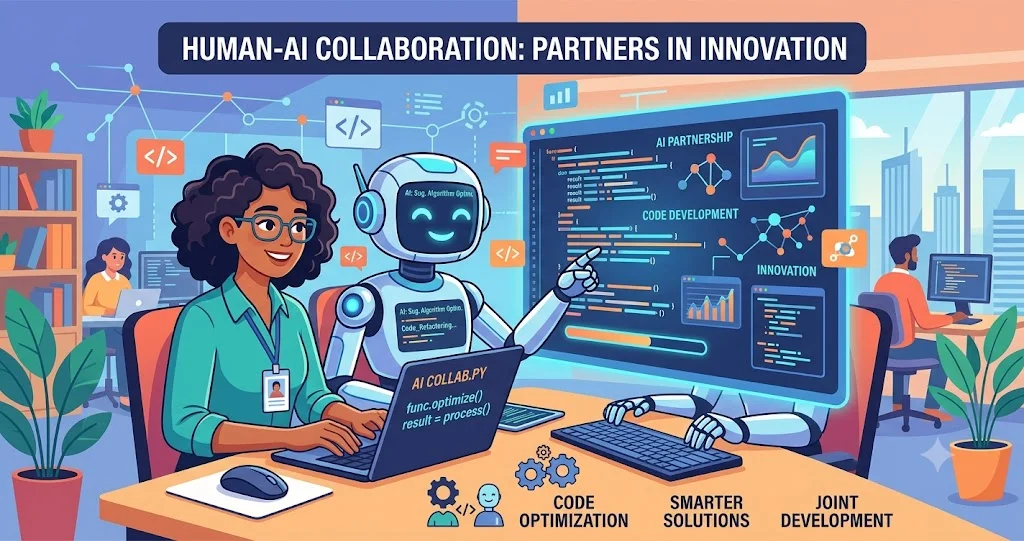
AI tools have become remarkably adept at writing code, generating solutions from natural language prompts, and even debugging simple programs. This has led to understandable concern among programmers about job security. However, the reality is more nuanced. While AI can automate certain coding tasks, it does not replace the full range of skills and expertise that experienced developers bring to the table. The future of programming is likely to be a partnership between human developers and AI, where each contributes its unique strengths. Understanding this dynamic is important for anyone working in or considering a career in software development.
What AI Can and Cannot Do in Programming
Understanding the capabilities and limitations of AI in programming is essential for assessing its impact. Here is a breakdown of what AI can and cannot do well.
- What AI Excels At: Generating boilerplate code, auto-completing functions, detecting bugs in simple code, converting between languages, generating routine tests, and providing code explanations.
- Where AI Struggles: Understanding complex business logic, designing large-scale architectures, debugging subtle or complex issues, making ethical decisions, understanding user context, maintaining legacy code systems, and creating novel algorithms.
- Why Human Programmers Are Still Essential: Programming involves much more than writing code. It involves problem-solving, system design, understanding user needs, making trade-offs, and ensuring security and reliability. These are areas where human judgment and experience are crucial.
How AI Is Transforming the Developer's Role
Rather than eliminating the need for programmers, AI is changing how developers work. The role is shifting from writing code manually to guiding and collaborating with AI tools.
- From Coder to Problem Solver: Developers will spend less time on routine coding and more time on high-level problem solving, system design, and strategic planning.
- From Code Writer to Code Reviewer: The focus will shift to reviewing, understanding, and refining AI-generated code rather than writing it from scratch.
- From Developer to AI Trainer: Programmers will be needed to train, fine-tune, and customize AI models for specific tasks and domains.
- Greater Emphasis on Soft Skills: As AI handles more technical tasks, skills like communication, collaboration, empathy, and understanding user needs become increasingly valuable.
Skills Developers Should Learn for the AI Era
To remain competitive and valuable in an AI-assisted world, developers should focus on developing these key skills and competencies.
- System and Architecture Design: Understanding how to design complex, scalable, and maintainable systems is a skill that AI cannot replicate.
- Algorithm Selection and Optimization: Knowing which algorithms to use for different problems and how to optimize them remains a highly valued human skill.
- Security Fundamentals: Ensuring code is secure from vulnerabilities requires a deep understanding that goes beyond what AI can reliably provide.
- Data Structures and Algorithms: A strong foundation in data structures and algorithms allows developers to think about problems abstractly and make informed choices.
- Domain-Specific Knowledge: Specializing in areas like healthcare, finance, or AI itself makes developers more valuable by combining technical skills with industry expertise.
- Communication and Collaboration: Working effectively with teams, stakeholders, and users requires strong communication and interpersonal skills.
- Problem-Solving and Critical Thinking: The ability to break down complex problems, evaluate trade-offs, and find creative solutions is a uniquely human strength.
- AI Literacy and Prompt Engineering: Understanding how AI works and crafting effective prompts for code generation is a new and important skill.
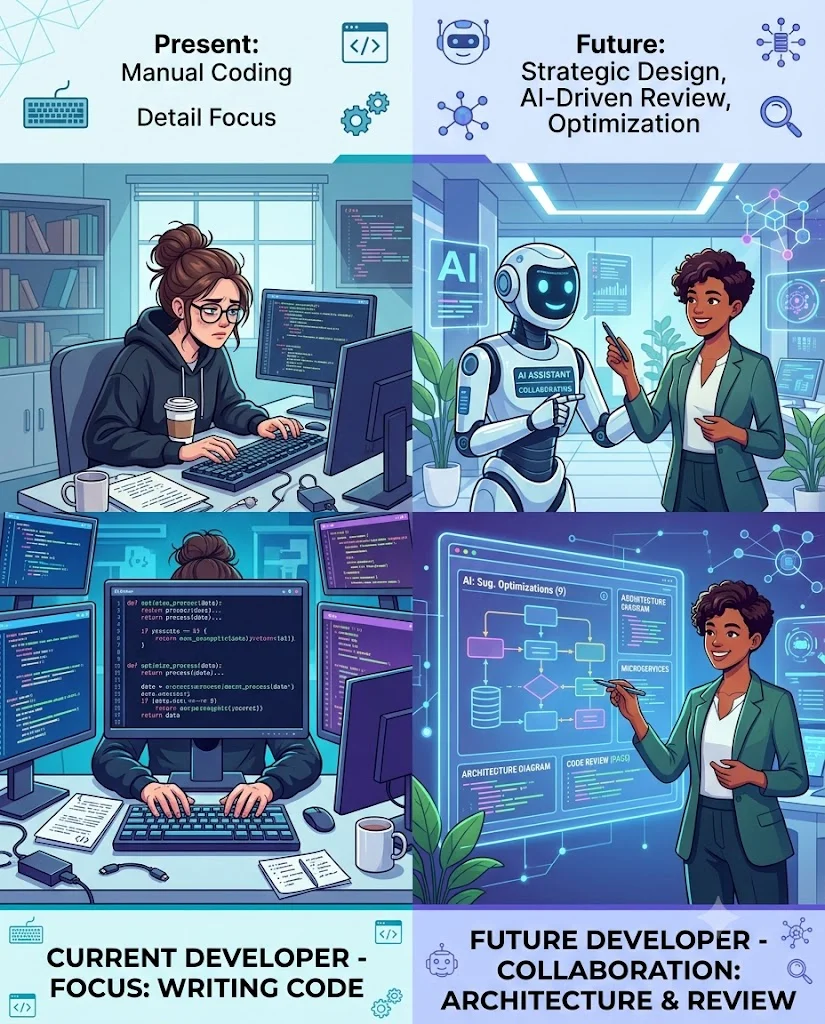
Comparison of Traditional Developer Skills and Future-Ready Skills
The following table compares the skills that have traditionally been valued in software development with the skills that will become more important in an AI-assisted future.
| Traditional Focus | Future-Ready Focus | Reason for Shift |
|---|---|---|
| Writing code efficiently | Reviewing and refining AI-generated code | AI handles routine code generation |
| Memorizing syntax | Understanding concepts and patterns | AI can generate syntax; human value is conceptual understanding |
| Building features quickly | Designing robust, scalable systems | AI speeds up implementation; human value is in architecture |
| Debugging simple issues | Debugging complex and subtle issues | AI is good at simple bugs; complex issues require human insight |
| Technical expertise alone | Combining technical and soft skills | Soft skills are harder to automate and increasingly valuable |
Checklist: Skills for an AI-Assisted Career
Use this checklist to assess and plan your skill development for an AI-assisted future in programming.
- Solidify core CS fundamentals: Data structures, algorithms, and system design.
- Develop expertise in a specific domain: Healthcare, finance, AI, or any specialized field.
- Enhance communication skills: Practice explaining technical concepts clearly and working collaboratively.
- Learn AI and ML basics: Understand how AI models work and how they can be applied.
- Practice prompt engineering: Learn to write effective prompts for code generation and other tasks.
- Focus on problem-solving: Practice complex algorithm and system design problems.
- Stay adaptable: Be ready to learn new tools and languages as technology evolves.
Tips for Integrating AI into Your Development Workflow
For developers looking to use AI effectively, these tips can help you integrate AI into your workflow while maintaining high-quality output.
- Start with Small Tasks: Begin by using AI for small, isolated tasks like generating boilerplate code or writing simple functions.
- Review Everything: Treat AI-generated code as a draft that requires thorough review, testing, and refinement.
- Use AI for Learning: Use AI to explain new concepts, find examples, and generate practice problems for learning.
- Maintain Security Awareness: Be extra cautious with AI-generated code that might contain vulnerabilities.
- Document Your Use of AI: Keep records of how you use AI in your work to ensure transparency and reproducibility.
Frequently Asked Questions About AI and Programming
Will AI replace programmers completely?
It is highly unlikely that AI will replace programmers entirely. While AI can automate some tasks, programming involves creativity, problem-solving, and collaboration that AI cannot replicate. The role of the programmer will evolve rather than disappear.
What programming languages are safest from AI?
No language is completely safe, but the value of a developer lies in their understanding of concepts and ability to solve problems, not their knowledge of a specific language. The same skills that make you a good developer are transferable across languages.
How can I use AI to become a better programmer?
Use AI for code suggestions, learning new concepts, generating boilerplate, and automating routine tasks. This frees your time for more complex problem-solving and learning.
Is prompt engineering an essential skill for developers?
Prompt engineering is becoming increasingly important. It involves crafting effective instructions for AI models to generate desired outputs, which helps developers leverage AI more effectively.
Should I learn AI and machine learning as a developer?
Understanding AI and ML fundamentals is valuable for any developer, as these technologies are increasingly embedded in applications and development tools. It also positions you well for future opportunities.
Will AI make coding less fun?
For many, AI can make coding more enjoyable by removing tedious tasks and allowing developers to focus on more creative and challenging aspects of their work.
How do I stay updated with AI developments?
Follow industry news, blogs, and podcasts. Attend conferences, join online communities, and take courses to continuously update your knowledge.
What is the best way to future-proof my career?
Focus on building deep expertise, continuous learning, and developing skills that are complementary to AI, such as creativity, communication, and complex problem-solving.
Conclusion
The question 'Can AI replace programmers?' is not a straightforward one. AI is unlikely to replace programmers entirely, but it will transform the nature of programming work significantly. The future of software development is likely to be a collaborative partnership between humans and AI, where developers leverage AI for routine tasks and focus on the higher-level problem-solving and creative aspects of development. To thrive in this new landscape, developers should cultivate skills that are difficult to automate: system design, complex problem-solving, algorithm selection, security, communication, and collaboration. By embracing AI as a tool and focusing on these uniquely human skills, developers can ensure they remain essential and valuable in the evolving tech industry.