

The phrase best open-source AI models in 2026 sounds like it should produce a simple ranking. It does not. A model that is attractive for local development may be impractical for a production cluster, while a very large reasoning model may be unnecessary for a small application.
The bigger issue is that "open-source" and "open-weight" are often used interchangeably even though they do not mean exactly the same thing. That distinction becomes especially important when licensing, commercial redistribution, fine-tuning, and reproducibility matter.
What counts as an open-source AI model?
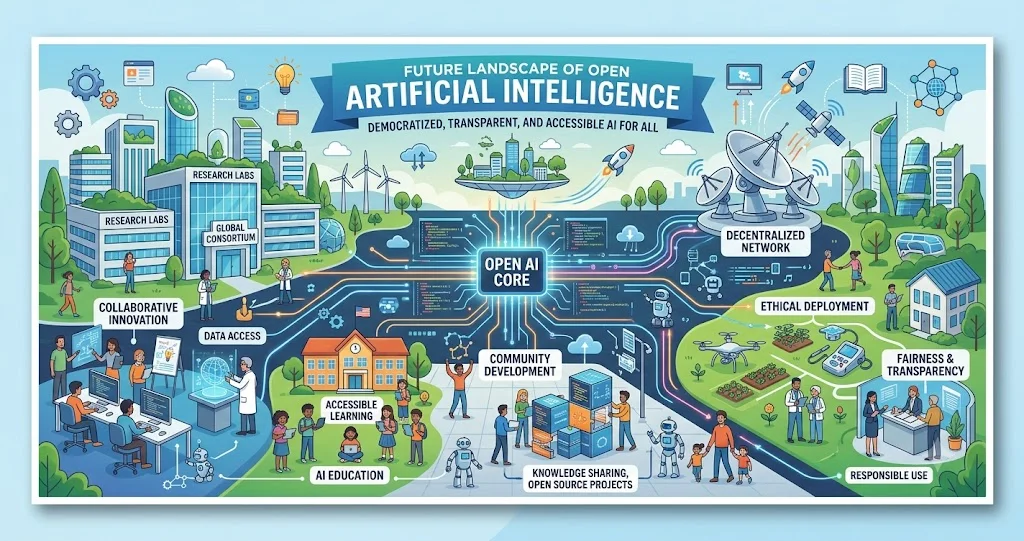
An open-weight model generally makes trained model parameters available so developers can download, run, fine-tune, or otherwise use the model subject to its license. An open-source model can imply a broader level of openness around the model's code, training materials, datasets, and reproducibility.
These categories overlap, but they are not identical. For example, Meta describes Llama 4 as open-weight, while its model repository is governed by the Llama 4 Community License rather than a standard permissive license such as MIT or Apache 2.0.
By contrast, Qwen3 models such as Qwen3-235B-A22B are published under Apache 2.0, while DeepSeek-V4-Pro is released under MIT.
For this reason, this article uses open-source AI models in the broad search sense, while identifying the actual openness and license of individual models wherever it matters.
Best open and open-weight AI models in 2026
| Model | Best suited for | Openness / license | Key capability | Deployment profile |
|---|---|---|---|---|
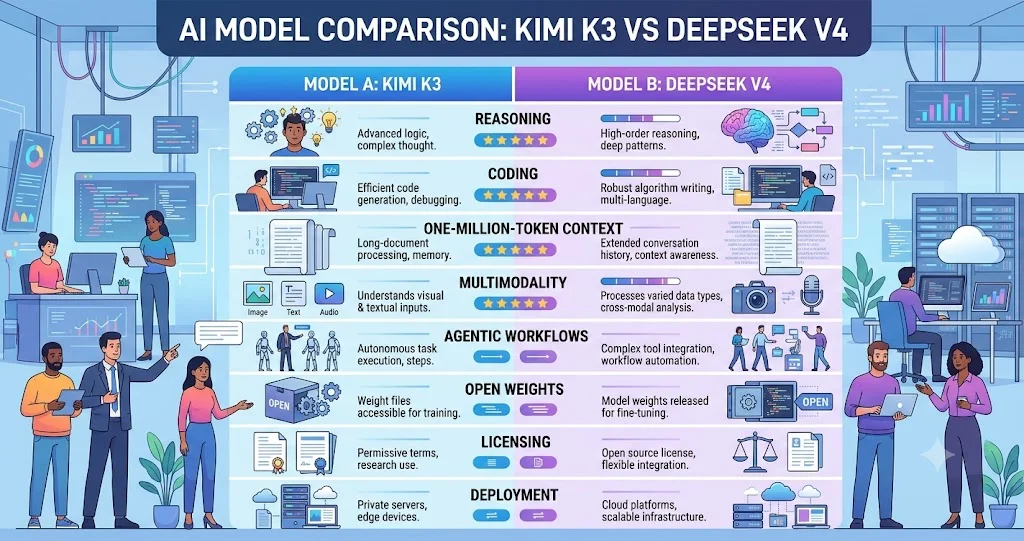
| DeepSeek-V4 | Reasoning, coding, long-context agents | MIT | Million-token context; large MoE architecture | High-end multi-GPU infrastructure |
| Qwen3.8-27B | General applications and multimodal workloads | Apache 2.0 | Text and image understanding | More practical than frontier-scale models |
| GLM-5.2 | Reasoning, coding, multilingual applications | MIT | Large-scale reasoning model | High-end infrastructure |
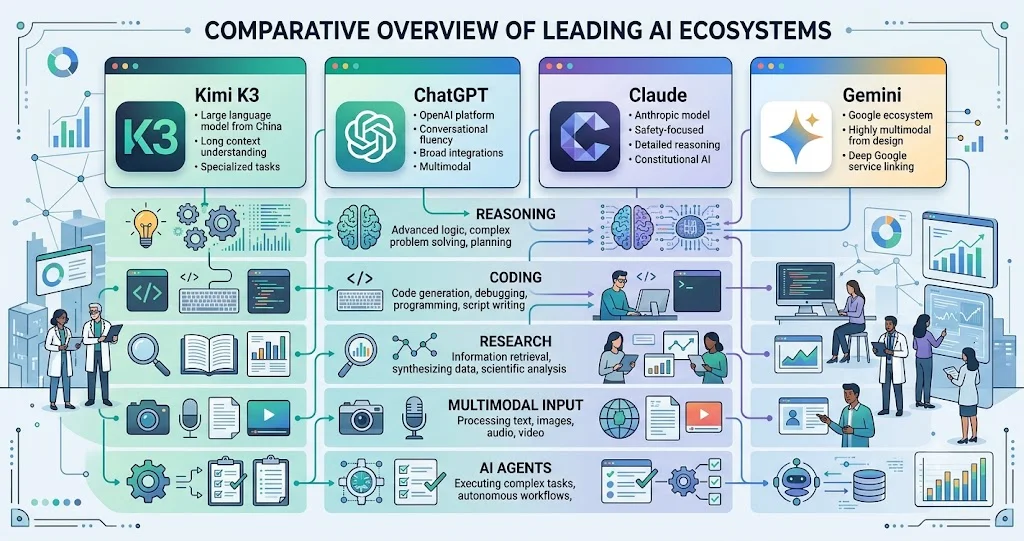
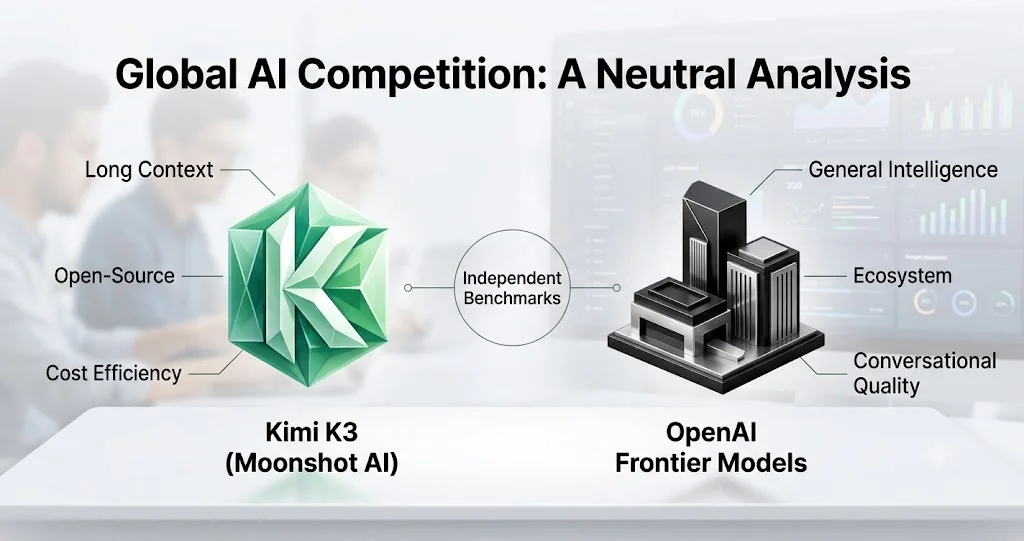
| Kimi K3 | Agentic and multimodal applications | Custom Kimi K3 license | Native multimodal agent capabilities | Large-model deployment |
| Mistral Small 4 | Coding, reasoning, multimodal assistants | Apache 2.0 | Unified instruct, reasoning, coding and vision | Designed for comparatively efficient deployment |
| gpt-oss-120b / 20b | Reasoning and tool-using agents | Apache 2.0 | Configurable reasoning and agentic tool use | 20B is more accessible; 120B targets H100-class hardware |
| Gemma 3 | Local multimodal applications | Google Gemma terms | Text and image input; up to 128K context | Small sizes suitable for local hardware |
| Llama 4 Scout / Maverick | Multimodal applications and long context | Llama 4 Community License | Native multimodal MoE models | Scout is substantially more accessible than Maverick |
| OLMo 3 | Research, reasoning and transparent experimentation | Apache 2.0 | Open training artifacts and reasoning variants | 7B and 32B family |
1. DeepSeek-V4: a strong choice for reasoning and long-context work
DeepSeek-V4 is one of the most significant open releases of 2026. Hugging Face describes two released checkpoints: DeepSeek-V4-Pro at 1.6 trillion total parameters with 49 billion active parameters and DeepSeek-V4-Flash at 284 billion total parameters with 13 billion active parameters. Both support a 1 million-token context window.
The official DeepSeek-V4-Pro model repository lists the model and weights under the MIT License. The repository also provides instructions for local deployment and recommends a context window of at least 384K tokens for its Think Max reasoning mode.
Why it stands out: its design is particularly relevant to applications that need very long context, large codebases, multi-document reasoning, or agent workflows. The model's scale also means that "open" does not mean easy to run on an ordinary desktop.
Best use cases
- Long-context coding assistants
- Research and document analysis
- Agentic workflows
- Complex reasoning tasks
- Large-scale private inference
Main limitation: the hardware requirements are substantial for the full-size models. A permissive license does not remove the compute cost of inference.
2. Qwen3.8-27B: a practical multimodal option
Qwen has become one of the most influential model families in the open ecosystem. Hugging Face's August 2026 analysis found that Qwen-based models accounted for a very large share of downstream derivatives and described Qwen as a major community base model.
The Qwen3.8-27B model currently listed on Hugging Face uses an Apache 2.0 license and supports image-text input. This makes the 27B model particularly interesting for developers who want a capable multimodal model without jumping directly to trillion-parameter infrastructure.
Earlier Qwen3 releases also established a broad family strategy. Qwen3 included dense models from 0.6B through 32B and MoE models including 30B-A3B and 235B-A22B, with Apache 2.0 licensing for the released Qwen3 dense models.
Why it stands out: Qwen's combination of model-size variety, multilingual support, coding capability, community derivatives, and permissive licensing makes it one of the more practical families to evaluate before committing to a single model.
3. GLM-5.2: a large reasoning and coding model
GLM-5.2 is another significant 2026 open model. Its current Hugging Face repository lists the model under the MIT License and provides deployment instructions compatible with common inference tooling.
Its scale is considerable: the repository currently contains 282 model shards, making it a model for serious inference infrastructure rather than a typical laptop deployment.
For developers, the important distinction is therefore between capability and accessibility. GLM-5.2 may be attractive for organizations with substantial compute, while a smaller model may produce a better overall engineering result for a constrained application.
4. Kimi K3: native multimodal agentic capabilities
Kimi K3 is described by Moonshot AI as an open-weight, native multimodal agentic model. Its Hugging Face repository provides the model, configuration, and implementation files for local deployment.
Its license is a custom Kimi K3 license rather than MIT or Apache 2.0. The license grants broad rights to use, modify, distribute, sublicense, sell, deploy, fine-tune, and create derivatives, subject to its stated conditions.
This makes Kimi K3 a good example of why developers should inspect the actual license instead of assuming that every model described as open-weight has the same legal terms.
5. Mistral Small 4: efficient multimodal, reasoning, and coding
Mistral Small 4 was announced in March 2026 as a hybrid model that combines capabilities associated with Mistral's reasoning, multimodal, and agentic coding model families. Mistral says it supports general chat, coding, agentic tasks, complex reasoning, and text-and-image inputs. It is released under Apache 2.0.
This positioning makes Mistral Small 4 particularly interesting for developers who do not want separate models for ordinary instruction following, reasoning, coding, and vision.
Mistral's current model catalog also lists Mistral Small 4 as an Apache 2.0 model and places it alongside larger open models such as Mistral Large 3 and smaller Ministral 3 variants.
Best use cases
- Developer assistants
- Multimodal business applications
- Agentic workflows
- Private inference
- Applications requiring a balance between capability and deployment cost
6. gpt-oss: OpenAI's open-weight reasoning models
OpenAI released gpt-oss-120b and gpt-oss-20b in August 2025 under Apache 2.0. OpenAI describes them as open-weight reasoning models designed for local or controlled infrastructure, with strong instruction following, tool use, reasoning, and agentic workflows.
The current OpenAI documentation states that gpt-oss-120b is designed to fit into a single H100 GPU and has 117 billion parameters with 5.1 billion active parameters. It supports configurable reasoning effort, fine-tuning, function calling, web browsing, Python execution, and structured outputs.
The 20B model is the more approachable member of the family for developers with more limited infrastructure. Both are text-only, so they should not be selected simply because they come from OpenAI if an application requires native image understanding.
7. Gemma 3: a strong option for smaller local deployments
Google describes Gemma 3 as a family of lightweight open models with open weights. The models accept text and image inputs, support more than 140 languages, and provide up to a 128K context window on the 4B, 12B, and 27B sizes. Google also specifically describes Gemma 3 as suitable for laptops, desktops, and private cloud infrastructure.
That makes Gemma 3 useful when the primary requirement is not maximum benchmark performance but a practical model that can operate closer to the edge or inside a developer-controlled environment.
However, Google uses its own Gemma Terms of Use rather than simply applying MIT or Apache 2.0. Teams planning commercial redistribution should therefore review the applicable terms before deployment.
8. Llama 4: a major multimodal ecosystem
Meta's Llama 4 family includes Scout and Maverick, both native multimodal mixture-of-experts models. Meta reports that Scout has 17 billion active parameters and 109 billion total parameters, while Maverick has 17 billion active parameters and 400 billion total parameters. Meta also reports a 10-million-token context window for Scout.
Meta says Scout can fit on a single H100 GPU when using Int4 quantization, while Maverick is designed for a single H100 host.
The important licensing caveat is that Llama 4 uses Meta's Llama 4 Community License. The Hugging Face model card includes additional conditions, including attribution requirements and special commercial terms for organizations above the specified user threshold.
Llama therefore remains highly relevant, but it should not automatically be described as equivalent to an MIT- or Apache-licensed model.
9. OLMo 3: particularly interesting for research transparency
OLMo 3 from Ai2 takes a different approach. Its model family includes 7B and 32B models with Instruct and Think variants. Ai2 states that it releases code, checkpoints, and associated training details, with the model repositories using Apache 2.0.
That broader research transparency makes OLMo especially relevant to researchers and teams interested in understanding or reproducing more of the model-development process rather than simply downloading weights.
The 32B Think model is substantial enough to require meaningful compute, but its size is much more approachable than trillion-parameter frontier models. The model card also cautions that generated statements can be inaccurate and should be verified.
How the models compare by use case
| Use case | Models worth evaluating | Why |
|---|---|---|
| Local AI development | Gemma 3, Qwen3.8-27B, Mistral Small 4 | Smaller or more deployment-oriented options |
| Advanced reasoning | DeepSeek-V4, gpt-oss, GLM-5.2 | Designed around reasoning-heavy workloads |
| Coding | DeepSeek-V4, Mistral Small 4, Qwen family, gpt-oss | Strong emphasis on coding, tools, or agent workflows |
| Multimodal applications | Qwen3.8-27B, Mistral Small 4, Gemma 3, Llama 4, Kimi K3 | Native image or multimodal capabilities |
| Long-context applications | DeepSeek-V4, Llama 4 Scout | Very large context capabilities |
| Research transparency | OLMo 3 | Broader release of training-related artifacts |
| Permissive licensing | DeepSeek-V4, GLM-5.2, gpt-oss, Qwen3.8-27B, Mistral Small 4 | MIT or Apache 2.0 model repositories, subject to each project's complete terms |
Open-source vs open-weight: why licensing matters
One of the easiest mistakes when comparing AI models is to treat the word "open" as a legal category. It is not.
For example, DeepSeek-V4-Pro is MIT licensed, GLM-5.2 is MIT licensed, Mistral Small 4 is Apache 2.0, Qwen3.8-27B is Apache 2.0, and gpt-oss is Apache 2.0.
Llama 4 instead uses Meta's custom Community License, Gemma uses Google's Gemma terms, and Kimi K3 has its own license.
Before using a model commercially, check at least:
- Whether commercial use is permitted.
- Whether redistribution is permitted.
- Whether fine-tuning and derivative models are covered.
- Whether attribution is required.
- Whether additional terms apply above a particular usage threshold.
- Whether the license applies to weights, code, datasets, or only particular components.
Hardware requirements: model size is only part of the story
Parameter count is useful for understanding the rough scale of a model, but it does not directly tell you exactly how much hardware an inference deployment will require. Quantization, precision, context length, batch size, architecture, active parameters, KV-cache requirements, and serving software all affect memory and performance.
Mixture-of-experts models make this particularly important. A model may have hundreds of billions or even trillions of total parameters while activating only a smaller subset for each token. DeepSeek-V4-Pro, for example, is listed at 1.6T total parameters and 49B active parameters.
For a first local experiment, a smaller model such as Gemma 3, Qwen3.8-27B, or a smaller Mistral variant may be more useful than choosing the model with the largest parameter count.
How to choose the best open model for your project
Choose based on the workload first
Start with the task rather than the model leaderboard. Decide whether the application needs coding, reasoning, image understanding, multilingual support, long context, tool calling, structured output, or simple text generation.
Check the license before building around it
If commercial redistribution or fine-tuning is important, put the license near the beginning of the evaluation rather than treating it as a legal detail to check later.
Estimate the actual hardware budget
Determine whether the model needs a laptop, workstation GPU, single data-center GPU, multiple GPUs, or hosted infrastructure. The model's published size and inference documentation provide a starting point, but actual requirements should be tested with your expected context and workload.
Test your own tasks
Published benchmarks can help narrow the field, but they should not be treated as a universal ranking. A model that scores well on mathematics may not be the best model for your codebase, language mix, documents, or tool-calling workflow.
Evaluate the ecosystem
Check support for inference frameworks, quantization, model-serving systems, fine-tuning libraries, monitoring, and community-maintained integrations. Hugging Face's 2026 ecosystem analysis highlights how important derivatives, quantization, and local inference tooling have become to open-model adoption.
What changed in the open-model ecosystem in 2026?
One major trend is the movement toward very large mixture-of-experts models alongside increasingly capable smaller models. Hugging Face's summer 2026 analysis describes a widening frontier in which several Chinese laboratories released models far above the parameter scale of many U.S. open-model releases, while Qwen continued to maintain a broad range of model sizes.
Another trend is that small models remain important in actual usage. The same analysis found that models below 1B parameters account for a very large share of historical downloads, while models above 100B represent a much smaller portion of download volume. This does not mean small models are universally better; it illustrates that hardware accessibility strongly influences adoption.
There is also increasing attention on the infrastructure surrounding models. Quantization formats, inference engines, hardware-specific optimizations, and deployment frameworks can be as important to a developer as the original model weights.
Common mistakes when selecting an open AI model
Calling every model open source
Check the actual license and what artifacts have been released. "Open-weight" is often the more accurate description for models where weights are available but the full training process is not reproducible.
Choosing by benchmark score alone
Benchmarks are useful evidence, not a substitute for testing the actual workload. A model's performance can change significantly depending on prompting, context length, quantization, tool integration, and evaluation methodology.
Ignoring deployment complexity
A model can be freely downloadable and still be expensive or technically difficult to operate. Compute, storage, networking, cooling, inference software, and engineering time all matter.
Ignoring license changes
Model families can release different variants under different terms. Always check the license attached to the exact model version you plan to deploy rather than relying on a family-level assumption.
Is there one best open-source AI model in 2026?
No. The current ecosystem is too diverse for a single model to be the best choice for every workload.
DeepSeek-V4 is particularly interesting for very long-context and advanced reasoning workloads. Qwen3.8-27B is a compelling option for developers seeking a comparatively practical multimodal model with Apache 2.0 licensing. Mistral Small 4 is designed around a useful combination of reasoning, coding, agentic work, and vision. gpt-oss is notable for open-weight reasoning and tool use under Apache 2.0. Gemma 3 is attractive when local deployment and smaller model sizes matter. Llama 4 remains an important multimodal ecosystem, while OLMo 3 is particularly relevant to researchers who value broader transparency around model development.
The right choice depends on the intersection of capability, license, hardware, workload, ecosystem, and operational requirements. That is a more useful selection framework than a simple first-to-last ranking.
Frequently asked questions
What is the best open-source AI model in 2026?
There is no universal winner. DeepSeek-V4, Qwen3.8, Mistral Small 4, gpt-oss, GLM-5.2, Gemma 3, Llama 4, Kimi K3, and OLMo 3 serve different deployment and capability requirements.
Is DeepSeek-V4 open source?
DeepSeek-V4-Pro and DeepSeek-V4-Flash are available with their repository and model weights under the MIT License. They are also available for local deployment, although their large scale makes infrastructure requirements significant.
Is Qwen3.8-27B open source?
The Qwen3.8-27B repository currently lists an Apache 2.0 license and supports image-text input. As with any model, developers should review the license and documentation for the exact version they deploy.
Which open model is best for coding?
There is no single answer. DeepSeek-V4, Qwen-family models, Mistral Small 4, gpt-oss, and GLM-family models are all worth evaluating for coding, but the best choice depends on repository size, languages, tool use, context requirements, latency, and available hardware.
Which open AI model is easiest to run locally?
Smaller models are generally more practical for local deployment. Gemma 3 explicitly targets environments including laptops and desktops, while Qwen and Mistral also provide smaller model variants.
Are open-weight models free for commercial use?
Not automatically. Some models use permissive licenses such as MIT or Apache 2.0, while others use custom licenses with additional conditions. Commercial users should review the license for the exact model and version before deployment.
Conclusion
The best open-source AI model in 2026 is not necessarily the largest, newest, or highest-scoring model. The better choice is the model that fits the application's workload, hardware, licensing requirements, and operational constraints.
The current ecosystem offers unusually broad options: very large reasoning models such as DeepSeek-V4, multimodal families such as Qwen and Llama, efficient models such as Mistral Small 4 and Gemma 3, agent-oriented reasoning models such as gpt-oss, and research-focused releases such as OLMo 3.
For a serious evaluation, shortlist two or three models, verify their current licenses, run them against representative tasks, measure latency and resource consumption, and then compare the results with the cost and complexity of operating them. That process will usually produce a more reliable decision than any universal "best model" ranking.