

If you are a developer in 2026, the question is no longer whether to use an AI coding assistant—it is which one to use. According to the 2025 Stack Overflow Developer Survey, 84% of developers use or plan to use AI tools, and 51% use them daily.
But the category has fractured. "AI coding assistant" now covers IDE plugins, full forks of VS Code, terminal agents, open-source bring-your-own-key tools, and enterprise platforms. They are not interchangeable, and the pricing models drift every quarter.
This guide compares the leading AI coding assistants in 2026 focused on developer workflow: autocomplete, code explanation, debugging, refactoring, test generation, terminal assistance, repository context, supported environments, and collaboration. The goal is not to declare a single winner—the right choice depends on how you work and what you are building.
AI Coding Assistant Capabilities: What Matters for Developers
Before comparing specific tools, it helps to understand the core capabilities that matter in daily developer workflow.
Autocomplete and Inline Suggestions
Autocomplete is the most-used AI coding feature. It predicts your next edit, completing lines, functions, or blocks as you type. The best autocomplete tools feel like an extension of your typing, not a distraction.
Code Explanation and Understanding
AI can explain unfamiliar code, summarize functions, and help you understand legacy codebases. This is particularly valuable when onboarding to new projects or working with code you didn't write.
Debugging and Error Resolution
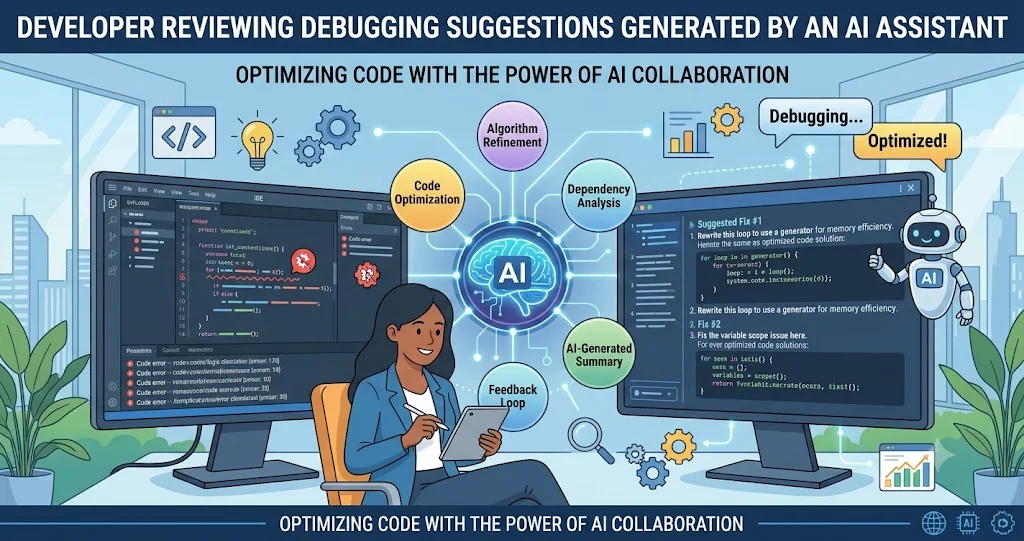
AI assistants can analyze error messages, suggest fixes, and explain why bugs occur. The best tools work with your debugger and terminal output to provide actionable insights.
Refactoring and Code Improvements
AI can suggest code improvements, optimize performance, and handle large-scale refactoring across multiple files. This is where agentic capabilities shine—the tool understands the entire codebase and makes coordinated changes.
Test Generation
AI can generate unit tests, integration tests, and test suites based on your code. This accelerates development and helps maintain test coverage.
Terminal Assistance
Some tools can read terminal output, suggest commands, and even execute them autonomously. This is particularly useful for build processes, deployment, and infrastructure tasks.
Repository Context
The best tools understand your entire codebase, not just the file you're editing. They use embeddings or cross-file analysis to provide context-aware suggestions across your project.
Supported Environments
Consider whether the tool works in your preferred IDE or editor, supports your programming languages, and integrates with your existing workflow.
Collaboration and Team Features
For teams, features like shared context, inline reviews, and integration with version control matter as much as individual productivity.
The 2026 Reality: Backing Models Have Converged
In late 2024 and through 2025, the "best AI coding assistant" question had a clean answer: whichever wrapped the latest Claude model. That changed in 2026 because all major tools now offer Claude as a backing model option.
- GitHub Copilot Pro+ ($39/mo) unlocks Claude Opus 4.7 alongside GPT-4o and Gemini 2.5 Pro
- Cursor Pro ($20/mo) includes GPT-5.4, Claude Opus 4.6, Claude Sonnet 4.6, Gemini 3 Pro, and Grok Code
- Claude Code runs Claude Opus and Claude Sonnet natively
Cursor, GitHub Copilot, and Claude Code all expose the same backing models under their respective UIs, so the model choice is no longer the differentiator. The workflow shell is.
AI Coding Assistants at a Glance
| Tool | Format | Best For | Free Tier | Paid Entry | Model Access | Notable Feature |
|---|---|---|---|---|---|---|
| Cursor | Fork of VS Code | Daily IDE work with deep AI | Yes (Hobby) | $20/mo Pro | OpenAI, Claude, Gemini | Composer for multi-file edits |
| GitHub Copilot | IDE extension | Teams already on GitHub | Yes | $10/mo Pro | OpenAI, Anthropic, Google | Native GitHub PR and issue integration |
| Claude Code | Terminal CLI | Multi-file refactors and codebase work | No | $20/mo Pro | Claude (Sonnet, Opus) | Project-level autonomy |
| Codeium/Windsurf | Fork of VS Code | Agentic editor with codemaps | Yes | $15/mo Pro | Multiple, plus SWE-1.5 | Cascade agent, AI-annotated code maps |
| Sourcegraph Cody | IDE plug-in | Large multi-repo codebases | No (since 2025) | Enterprise from ~$16K | Claude, GPT-4o | Cross-repo retrieval |
| Cline | VS Code agent (open-source) | Vendor independence and local models | Yes (BYO key) | API costs only | Anthropic, OpenAI, Gemini, local | Plan/Act mode, BYO API key |
Detailed Tool Comparisons
Cursor: The AI-Native IDE
Cursor is a fork of Visual Studio Code, so your extensions, keybindings, and settings carry over. It is an editor you open and work inside, keeping a human in the loop by default.
Key features: Tab completion predicts your next edit and lets you accept it with a keystroke. Inline diffs show proposed changes in context. Composer enables multi-file edits with a chat-like interface. Cursor also gives you model choice across Claude, GPT, and Gemini.
For developers: Cursor is best for day-to-day coding where you want deep AI integration without switching editors. The workflow is edit-first—you think in edits, moving cursor to cursor and shaping code as you read it.
Pricing (2026): Hobby (Free), Pro ($20/mo), Pro+ ($60/mo for about 3x usage), Ultra ($200/mo for about 20x), Teams starting near $40/user/mo. Cursor also launched a ₹649/mo India-specific tier (Cursor Start) with access to Composer 2.5, Grok 4.5, cloud agents, and MCP support.
GitHub Copilot: The Plugin Powerhouse
GitHub Copilot has surpassed 20 million users, with roughly 4.7 million on paid plans, making it the most widely adopted AI coding assistant. Its deep integration with GitHub and VS Code makes it the default choice for many developers.
Key features: Inline completions, conversational chat panel, multi-file editing, and an autonomous agent mode. The Copilot CLI now includes a Sessions sidebar, /worktree command for isolated workspaces, and /rewind for restoring conversations. Kimi K3, an open-weight model, is now generally available in Copilot.
For developers: Copilot is best for developers already on GitHub who want AI deeply integrated into their existing workflow. The plugin model means lower onboarding cost than switching to a new IDE.
Pricing (June 2026): GitHub restructured Copilot's pricing around an AI credits system. One credit = $0.01, and code completions remain unlimited on paid plans.
- Free: 2,000 completions and 50 chat requests per month
- Pro ($10/mo): $15 in AI credits
- Pro+ ($39/mo): $70 in AI credits
- Max ($100/mo): $200 in AI credits
All Copilot plans moved to usage-based AI Credits billing on June 1, 2026.
Claude Code: The Terminal Agent
Claude Code runs in your terminal as an agent you hand a task to. It optimizes for autonomous execution—you describe an outcome, and the agent reads your project, plans an approach, edits across files, and runs commands with less supervision at each step.
Key features: Direct terminal execution in your local environment, granular per-tool permission prompts, CLAUDE.md configuration for project-specific behavior, a skills marketplace, and MCP support. Dynamic workflows let Claude break a task into multiple subtasks and run them through tens to hundreds of parallel subagents within a single session. The ultracode setting automatically decides when to use a workflow. Claude Code on desktop now includes a built-in browser.
For developers: Claude Code is best for large-scale refactoring, codebase-wide reasoning, and tasks that require autonomy. The workflow is task-first—you think in tasks, writing a clear instruction and trusting the agent to carry it out before you inspect the diff.
Benchmark performance: Claude Fable 5 scores 95.0% on SWE-bench Verified and 80.3% on SWE-bench Pro—the highest here. Claude Opus 4.8 scores 88.6% on SWE-bench Verified and 74.6% on Terminal-Bench 2.1.
Pricing (2026): Pro ($20/mo, $17/mo billed annually); Max runs from $100/mo. Claude Opus 5 is the default since July 24, 2026: $5 / $25 per 1M tokens, with a 1M-token context window.
Codeium / Windsurf: The Value Player
Windsurf is a standalone AI IDE developed by Codeium. It combines copilot-style code completion with agentic multi-file editing capabilities.
Key features: Cascade flows for agentic but guided multi-file editing, Supercomplete (context-aware completion predicting your next moves), and local indexing for private codebase search. Codeium offers unlimited AI autocomplete on the free individual plan, in-editor chat, codebase-aware context, and support for 70+ languages and 40+ IDEs.
For developers: Windsurf is best for developers who want an AI-powered editor with a familiar VS Code-like interface and visual feedback, at a lower price point than Cursor.
Pricing (2026): Free tier with unlimited completions. Pro at $15/mo. If GitHub Copilot's 2,000 completions/month limit annoys you, Codeium's free tier is unlimited.
Sourcegraph Cody: The Enterprise Choice
Cody is an enterprise-grade AI coding assistant developed by Sourcegraph that leverages a comprehensive "Code Graph" to provide deep, context-aware assistance across entire multi-repo codebases.
Key features: Deepest codebase context in the AI coding category. Supports autonomous multi-repository reasoning, semantic context retrieval via MCP 3.1 / FastMCP 3.1, and native execution with frontier models such as Claude 5.1 and GPT-5.5. Platform bundle includes Deep Search, Batch Changes, and Insights.
For developers: Cody is best for developers working in large enterprises with massive, multi-repository codebases. Not suitable for individual developers or small teams—enterprise pricing starts around $16K.
Amazon Q Developer: The AWS-Native Agent
Amazon Q Developer is Amazon's AI-powered coding assistant and the direct successor to AWS CodeWhisperer. It adds autonomous agents, conversational AI for AWS resource usage, and console error diagnostics.
Key features: Deep AWS service awareness that general-purpose coding tools cannot match—Q understands IAM policies, Lambda patterns, CloudFormation, and the specific API shapes of every major AWS service. It supports agentic coding (auto-generating features, refactors), cloud-aware chat, AWS CLI command generation, built-in security scans, and license-aware completions. Free tier includes the latest Claude models and 50 agentic requests per month across IDE and CLI.
For developers: Q is best for development teams building on AWS who need an AI assistant that deeply understands AWS services, IAM, and cloud infrastructure patterns.
Pricing (2026): $19/user/month.
Google Antigravity: The Agent-First IDE
Google Antigravity 2.0, announced at I/O 2026, is a full developer platform with a revamped desktop app, a new CLI built in Go, and an SDK for custom agents.
Key features: Dynamic subagents for parallelized workflows, scheduled tasks for background automation, native voice command support, and ecosystem integrations across Google AI Studio, Android, and Firebase. The desktop app lets developers talk to their agents rather than type. Antigravity defaults to Gemini 3.5 Flash and is free in public preview for individuals.
For developers: Antigravity is best for developers who want a zero-entry-cost agent-first IDE with tight Google ecosystem integration.
Open-Source Options
For developers who value model freedom, transparency, and cost control, several open-source options are worth considering.
Cline: The OG VS Code Agent
Cline is the most popular open-source AI coding extension with 5M+ installs, 58K+ GitHub stars, and support for every major LLM. It creates and edits files, runs terminal commands, controls the browser, and supports MCP—all step-by-step with your permission. Cline pioneered MCP and Plan/Act workflows.
For developers: Cline is best for developers who want an open-source, transparent agent with the ability to bring your own model (BYOK). The Plan/Act workflow gives you granular control over what the agent does.
Pricing: Free and open-source. You pay only for the model tokens you route through it.
Aider: The Git-Native Terminal Tool
Aider is an open-source terminal-based AI pair programming tool that edits code directly in your local git repository. Every change becomes a discrete Git commit. It supports 100+ LLMs, 100+ code languages, and integrates with vim/tmux/ssh workflows.
For developers: Aider is best for developers who live in the terminal, use vim or neovim, and want Git-native AI assistance.
Pricing: Free and open-source under Apache 2.0. You pay only for model tokens.
OpenCode: The Model-Agnostic Alternative
OpenCode is the most-used open-source coding agent in the world, with over 160,000 GitHub stars and roughly 7.5 million monthly developers by mid-2026. It connects to 75+ model providers. OpenCode was catalyzed by Anthropic's January 2026 attempt to block third-party Claude access, making it a response to vendor lock-in.
For developers: OpenCode is best for developers who want maximum model choice and freedom from vendor lock-in. It works with 75+ model providers.
Pricing: Free and open-source. You pay only for the model tokens you route through it.
OpenAI Codex CLI
OpenAI Codex is open-source under Apache-2.0 with 105,310 GitHub stars. It runs in the terminal, IDE, and cloud with network-isolated task sandboxes, making it strong for security-sensitive work. GPT-5.6 Sol defaults and leads Terminal-Bench 2.1 at 89.5% (xhigh effort).
For developers: Codex CLI is best for developers who want an open-source agent with strong security isolation.
Pricing: Bundled with ChatGPT plans from $0 (limited) to $20/mo Plus.
Benchmarks: SWE-bench Verified
SWE-bench Verified gives a model a real GitHub issue plus a Python codebase and asks it to write a patch that fixes the bug without breaking existing tests. The 2026 Verified leaderboard shows the Claude family at 88-95%, while SWE-bench Pro (harder, unseen tasks) drops top scores to ~45-50%.
Claude Opus 4.8 leads SWE-bench Verified at 88.6%, while GPT-5.5 leads Terminal-Bench 2.0 at 82.7%. Claude Fable 5 scores 95.0% SWE-bench Verified and 80.3% SWE-bench Pro—the highest. GPT-5.6 Sol leads Terminal-Bench 2.1 at 89.5% (xhigh effort).
The methodological caveat: SWE-bench scores are a useful signal, but they are not a complete picture of real-world performance. The best tool for you depends on your workflow, not just the benchmark score.
How to Choose: A Decision Framework
The right choice depends on workflow more than on any single benchmark. Most teams end up combining an IDE assistant for daily work with a terminal agent for big refactors.
Choose Cursor if: You want a familiar VS Code experience with deep AI integration, model choice, and a fast, visual editing loop. The workflow is edit-first.
Choose GitHub Copilot if: Your team is already on GitHub and you want AI deeply integrated into your existing workflow. The plugin model means lower onboarding cost.
Choose Claude Code if: You need autonomous multi-file refactoring and codebase-wide reasoning. The workflow is task-first—you hand off a task and review the result.
Choose Codeium/Windsurf if: You want an AI-powered editor at a lower price point, or you need unlimited free completions.
Choose Sourcegraph Cody if: You are in a large enterprise with massive, multi-repository codebases and need deep cross-repo context.
Choose Amazon Q Developer if: You are building on AWS and need deep cloud service awareness.
Choose Google Antigravity if: You want a free, agent-first IDE with Google ecosystem integration.
Choose open-source (Cline, Aider, OpenCode) if: You value model freedom, transparency, cost control, and are willing to manage your own API keys.
The Hybrid Pattern
Most working developers settle into a hybrid pattern: run Cursor or Copilot for editor work, Claude Code for CLI refactoring, and a chat UI for learning, with a total monthly cost around $30-60.
This reflects the reality that different tools excel at different tasks. The agentic depth spectrum—from inline autocomplete to multi-file edits to autonomous task completion—is the defining change of 2025-2026. The shift from "complete this line" to "complete this ticket" is what separates the tools.
Frequently Asked Questions
What is the best AI coding assistant for developers in 2026?
There is no single best tool—it depends on your workflow. Cursor is best for daily IDE work, Claude Code for autonomous refactoring, GitHub Copilot for GitHub-integrated teams, and open-source tools for model freedom. Most developers use a hybrid of two or more tools.
How much do AI coding assistants cost in 2026?
Pricing varies widely. Cursor Pro is $20/mo, GitHub Copilot Pro is $10/mo (with usage-based credits), Claude Code Pro is $20/mo, and Codeium/Windsurf Pro is $15/mo. Open-source tools like Cline, Aider, and OpenCode are free—you pay only for model tokens.
What is the difference between Cursor and Claude Code?
Cursor is an AI-native IDE (fork of VS Code) that keeps a human in the loop by default—you watch suggestions appear and accept or reject inline diffs. Claude Code is a terminal agent you hand a task to—it reads your project, plans an approach, edits across files, and runs commands with less supervision at each step.
Is GitHub Copilot still worth it in 2026?
Yes—Copilot has surpassed 20 million users and offers deep GitHub integration. However, the June 2026 move to usage-based pricing means costs can scale with heavy agentic use. The Free tier offers 2,000 completions and 50 chat requests per month.
What is SWE-bench Verified?
SWE-bench Verified is the authoritative benchmark for AI coding performance. It gives a model a real GitHub issue plus a Python codebase and asks it to write a patch that fixes the bug without breaking existing tests. Claude Fable 5 scores 95.0%.
Are there free AI coding assistants?
Yes. Cursor has a free Hobby tier. GitHub Copilot has a Free tier (2,000 completions, 50 chat requests/mo). Codeium offers unlimited free completions. Google Antigravity is free in public preview. Open-source tools like Cline, Aider, and OpenCode are free—you pay only for model tokens.
Which AI coding assistant is best for teams?
GitHub Copilot offers the deepest GitHub integration with team plans. Cursor Teams starts at ~$40/user/mo. Sourcegraph Cody is designed for large enterprises with multi-repo codebases. Amazon Q Developer is ideal for AWS-centric teams.
Conclusion
The AI coding assistant landscape in 2026 has fractured into distinct categories: IDE forks (Cursor, Windsurf), IDE plugins (GitHub Copilot, Codeium), terminal agents (Claude Code, Aider), open-source agents (Cline, OpenCode), and enterprise platforms (Sourcegraph Cody, Amazon Q Developer).
The backing models have converged—most tools now offer Claude, GPT, and Gemini options—so the workflow shell is the actual differentiator. The choice is no longer about which model is best, but about how you want to work: edit-first in an IDE, plugin-first in your existing editor, or task-first with a terminal agent.
Most developers settle into a hybrid pattern: an IDE assistant for daily work, a terminal agent for big refactors, and occasionally a chat UI for learning. The total monthly cost for this hybrid setup is around $30-60.
As the shift from "complete this line" to "complete this ticket" continues to define the category, the tools will only become more capable and more specialized. The best advice for 2026: try the free tiers, experiment with different workflows, and build the hybrid setup that works for you.