

After years of anticipation and a $250 million class-action settlement, Apple has finally delivered its AI-powered vision for Siri. At WWDC 2026, the company unveiled Siri AI, a complete rebuild of its voice assistant. Described as a "profoundly more capable and conversational assistant," this new version is powered by the next generation of Apple Intelligence.
Siri AI represents a major shift from a command-based tool to a true conversational AI companion. It can understand personal context, see what's on your screen, take actions across apps, and access up-to-date information from the web. This guide explores every aspect of the new Siri AI, from its features and architecture to its privacy approach and device support.
From Old Siri to Siri AI: A Complete Transformation
For years, Siri was often seen as lagging behind competitors like ChatGPT and Google Assistant. The old Siri could set timers, place calls, and read texts, but it struggled with complex, multi-step requests and conversational understanding. Apple's attempt to deliver a smarter Siri with iOS 18 in 2024 failed, leading to a class-action lawsuit and a $250 million settlement.
Siri AI is Apple's answer to that failure. It is built from the ground up with a bold new architecture designed to be more intelligent, knowledgeable, and advanced. According to Craig Federighi, Apple's senior vice president of Software Engineering, Siri AI can "help users find information and get things done throughout the day" more naturally than ever before.
Key Features of Siri AI
Siri AI introduces a range of powerful new features that transform how users interact with their Apple devices.
Personal Context Understanding
One of the most significant upgrades is Siri AI's ability to understand personal context. It can draw on information from a user's messages, emails, photos, calendar, and more to provide relevant and personalized responses. For example, you can ask Siri to find a restaurant recommendation a friend messaged you about, surface a hotel confirmation number from an old email, or pull up photos from a recent trip. This personal context also extends to third-party apps when developers integrate with Spotlight.
Onscreen Awareness
Siri AI can now see and understand what is on your screen. If you receive a text about a potluck, you can ask Siri for recipe ideas and then add one to the Notes app. It can extract details from screenshots, add events to calendars, and search for information related to the content displayed. This feature makes Siri far more proactive and useful in the moment.
App Actions and Cross-App Tasks
With even more systemwide app actions, Siri AI can help users get things done across apps. It can draft an email from scratch, edit and share a set of photos, or combine information from multiple services to handle more advanced requests. This moves Siri from a question-answerer to a true task executor.
World Knowledge and Web Search
Siri AI has access to broad world knowledge, allowing it to answer questions on virtually any topic. It can get up-to-date information from the web, such as when and where to see the next solar eclipse or when a musician is coming to town. It can generate helpful, detailed answers and engage in natural back-and-forth conversations.
Visual Intelligence
Apple is expanding Visual Intelligence to iPhone, iPad, Mac, and visionOS. On iPhone, Siri can use the camera to recognize nearby objects and answer contextual questions. On Mac and iPad, users can analyze screenshots or on-screen content to search visually and complete actions. This feature was demonstrated by adding multiple calendar events by pointing the camera at a poster.
Dedicated Siri App
For the first time, Siri has its own standalone app on iPhone, iPad, and Mac. This app keeps a private record of conversations, making it easier to revisit previous chats or continue them across devices. Conversation history syncs securely through iCloud, allowing users to start on an iPhone and continue on an iPad or Mac without losing context.
Write with Siri
A new "Write with Siri" option lets users get help writing text across the system. When writing in Mail and Messages, Siri can reflect how you usually communicate with a specific colleague or friend. It can suggest edits, generate drafts, and automatically proofread text systemwide, including in third-party apps. Siri can even learn your communication style with specific contacts.
Improved Voice and Dictation
Siri AI features a brand-new, more expressive voice experience. Users can customize the pace and expressivity of Siri's voice. System-wide dictation has also been updated with a significant boost in accuracy, automatically handling punctuation, capitalization, and formatting more precisely.
How Siri AI Works: Architecture and Privacy
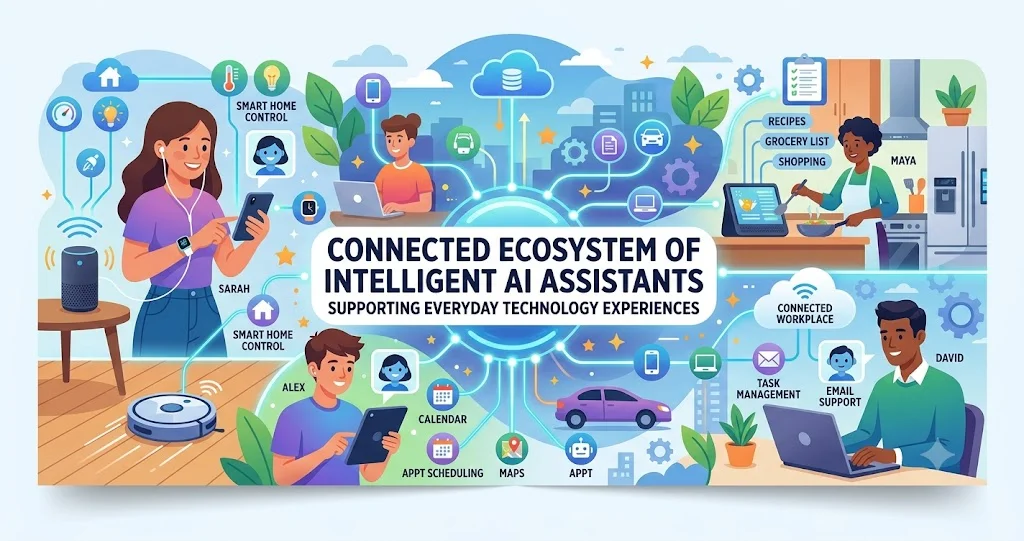
Apple's approach to Siri AI is defined by its unique three-tier architecture, designed to balance powerful AI capabilities with its core privacy promise.
The Three-Tier System
Siri AI routes queries through three distinct layers:
- On-Device: Simple tasks are handled entirely on the device using Apple's own models. No data leaves the phone.
- Private Cloud Compute: Moderately complex requests are sent to Apple's own servers, which use Apple silicon and are designed to process data without storing or sharing it.
- Google Cloud: The heaviest reasoning tasks are routed to Google Cloud, running on a custom 1.2-trillion-parameter Gemini model on Nvidia Blackwell GPUs.
At each tier, Apple says queries are anonymized and tokenized so that neither Apple staff nor Google can link requests to individual users.
The Google Gemini Partnership
A key revelation from WWDC 2026 was that Siri AI is built on a custom Google Gemini model. This is a significant shift for Apple, which has long prided itself on its own technology. The deal is reportedly worth about $1 billion per year. Apple has stressed that it uses "none of the models that Google deploys to its customers" and that requests are completely private, never stored, and never accessible to anyone. The contract reportedly bars Google from training future models on Apple user data.
Privacy-First Approach
Apple has made privacy a central pillar of Siri AI. The company emphasizes that user data is only used to execute the request and is not retained. Craig Federighi stated, "We believe privacy in AI is non-negotiable". The system is designed so that even Apple itself cannot see Siri's contextual data. Outside researchers can also inspect the system to verify these privacy promises].
Supported Devices and Hardware Requirements
Siri AI's advanced features come with significant hardware requirements, leading to a clear compatibility list and some notable limitations.
iPhone Compatibility
Siri AI is supported on the following iPhone models:
- iPhone 15 Pro and iPhone 15 Pro Max
- iPhone 16, iPhone 16 Plus, iPhone 16 Pro, iPhone 16 Pro Max, iPhone 16e
- iPhone 17, iPhone 17e, iPhone Air, iPhone 17 Pro, iPhone 17 Pro Max
Notably, the standard iPhone 15 and 15 Plus are not supported. According to some reports, over 13 billion iPhones in use are unable to run the most advanced Siri AI features due to hardware limitations.
iPad, Mac, and Other Devices
For iPad, support requires an M1 chip or later, or an iPad mini with an A17 Pro chip. All Macs with Apple Silicon (M1 and later) are compatible. The Apple Watch Series 9 and newer, Ultra 2 and newer, and SE 3 are supported when paired with a compatible iPhone. Apple Vision Pro is fully compatible.
Advanced Feature Requirements
Some of the most advanced Siri AI features, such as fully customizable voice and high-precision offline dictation, require even more powerful hardware. These features need at least 12GB of RAM, which is only available on:
- iPhone 17 Pro, iPhone 17 Pro Max, and iPhone Air
- iPad with M4 chip and at least 12GB of unified memory
- Mac with M3 chip and at least 12GB of unified memory
- Apple Vision Pro with M5 chip
Limitations and Rollout Challenges
Despite the significant upgrade, Siri AI faces several limitations and challenges.
Regional Availability
Siri AI will not be available in the European Union or China at launch. Due to the Digital Markets Act (DMA), Apple will not be able to ship Siri AI in the EU with the release of iOS 27. There is currently no timeline for availability in these regions.
Beta Status and Language
Siri AI will launch as a beta in September 2026. It will initially be available in English only, with additional languages expected to expand over time.
Performance and Stability
Early reports indicate that Siri AI is not a finished product and may have performance issues. Some reviewers noted a noticeable delay before Siri AI answered commands. Apple's decision to ship it as a beta suggests that the company is still working on stability and performance.
The Context: Apple's AI Strategy and the Future
The launch of Siri AI comes at a pivotal moment for Apple. It marks the end of an era, as WWDC 2026 was Tim Cook's last as CEO before handing the role to hardware chief John Ternus.
Apple has acknowledged that its AI efforts have not yet delivered on everything promised. The company settled a $250 million class action lawsuit over marketing Siri AI features in 2024 that were not ready. Siri AI is, in many ways, the delivery of those promised features.
Looking ahead, Apple is committed to integrating AI deeply across its ecosystem. The next generation of Apple Intelligence will power features across Photos, Messages, and other apps. The company is also allowing users to set third-party AI models like Claude or ChatGPT as their default assistant, a concession to both competitive pressure and EU regulations.
Frequently Asked Questions
What is Siri AI?
Siri AI is an entirely new version of Siri, powered by the next generation of Apple Intelligence. It is a conversational AI assistant with personal context understanding, onscreen awareness, and broad world knowledge.
How is Siri AI different from the old Siri?
The old Siri was a command-based voice assistant that struggled with complex requests. Siri AI is a rebuilt, conversational AI that can understand context, see your screen, take actions across apps, and engage in natural dialogue.
What is the three-tier architecture of Siri AI?
Siri AI uses a three-tier system for privacy and performance. Simple tasks are handled on-device, moderately complex ones go to Apple's Private Cloud Compute, and the heaviest reasoning tasks are routed to a custom Google Gemini model on Google Cloud.
Is Siri AI private?
Apple has designed Siri AI with a strong privacy focus. Data is only used to execute your request, is not stored, and is not accessible to Apple or Google. A three-tier architecture ensures that personal data stays on-device or under the user's control.
Which devices support Siri AI?
Siri AI is supported on iPhone 15 Pro and newer, iPads with M1 or A17 Pro chips, Macs with Apple Silicon, Apple Watch Series 9 and newer, and Apple Vision Pro. Some advanced features require devices with at least 12GB of RAM.
When will Siri AI be available?
Siri AI will be available as a beta in September 2026. It will launch in English first, with additional languages later. It will not be available in the EU or China at launch due to regulatory issues.
Does Siri AI use Google Gemini?
Yes, Siri AI is built on a custom 1.2-trillion-parameter Gemini model. The heaviest reasoning tasks are routed to this model on Google Cloud.
Conclusion
With Siri AI, Apple has finally delivered a truly intelligent, conversational assistant that can compete with the best in the industry. By focusing on personal context, onscreen awareness, and deep system integration, Siri AI transforms the way users interact with their devices]. The dedicated app, Visual Intelligence, and systemwide writing tools make it a powerful productivity tool.
However, the rollout is not without its challenges. The strict hardware requirements mean that millions of users will be left out, and the regional unavailability in the EU and China is a significant setback. The reliance on Google's Gemini also represents a strategic shift for Apple.
Nevertheless, Siri AI marks a new chapter for Apple's voice assistant. It is a bold step forward, and its success will depend on how well it delivers on its promises of intelligence, utility, and privacy. As the AI landscape continues to evolve, Siri AI is poised to be a central part of Apple's ecosystem for years to come.