

If you have searched for anything online in 2026, you have probably noticed something has changed. The search experience is no longer just a list of blue links—it is increasingly an answer delivered directly to you, sometimes before you even finish typing the question.
Google still dominates the search landscape with approximately 90% of global search traffic, according to StatCounter data. But AI-powered search platforms—ChatGPT Search, Perplexity, Google's own AI Overviews and AI Mode, and Microsoft's Copilot—are reshaping how people find information online. AI search platforms collectively process over 3.5 billion queries per week as of June 2026.
This article compares AI-powered search experiences with conventional Google Search across nine dimensions. The goal is not to declare a winner—both approaches have distinct strengths and trade-offs—but to help you understand when and why to use each.
The Search Landscape in 2026: A Snapshot
Before diving into the comparison, it helps to understand the current landscape. Google remains the dominant player with 90.01% of worldwide search traffic as of March 2026, followed by Bing at 4.98%. According to BrightEdge data, the "All AI" category represents approximately 1.4% of the total search market.
But the directional story matters more than the current share. ChatGPT Search grew 340% year-over-year, reaching 900 million daily queries in Q1 2026. Perplexity reached 500 million daily queries, up 280%. At current growth rates, ChatGPT Search is projected to surpass Bing in total query volume by late 2026.
In the AI search niche specifically, ChatGPT holds approximately 76.85% of referral traffic, down from 84.21% a year ago, as a four-platform market—ChatGPT, Gemini, Perplexity, and Claude—has permanently replaced the single-platform era. Gemini holds about 9.0%, Perplexity 7.73%, Copilot 3.76%, and Claude 2.66%.
1. Result Presentation: Links vs. Answers
This is the most visible difference. Traditional Google Search returns a ranked list of web pages with titles, snippets, and URLs. The user scans the list, clicks a result, and reads the full content on the publisher's site.
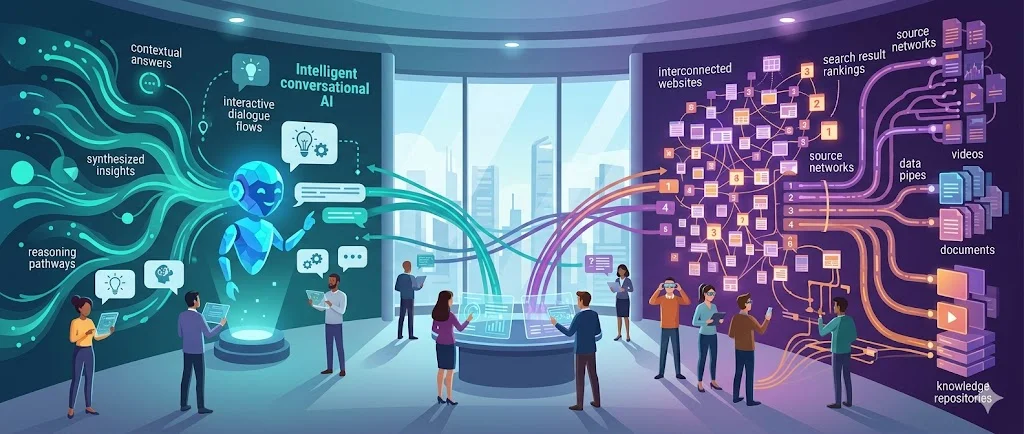
AI search, by contrast, synthesizes information from multiple sources into a single, coherent answer. The user receives a summary directly on the search page, often with numbered citations indicating where the information came from.
Google itself has embraced this shift. AI Overviews now appear in 43% of Google searches, up from just 15% a year earlier. AI Mode visits grew from 126 million in June 2025 to 279 million by May 2026, and Google announced at I/O 2026 that AI Overviews had surpassed 2.5 billion monthly active users.
The trend is clear: search is moving from "here are some links" to "here is the answer." Google is making the answer the default.
2. Source Discovery: Where Results Come From
Traditional Google Search and AI search engines retrieve information from substantially different sources. A 2026 academic study comparing Google Search, AI Overviews, and Gemini Flash 2.5 found that the retrieved sources have less than 0.2 average Jaccard similarity—meaning they share very little overlap.
Traditional Google Search is significantly more likely to retrieve information from popular or institutional websites in government or education. Generative search engines, by contrast, are significantly more likely to retrieve Google-owned content.
The study also found that websites that block Google's AI crawler are significantly less likely to be retrieved by AI Overviews, even though Google still has access to the content. This creates a new visibility dynamic: being discoverable in traditional search does not guarantee being discoverable in AI search.
Yext Research analyzed 17.2 million AI citations across ChatGPT, Perplexity, Gemini, and Claude and found that verified, structured, directly distributed data accounted for 54.53% of distinct citation sources. Websites generated 4.31 citations per URL. The brands winning AI mentions are not necessarily the ones with the best website content—they are the ones that own the source of truth every engine reads from.
3. Citations and Attribution
Citation behavior varies significantly across platforms. A 2026 study of 602 prompts across ChatGPT, Google AI Overviews/Gemini, and Perplexity found sharp divergence between citation breadth and citation depth:
- Perplexity cites the most sources on average per prompt (16.35 citations)
- Google cites broadly (12.06 citations per prompt)
- ChatGPT cites fewer sources (6.88 citations per prompt) but shows substantially higher average citation influence among fetched pages
Citation accuracy also varies. Research on generative search engines and deep research agents found citation accuracy ranging from 40–80% across systems. Gemini shows citation gaps in 70.3% of queries with 3.04 expected missing citations per query, while OpenAI's models have only a 10.5% probability of any citation gaps.
Google has also acknowledged that 11% of AI Overviews include hallucinated content. This is an important reminder that AI-generated answers, while convenient, are not always reliable.
For website owners, the rise of AI citations represents a new visibility metric. The unit of digital visibility is changing from position to participation—from ranking on a page to being cited in an answer.
4. Conversational Queries and Natural Language
How people ask questions differs dramatically between platforms. Traditional Google Search queries average 3.9 words and are keyword-based. ChatGPT Search queries average 23.1 words and are conversational with context. Perplexity queries average 17.8 words and are research-oriented.
The same intent expressed differently tells the story. A traditional Google query for legal advice might be: "personal injury lawyer NYC." The same intent in ChatGPT Search might be: "I was in a car accident in New York City three weeks ago where the other driver ran a red light and I have documented medical bills of around $15,000. What type of lawyer should I contact, what should I expect the process to look like, and how do contingency fees work?"
Google is adapting to this shift. AI Mode now supports conversational, natural-language queries. Google says people who use AI features search more, and that Search "feels more like an ongoing conversation".
AI search platforms are also developing follow-up research capabilities. Perplexity's Research feature allows users to ask clarifying questions before research starts and add follow-up questions while research is still running. ChatGPT and Gemini similarly support threaded follow-ups within search sessions.
5. Advertising Models
Advertising is where the business models diverge significantly. Google Search and advertising revenue reached $60.4 billion in Q1 2026, up 19% year over year—counter to predictions that AI-generated answers would hollow out Search's ad business.
Google is adapting its ad formats to the AI era. At Google Marketing Live, the company introduced Gemini-built ad formats that answer a user's question directly inside AI Mode. Google is also sunsetting Dynamic Search Ads and migrating them to AI Max from September 2026, which combines keywordless matching, AI-generated ad copy, and dynamic URL expansion.
AI search platforms are still developing their ad models. ChatGPT Search is ad-supported in the free tier but currently does not display traditional search ads. Perplexity has experimented with sponsored follow-up questions. The ad experience in AI search remains less mature than Google's—but that is likely to change as these platforms scale.
For users, this means Google Search remains ad-heavy but familiar, while AI search offers an ad-light experience that may not be sustainable long-term.
6. Content Freshness and Recency
AI search engines place a premium on fresh content. Research from 2026 shows that the average age of URLs cited by AI assistants is 1,064 days, compared to 1,432 days for traditional organic search results—making AI-cited content nearly 370 days newer. ChatGPT specifically cites URLs that are 458 days newer than Google's organic results.
Gander's research indicates that content has a one-year half-life in AI search: each year of age cuts retrieval visibility by roughly 40–60%. Recency has a higher impact on AI citations than domain rating.
For time-sensitive topics—breaking news, current events, product releases—AI search can deliver very recent information. Perplexity Deep Research operates with a 32-hour average lag, while ChatGPT responds in minutes to hours.
Google's edge remains coverage and recency at billions-of-pages scale. For the absolute freshest information on breaking events, Google's traditional index still has advantages over AI platforms that may not have crawled the newest content yet.
7. Follow-Up Research and Depth
One area where AI search has a clear advantage is deep research. Perplexity's Deep Research feature allows users to get researched answers, ask follow-ups, pull in connected context, and turn findings into finished assets—all in a single query. Users can run searches in parallel, follow new threads when they appear, and try again when answers fall short[.
EBSCO has introduced AI Conversational Search that allows users to ask research questions in natural language and receive concise answers supported by citations from trusted content. Users can continue the conversation with follow-up questions, helping them refine topics, expand research, and validate information within a single workflow.
Traditional Google Search supports follow-up searches but does not maintain context across searches in the same way. Each search is essentially a fresh start. AI search platforms maintain conversational memory, making multi-turn research more natural.
That said, research suggests that learning through AI summaries may lead to shallower knowledge compared to doing the work of search through traditional Google Search. The trade-off is efficiency versus depth of understanding.
8. User Control and Privacy
User control differs significantly between platforms. Google AI Mode offers several privacy and control features:
- Personal Intelligence can personalize responses using Gmail, Google Photos, travel bookings, and shopping activity—but it is opt-in and can be disabled at any time
- Domain blocking: Chrome Canary's "Never share these sites" list lets users exclude privacy-sensitive websites from AI Mode responses
- Website opt-out: Google is testing tools that let website owners opt out of AI Overviews and AI Mode—but opting out means the site will not receive traffic or impressions from Google's generative AI search features
- No official opt-out for users: As of July 2026, there is no official button to hide AI Overviews from search results
Privacy is a growing concern. According to a Havas Market study, 34% of users now judge AI responses as more reliable than search engines and media—but this trust may be misplaced given the citation accuracy issues noted above.
AI search platforms generally have less historical data on users than Google, which some users view as a privacy advantage. However, as these platforms scale their ad models, data collection is likely to increase.
9. Zero-Click Search: The Big Shift
Perhaps the most significant trend reshaping search is the rise of zero-click searches—searches where the user gets an answer without ever visiting a third-party website.
In the U.S., 68.01% of Google searches ended without a click in early 2026, up from 60.45% in 2024. On mobile, up to 77% of searches end without a click.
AI search platforms have even higher zero-click rates. According to 2026 data:
- Perplexity: ~93% zero-click
- Google AI Mode: ~88% zero-click
- ChatGPT Search: ~82% zero-click
Google AI Overviews have been found to reduce clicks to the top-ranking page by 58% and produce a 93% zero-click rate in Google's full AI Mode. An Ahrefs study found that AI Overviews correlate with a 58% reduction in click-through rates for top-ranking pages. A field experiment found that AIOs reduce outbound organic clicks by 39.8% and increase zero-click searches by 34.5%].
For publishers, the impact has been severe. Google referral traffic to publishers dropped 33% globally in 2025, with the U.S. down 38%. Some publishers have reported traffic declines of 30% to 40% year over year. One website that had documented overfishing for 21 years closed after Google's AI Overviews stripped away its traffic.
At the same time, AI referral sessions grew 1,200% over the same period. The traffic is moving—it is just not going to traditional websites in the same way.
When to Use Each Approach
Neither AI search nor Google Search is universally superior. The right choice depends on what you are trying to do.
Use AI search when:
- You need a synthesized answer from multiple sources
- You are researching a complex topic and want citations
- You want to ask follow-up questions in a conversational thread
- You are willing to trade some depth for efficiency
- You want an ad-light experience
Use Google Search when:
- You need to verify information from a specific source
- You are looking for local services, maps, or real-time business information
- You want to browse multiple perspectives on a topic
- You are shopping and want to compare products across sites
- You value serendipity—stumbling across unexpected content
As one user put it after switching from Google to Perplexity: "Perplexity was far superior at providing reliable, transparently sourced information about the topics I was researching". But the same user noted that "Google is still great when I have a specific destination in mind".
The realistic 2026 setup is not either/or—it is both/and.
Frequently Asked Questions
What is the difference between AI search and Google Search?
Google Search traditionally returns a ranked list of web pages for the user to explore. AI search synthesizes information from multiple sources into a single answer with citations. However, Google now includes AI Overviews and AI Mode, blurring the distinction.
Is AI search replacing Google?
Not yet. Google still holds approximately 90% of global search market share. AI search platforms collectively represent a small fraction of total search traffic. However, AI search is growing rapidly—ChatGPT Search grew 340% year-over-year in Q1 2026.
Which is more accurate: AI search or Google Search?
It depends. Google Search directs you to sources you can evaluate yourself. AI search provides synthesized answers that may contain errors—Google has acknowledged that 11% of AI Overviews include hallucinated content. Research shows citation accuracy ranging from 40–80% across AI systems. For factual verification, Google Search is generally safer.
What are zero-click searches?
Zero-click searches are searches where the user gets an answer without clicking through to a website. In the U.S., 68% of Google searches now end without a click. AI search platforms have even higher zero-click rates, with Perplexity at ~93% and Google AI Mode at ~88%.
Do AI search engines cite their sources?
Yes, most AI search engines provide citations. Perplexity cites the most sources on average (16.35 per prompt), followed by Google (12.06) and ChatGPT (6.88). However, citation accuracy varies, and some citations may not actually support the claims made.
Is AI search better for research?
AI search can be more efficient for research, providing synthesized answers with citations in seconds. Perplexity's Deep Research and similar features allow multi-turn, in-depth research. However, research suggests that learning through AI summaries may lead to shallower knowledge than doing the work of search through traditional methods.
How does advertising work in AI search?
Google has introduced Gemini-built ad formats that answer questions directly inside AI Mode and is migrating to AI Max for keywordless ad matching. ChatGPT Search is ad-supported in the free tier but does not currently display traditional search ads. Perplexity has experimented with sponsored follow-up questions.
Can I opt out of AI Overviews?
Google is testing tools that let website owners opt out of AI Overviews and AI Mode—but opting out means the site will not receive traffic from these features. For users, there is currently no official button to hide AI Overviews from search results.
Conclusion
The search landscape in 2026 is more diverse than it has been in decades. Google still dominates with approximately 90% of global search traffic, but AI search platforms are growing rapidly and reshaping user expectations. Search is moving from a list of links to a direct answer—a shift that Google itself is leading with AI Overviews now appearing in 43% of searches.
Each approach has distinct strengths. AI search offers efficiency, synthesis, and conversational follow-up. Google Search offers verification, serendipity, and unmatched scale—especially for local services, shopping, and navigation.
The rise of zero-click searches—68% of Google searches in the U.S., and even higher on AI platforms—represents a fundamental change in how information is discovered and consumed. For users, this means faster answers. For publishers, it means a challenging new reality where traffic is no longer guaranteed by ranking well.
The realistic approach for most users in 2026 is not to choose one over the other, but to use each for what it does best: AI search for research and synthesis, Google Search for verification and discovery. The search landscape has fractured—but that also means more tools are available than ever before.