
AI Predictions for 2027: What to Expect Next Year
As we look toward 2027, the landscape of artificial intelligence continues to evolve at an extraordinary pace. Predicting exactly what the next year will bring is challenging, but by analyzing current trends, research directions, and expert insights, we can identify key developments likely to shape the AI ecosystem in 2027. This guide explores these predictions, offering a balanced and informed perspective on the future of AI.
Introduction: The Evolving AI Landscape
The pace of AI innovation shows no sign of slowing down. In 2027, we can expect AI to become even more integrated into our daily lives and work, with significant progress in capabilities, accessibility, and application. This guide provides predictions across several key areas of AI development. It is important to note that these are informed forecasts based on current trajectories, not definitive statements about the future.
Prediction 1: Generative AI Will Become More Specialized
Generative AI will move beyond general-purpose models toward more specialized applications. Domain-specific models for industries like healthcare, law, and education will provide more accurate, tailored, and reliable outputs. This specialization will improve the utility of generative AI in professional settings.
Prediction 2: Multimodal AI Will Be Mainstream
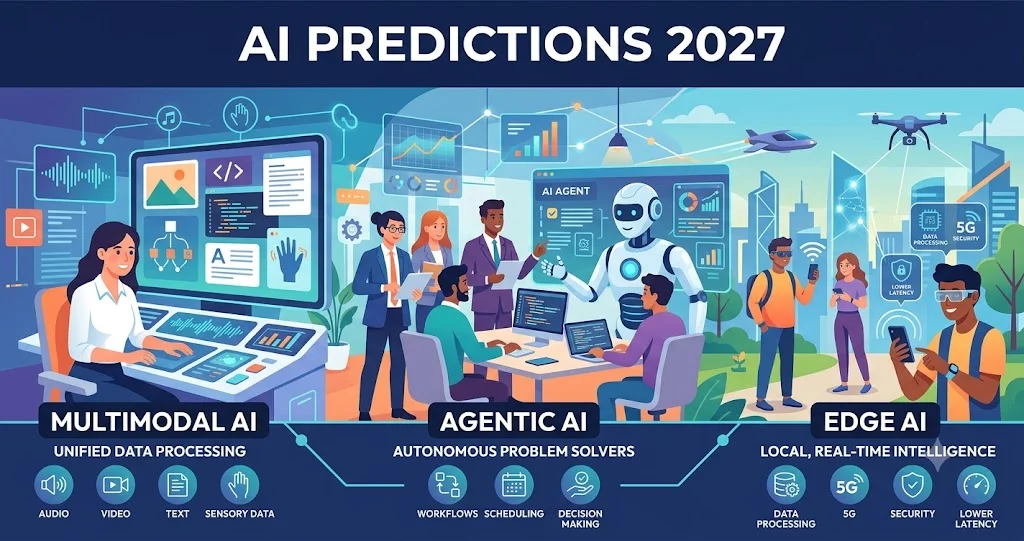
Multimodal AI systems, capable of processing text, images, audio, and video together, will become mainstream. This will enable richer user interactions and more comprehensive applications, allowing for more natural and intuitive AI experiences.
Prediction 3: Agentic AI Will Advance Significantly
Agentic AI systems, which can autonomously plan and execute complex tasks, will see significant advancements. While full autonomy remains a challenge, we will see more capable agents for specific tasks, such as research, planning, and problem-solving.
Prediction 4: AI Regulation Will Increase
Regulatory frameworks for AI will continue to develop in 2027, with more countries implementing legislation around transparency, accountability, and safety. This will impact how AI is developed and deployed.
Prediction 5: AI and Edge Computing Will Converge
More AI processing will occur at the edge, enabling faster, more private, and more reliable applications, especially in IoT and autonomous systems. This will reduce reliance on the cloud.
Prediction 6: Generative AI and Programming Will Evolve
AI-assisted programming will become more sophisticated, but developers will remain essential. The focus will shift to code review, architecture, and complex problem-solving.
Prediction 7: AI Literacy Will Become a Core Skill
Understanding AI concepts, capabilities, and limitations will become a fundamental skill across many professions. Employers will increasingly seek AI-literate candidates.
Prediction 8: AI for Science Will Accelerate Discovery
AI will be increasingly used to accelerate scientific discovery, particularly in drug discovery, material science, and climate modeling, driving breakthroughs at a faster pace.
Prediction 9: Personalized AI Assistants Will Become More Common
Personalized AI assistants will become more common, offering highly tailored support for work, learning, and daily tasks. These assistants will learn from user behavior and preferences.
Prediction 10: AI Safety and Ethics Will Be More Prominent
AI safety and ethics will become more prominent in public discourse and policy. There will be increased focus on addressing bias, ensuring transparency, and managing risks.
Prediction 11: Quantum Computing and AI Integration
While still in early stages, the integration of quantum computing with AI will begin to show potential for solving previously intractable problems. This could be a long-term driver of AI advancement.
Prediction 12: AI and Climate Action
AI will be more actively applied to climate action, including energy optimization, environmental monitoring, and accelerating the development of sustainable technologies.
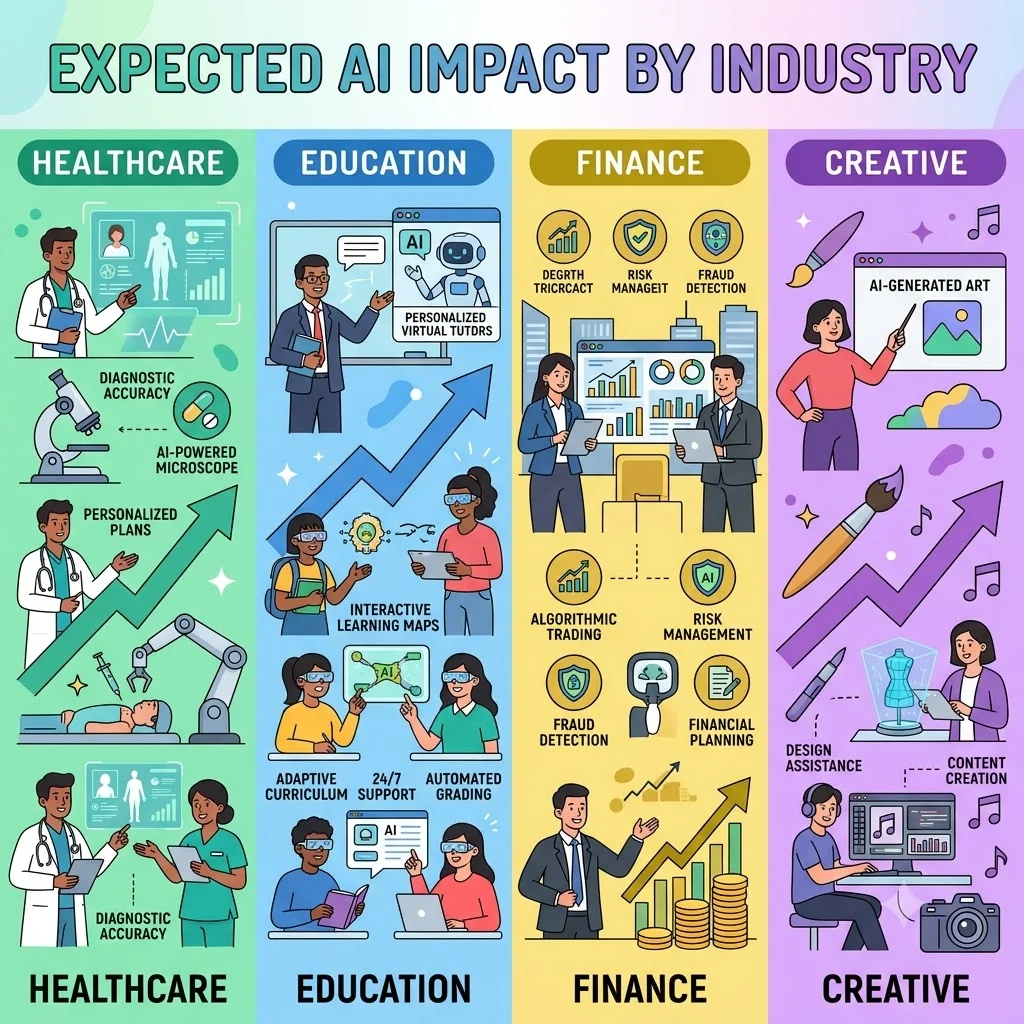
Comparison of AI Predictions for 2027
The following table provides a structured overview of key predictions and their expected impact on different sectors.
| Prediction Area | Expected Development | Primary Impact Sector | Likelihood |
|---|---|---|---|
| Generative AI | Domain-specific specialized models | Professional services, creative industries | High |
| Multimodal AI | Mainstream adoption of multimodal systems | Consumer applications, healthcare | High |
| Agentic AI | More capable autonomous agents | Business process automation, research | Medium-High |
| Regulation | Increased regulatory frameworks | Global technology, compliance | High |
| Edge AI | More processing on edge devices | IoT, autonomous systems | High |
| AI Literacy | Core skill across professions | Education, workforce development | High |
| AI for Science | Accelerated discovery in key fields | Healthcare, materials science | Medium-High |
Checklist: Preparing for AI Developments in 2027
Use this checklist to assess your readiness for the AI developments expected in 2027.
- Stay Informed: Follow AI news, research, and policy developments to stay current.
- Build AI Literacy: Invest in understanding AI concepts, capabilities, and limitations.
- Evaluate AI Applications: Consider how emerging AI developments could impact your industry or role.
- Develop Adaptability: Cultivate a mindset of continuous learning to adapt to technological change.
- Engage with Ethical Considerations: Understand the ethical implications of AI in your field.
Tips for Navigating AI Changes in 2027
These tips can help you navigate the AI landscape in 2027 effectively.
- Embrace Lifelong Learning: Stay curious and committed to learning about AI developments.
- Focus on Human-Centric Skills: Develop skills that are complementary to AI, such as creativity and empathy.
- Experiment with AI Tools: Gain hands-on experience with AI tools relevant to your work.
- Engage in Public Dialogue: Participate in discussions about AI policy and ethics to contribute to responsible development.
Frequently Asked Questions About AI Predictions for 2027
Is it possible to accurately predict AI developments?
Predictions are informed forecasts, not certainties. The fast-paced nature of AI makes predictions challenging, but analyzing current trends can provide valuable insights.
Which sector will be most impacted by AI in 2027?
Healthcare, education, finance, and creative industries are likely to be significantly impacted, but the influence will be widespread across almost all sectors.
Will AI replace jobs by 2027?
AI will automate some tasks, but it will also create new roles and augment human capabilities. Significant job displacement is not expected, but transformation of many roles is likely.
What is the most significant trend to watch in 2027?
The advancement of agentic AI and the integration of multimodal systems are among the most significant trends to watch, given their potential to change how we interact with technology.
How can I prepare for AI changes in 2027?
Focus on building AI literacy, developing human-centric skills, and staying informed about developments in your industry and relevant technologies.
Will AI regulation hinder innovation?
Regulation may slow some aspects of AI development but is also important for ensuring safety, building trust, and guiding responsible innovation.
What role will AI ethics play in 2027?
AI ethics will be increasingly important, influencing policy, development practices, and public acceptance of AI technologies.
Is quantum AI a realistic expectation for 2027?
While practical quantum AI remains early, 2027 may see more research and experimental applications, laying the groundwork for future developments.
Conclusion
The AI predictions for 2027 point toward a year of continued innovation and integration across industries. From specialized generative AI to advanced agentic systems, increased regulation, and a growing emphasis on AI literacy, the landscape will evolve in significant ways. While some predictions are more certain than others, the trend of AI becoming more embedded in our work and lives is clear. By staying informed, building relevant skills, and engaging with ethical considerations, individuals and organizations can prepare for the changes ahead and harness the potential of AI in responsible and beneficial ways.