

If you run a small business, you have probably heard about AI agents. But what exactly are they? And more importantly, can they actually help your business beyond the hype?
AI agents are increasingly being positioned as a practical tool for small businesses—not just for large enterprises with dedicated AI teams. In 2026, major vendors including Google, Salesforce, Anthropic, Wix, and Mastercard have launched or expanded AI agent offerings specifically for small and medium-sized businesses. But before you adopt any new technology, it is worth understanding what AI agents actually do, how they differ from tools you may already use, and where they genuinely add value.
What Are AI Agents?
An AI agent is a goal-oriented AI system that can independently execute multi-step tasks to achieve a specific objective. Unlike a chatbot that waits for a question and provides an answer, an AI agent receives a high-level goal and then plans and executes the steps needed to accomplish it.
For example, if you tell an AI agent to "qualify inbound leads and book demos for the sales team," it can review lead criteria, send follow-up emails, and schedule appointments—all without step-by-step human direction. The agent connects to your business systems, makes decisions based on the information it gathers, and takes action across multiple applications.
This represents a fundamental shift in how AI can support small businesses. Instead of simply providing information or generating content, AI agents can complete work on your behalf.
How AI Agents Differ from Chatbots and Traditional Automation
Understanding the difference between AI agents, chatbots, and traditional automation is essential for making the right technology choices for your business.
Chatbots: Smart Responders
A chatbot is a conversational tool that answers customer questions using natural language processing. It can handle open-ended phrasing and pull live data from sources such as product catalogs or order histories. However, a chatbot is reactive—it waits for a customer to ask something, then responds. It cannot independently take action across multiple systems or complete workflows.
Chatbots excel at high-volume, predictable customer inquiries such as store hours, shipping times, and return policies. They are best suited for answering questions, not for completing tasks.
Traditional Automation: Rules-Based Execution
Traditional automation follows rigid if/then rules: "if a form is submitted, send an email" or "if a payment fails, trigger a notification". This approach is reliable for repetitive, predictable tasks but cannot adapt to context or handle anything outside its programmed logic.
For example, an automated email sequence can send a welcome message when someone signs up. But it cannot decide whether that person is a qualified lead, tailor the follow-up based on their industry, or reschedule a meeting if they do not respond.
AI Agents: Autonomous Executors
An AI agent is fundamentally different. It is a goal-completing machine rather than a question-answering machine. It can plan work, use tools across multiple applications, and deliver outcomes with minimal human intervention.
Where a chatbot responds and traditional automation executes fixed rules, an AI agent reasons, adapts, and acts. It receives a high-level objective, breaks it down into steps, connects to the necessary systems, and completes the work.
| Chatbot | Traditional Automation | AI Agent | |
|---|---|---|---|
| Mode | Reactive (responds) | Rules-based (executes) | Goal-oriented (completes) |
| Input | User questions | Structured data/triggers | High-level objectives |
| Output | Answers, content | Predetermined results | Completed workflows |
| Adaptability | Responds to new prompts | Static until reprogrammed | Learns and adjusts |
| Best for | Customer FAQs, information | Repetitive, predictable tasks | End-to-end workflow execution |
Practical Use Cases for Small Businesses
AI agents can support a wide range of small business functions. The most practical applications in 2026 fall into several categories.
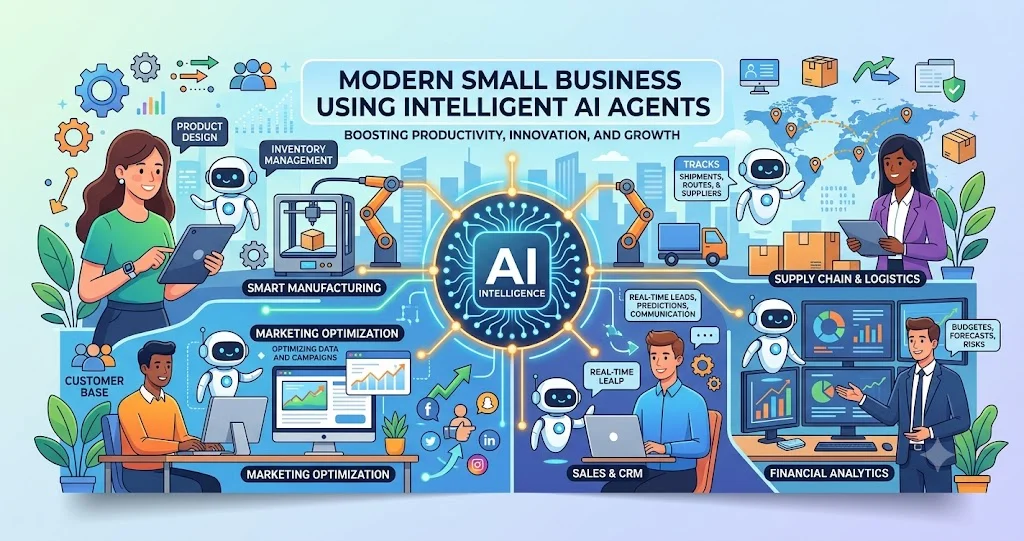
Customer Support
AI agents can handle customer inquiries across multiple channels, track orders, manage returns, and escalate complex issues to human staff when needed. For businesses operating with lean teams, this means providing enterprise-grade customer service without hiring additional support staff.
Google Cloud has demonstrated that small businesses can build AI customer agents in under an hour using no-code tools. These agents can handle voice interactions, understand customer intent, reason through complex conversations, and retrieve real-time business information.
Lead Qualification and Appointment Scheduling
AI agents can qualify inbound leads against company-defined criteria, trigger real-time follow-ups, and book appointments directly to business calendars. This works around the clock—an agent can qualify a lead at 11 PM on a Sunday and schedule a discovery call for Monday morning.
For service-based businesses, AI agents can answer calls, respond to questions, and capture leads whenever business owners are unavailable. This helps address the common problem of missed leads—some estimates suggest the average local business takes 47 hours to call back a new lead.
Internal Knowledge Retrieval
AI agents can help employees quickly find information across scattered systems. A salesperson preparing for a call can ask for account context instead of opening multiple screens. A service employee can use a summary to review a case more quickly. A team member can draft a tailored email in seconds instead of writing from scratch.
Salesforce has embedded these capabilities into its small business suites, allowing teams to ask an AI agent to prepare next steps and keep records up to date while work is underway.
Reporting and Analytics
AI agents can analyze business performance, identify risks and opportunities, and recommend next steps. Mastercard's Virtual C-Suite, for example, connects with accounting systems and banking applications to provide strategic insights typically available only to larger enterprises. Instead of simply visualizing a trend line, the agent explains what is driving it and recommends what to do next.
For small businesses, this means having access to data analysis and decision support without hiring a data analyst or finance team.
Workflow Automation
AI agents can automate multi-step workflows across different systems. Wix's Symphony platform, launched in August 2026, builds a coordinated team of specialized AI agents that learn how each business works and automate workflows, surface opportunities, and unlock growth. The platform includes a central agent that understands what is happening across the business and coordinates specialized agents for each job.
Anthropic's Claude for Small Business includes 15 ready-to-run agentic workflows across finance, operations, sales, marketing, HR, and customer service. These workflows can plan payroll, chase invoices, reconcile books, and generate plain-English profit and loss statements.
Inventory Management
AI agents can track stock levels, generate reorder alerts, and report on inventory turnover. For retail and product-based businesses, this helps prevent stockouts and overstock situations without manual monitoring.
Benefits of AI Agents for Small Businesses
For small businesses operating with lean teams and limited budgets, AI agents offer several practical advantages.
Faster customer service. AI agents can respond to inquiries instantly, outside business hours, and across multiple channels. This improves customer experience without requiring 24/7 staffing.
Lower operational costs. By automating routine tasks, AI agents reduce the need for additional hires. Some businesses report saving 10 to 15 hours per week using AI-powered assistants.
Enterprise capabilities with lean teams. AI agents allow small businesses to deliver customer experiences and analytical insights that were previously available only to larger enterprises.
Improved consistency. AI agents apply the same criteria and processes consistently, reducing human error and variability in tasks like lead qualification and customer follow-up.
24/7 operation. AI agents work around the clock, capturing leads, answering questions, and completing tasks while the business is closed.
According to Upwork Research Institute data from 2026, 32% of SMBs with 10 to 99 employees consider AI agents mission-critical to their company's strategy. 74% of SMBs report that AI has improved their productivity.
Limitations and Challenges
AI agents are not a universal solution. Small business owners should understand the limitations before adopting them.
Implementation complexity. While many platforms now offer no-code tools, building effective AI agents still requires careful planning. You need to define clear use cases, prepare data, and establish appropriate guardrails. According to industry estimates, only 11% of agentic AI use cases made it to production in 2025, reflecting a significant failure rate for early implementations.
Hallucinations and mistakes. AI agents can make errors, including hallucinations or incorrect actions. These mistakes require human oversight and can be costly if they affect customers or financial data.
Ongoing maintenance. AI agents require ongoing monitoring, debugging, and refinement. The cost is not just upfront implementation but also the time spent maintaining and improving the agents over time.
Token and usage costs. AI agents consume tokens for every interaction, and costs can add up, especially for high-volume use cases. Businesses need to factor usage costs into their budget.
Not suitable for all tasks. AI agents are not always the right tool. For simple, repetitive tasks with clear rules, traditional automation may be more reliable and cost-effective. For straightforward customer inquiries, a chatbot may be sufficient. AI agents are most valuable for complex, multi-step workflows that require decision-making across systems.
Data Privacy and Security Considerations
Security is one of the most significant concerns for small businesses adopting AI agents. According to Upwork research, data privacy and security top the list of adoption barriers at 49%.
Excessive access permissions. One of the biggest risks is granting AI agents more access than they need. A tool needed for one simple task can be given permission to read every mailbox, access an entire CRM, download files, or change records. Businesses should follow the principle of least privilege—an AI agent should only be able to access the specific information and functions needed for its task.
Shadow AI. Staff may use public AI tools outside approved company systems, entering customer or financial data into external services without IT knowledge. This creates data privacy and compliance risks.
Test before deploying. Security experts recommend avoiding direct connections to live business systems using standard employee or administrator accounts. Instead, businesses should use controlled test setups with dedicated credentials and non-sensitive data.
Human oversight. Smart businesses do not let AI run unsupervised. Effective governance includes review checkpoints, approval gates, and audit trails. As one industry observer noted, "clear workflows and human review are what turn automation into an asset instead of a liability".
Small businesses are more exposed when things go wrong, and they often lack dedicated cybersecurity teams. This makes careful security planning particularly important.
Human Oversight: Who Is in Charge?
AI agents should augment human workers, not replace them entirely. The most successful deployments treat AI agents as teammates that handle preparation, routing, drafting, analysis, and follow-up while humans make strategic decisions.
Anthropic's Claude for Small Business, for example, requires user approval before anything is sent, posted, or paid. This approval step reduces concerns about hallucinations, improper instruction following, and imprecisions that might be acceptable in a chat response but problematic when working with live systems and real money.
Effective human oversight involves three layers: communication protocols to define how agents interact with systems and people, orchestration logic to coordinate multiple agents, and human oversight at the system level—not just the task level.
Businesses should also be aware that human-in-the-loop models can fail if humans simply click "approve" on hundreds of AI-generated actions due to alert fatigue. True human-AI collaboration requires active interventions where the system highlights why the AI made a decision and calls out variables that require human validation.
When Traditional Automation May Be More Appropriate
AI agents are powerful, but they are not always the best solution. Traditional automation may be more appropriate in several situations.
Simple, repetitive tasks. If a task follows clear, unchanging rules—such as sending a welcome email when someone signs up—traditional automation is simpler, more reliable, and less expensive than an AI agent.
High-volume, low-complexity workflows. For tasks like data entry or basic notifications, rules-based automation is well-established and requires less oversight.
When reliability is critical. Traditional automation produces predictable, deterministic outcomes. AI agents can produce variable results and require monitoring. For tasks where errors are unacceptable, traditional automation may be preferable.
Limited data or integration needs. AI agents are most valuable when they can access and act across multiple systems. If a workflow involves only one system or simple data, the complexity of an AI agent may not be justified.
Many businesses use a hybrid approach: chatbots handle initial inquiries, and if the issue is complex, an AI agent completes the workflow. This combines the speed of chatbots with the power of agents without overcomplicating implementation.
How to Start Implementing AI Agents
For small businesses considering AI agents, a measured, incremental approach is advisable.
Start with a single, well-defined use case. Choose one high-volume workflow where the value is clear—such as customer support ticketing, lead qualification, or appointment scheduling. Prove the value before expanding to additional use cases.
Use no-code or low-code platforms. Most small businesses will never hire a data science team, and they do not need to. Platforms like Google's Gemini Enterprise, Wix Symphony, Salesforce Suites, and Anthropic's Claude for Small Business offer no-code or low-code options for building and deploying AI agents.
Connect the right data. AI agents are only as good as the data they can access. Ensure your agent can connect to the business systems it needs—CRM, calendar, email, accounting software, customer databases.
Test with guardrails. Before deploying to live systems, test your AI agent in a controlled environment with non-sensitive data. Define clear boundaries for what the agent can do autonomously and what requires human approval.
Monitor and refine. AI agents require ongoing monitoring. Track performance, review outputs, and refine the agent's instructions and access as needed.
Start small, scale gradually. A 90-day pilot with one agent in one function is more likely to succeed than a wholesale deployment across the business.
Frequently Asked Questions
What is the difference between an AI agent and ChatGPT?
ChatGPT is a generative AI tool that waits for a prompt and produces output—text, images, or code. It does not send emails, update CRMs, or complete workflows independently. An AI agent receives a high-level goal and executes the steps needed to achieve it, connecting to business systems and taking action without step-by-step direction.
Can AI agents replace my employees?
AI agents are best understood as teammates that handle preparation, routing, drafting, and follow-up—not as replacements for human judgment. Strategic decisions, financial management, and quality control remain human responsibilities. The most successful businesses run a blended workforce: humans handling judgment calls, AI agents handling execution chains.
How much do AI agents cost for small businesses?
Costs vary widely by platform and usage. Many vendors offer tiered subscription models. Some tools are included in existing subscriptions at no additional cost. Businesses should also factor in token/usage costs, which can add up for high-volume use cases. A Florida business owner reported replacing contractors with AI for approximately $100 per month.
Are AI agents secure for small businesses?
AI agents can be secure if deployed with appropriate guardrails. Key practices include: limiting access permissions to the minimum needed for each task, using controlled test environments before live deployment, maintaining human oversight and approval workflows, and avoiding connections to live systems through standard employee or administrator accounts.
What percentage of small businesses are using AI agents?
Adoption varies by business size and function. In marketing, small businesses report 7% AI agent adoption. Among UK SMEs, 34% of medium-sized firms use AI agents, compared with 18% of micro businesses. Across all SMBs, 32% with 10-99 employees consider AI agents mission-critical. The share actively piloting AI agents is higher than the share not considering it at all across every use case.
When should I use a chatbot instead of an AI agent?
Use a chatbot for high-volume, predictable customer inquiries such as FAQs, store hours, and shipping information. Use an AI agent when you need to complete multi-step workflows—qualifying leads, booking appointments, processing returns, or automating reporting across systems. Many businesses use both: a chatbot handles initial questions, and an AI agent handles the workflow when a complex issue arises.
Conclusion
AI agents are becoming increasingly accessible to small businesses in 2026. Major vendors are offering no-code or low-code platforms that allow small teams to deploy AI agents without dedicated data science expertise. When applied to the right use cases—customer support, lead qualification, appointment handling, knowledge retrieval, reporting, and workflow automation—AI agents can help small businesses operate more efficiently and deliver capabilities previously available only to larger enterprises.
However, AI agents are not a silver bullet. They require careful implementation, ongoing oversight, and appropriate security guardrails. Not every task is suitable for an AI agent—traditional automation and chatbots remain better choices for simple, repetitive, or high-reliability workflows. The key is to start small, choose a well-defined use case, test with guardrails, and scale gradually as you learn what works for your business.
For small business owners willing to invest the time to implement AI agents thoughtfully, the potential benefits—faster service, lower costs, and the ability to do more with lean teams—are substantial and increasingly within reach.