

When you ask an AI assistant to summarize a document, it responds. When you give an AI agent a goal—"find the best hotel for my trip"—it plans, searches, compares, books, and adapts. This is the difference between generative AI and agentic AI.
Agentic AI represents a fundamental shift in how AI systems operate. Instead of waiting for a prompt and producing a single response, an agentic system pursues a goal across multiple steps, using tools, memory, and reasoning to complete work with minimal ongoing human supervision. It is not just a chatbot that can do more—it is a different category of technology.
This guide explains what agentic AI is, how it works, and what distinguishes truly autonomous systems from conventional AI assistants and workflows. Written for researchers, developers, and business leaders, it provides a conceptual foundation for understanding this rapidly evolving field without overclaiming current capabilities.
What Is Agentic AI?
Agentic AI refers to artificial intelligence systems that can autonomously pursue complex goals with minimal human supervision. They plan, use tools, remember context, and adapt their behavior based on feedback—all in service of an objective.
The core distinction is between responding and pursuing. A generative AI model responds to a prompt with text, code, or an image. An agentic system pursues a goal—it decides what to do next, takes action, observes the result, and adjusts its plan.
As AI researcher Jim Fan put it: "You give it a goal, and it just does the work for you."
Agentic AI is not a single technology—it is an architecture pattern built on top of foundation models, combining planning, tool use, and feedback loops to create systems that can operate independently within defined boundaries.
Agentic AI vs Assistants: What's the Difference?
To understand agentic AI, it helps to see what it is not.
AI Assistants
An AI assistant (like ChatGPT in its default mode) is reactive. It processes a single prompt and generates a response. It may be able to browse the web or analyze files, but it does not plan across multiple steps or adapt to changing conditions without human direction. The user drives the interaction: ask, respond, ask again.
Assistants are human-directed. The user specifies each step.
Conventional Workflows
A conventional workflow (like an RPA bot or a Zapier automation) follows predetermined rules. It executes the same steps in the same order every time. If something changes, it breaks. There is no adaptation, no learning, no dynamic planning.
Workflows are predefined. The path is set in advance.
Agentic Systems
An agentic system receives a goal, plans the steps to achieve it, executes those steps using tools, evaluates the results, and adapts when something does not work. It is goal-directed, not step-defined. The path emerges dynamically based on the agent's reasoning and the environment's response.
Where an assistant responds to a prompt and a workflow follows a script, an agent pursues a goal.
| AI Assistant | Workflow | Agentic System | |
|---|---|---|---|
| Mode | Reactive | Predefined | Goal-directed |
| Control | Human-directed | Fixed rules | Autonomous within boundaries |
| Planning | None or minimal | Predetermined | Dynamic, adaptive |
| Adaptation | No | No | Yes, based on feedback |
| Tool use | Limited, user-initiated | Fixed integrations | Autonomously selected and invoked |
The Core Components of Agentic AI
Agentic systems are composed of several interrelated components. Each plays a distinct role in enabling autonomous behavior.
1. Goal Definition
Every agentic system begins with a goal. This is not a prompt—it is a high-level objective. "Book a flight to San Francisco for next Tuesday" is a prompt. "Plan my travel and book the best options" is a goal.
The agent interprets the goal, breaks it down into sub-goals, and determines the steps required to achieve it. Goals can be explicit (provided by the user) or implicit (derived from context).
2. Planning
Planning is the process of decomposing a goal into a sequence of actions. This can happen upfront (the agent creates a plan before acting) or dynamically (the agent plans on the fly, adjusting as it goes).
Planning involves:
- Task decomposition: Breaking a goal into subtasks
- Ordering: Determining what needs to happen in what sequence
- Dependency resolution: Understanding which steps depend on others
- Resource allocation: Deciding which tools or data sources to use
Frontier models exhibit strong planning capabilities, though the reliability of multi-step planning is still an active research area.
3. Memory
Agents need memory to maintain context across steps and to learn from past experiences. Memory in agentic systems operates at multiple levels:
- Short-term memory: The current context window, holding the immediate conversation and recent actions
- Long-term memory: Persistent storage of past interactions, knowledge, and learned patterns
- Episodic memory: Specific past experiences that inform current decisions
Memory enables agents to maintain coherence across long-running tasks, avoid repeating mistakes, and build on prior work.
4. Tools
Agents use tools to interact with the world. A tool is any external capability the agent can invoke—APIs, databases, web search, file systems, other agents, or even physical devices.
The Model Context Protocol (MCP) has become the standard for exposing tools to agents. MCP provides a unified interface for tool discovery and execution, enabling agents to call any MCP-compliant server without custom integration code.
Tool use involves several steps:
- Discovery: The agent learns what tools are available
- Selection: The agent chooses the appropriate tool for the task
- Invocation: The agent calls the tool with parameters
- Interpretation: The agent processes the result and decides the next step
The Agentic Reasoning Loop
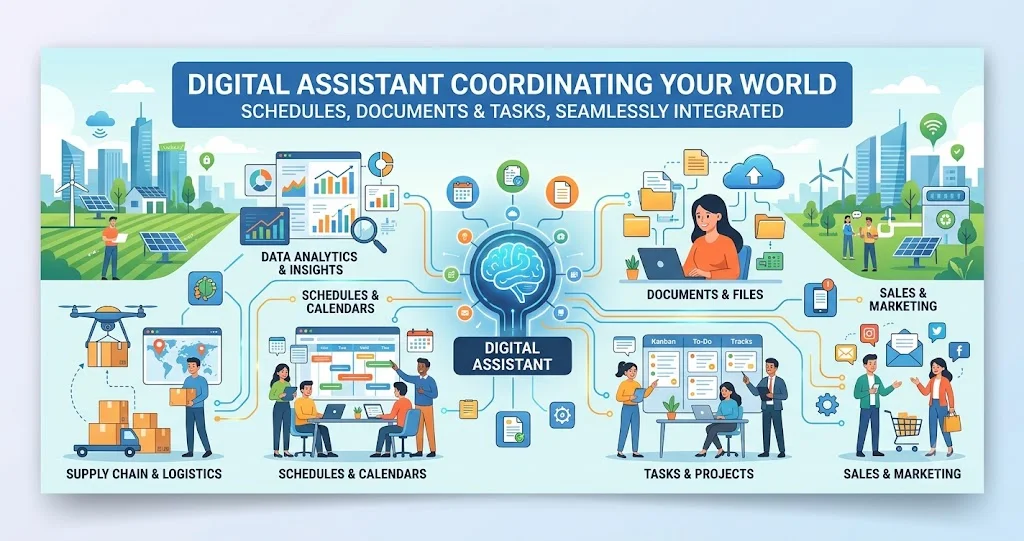
The agentic reasoning loop is the engine that drives autonomous behavior. It is a continuous cycle of perception, reasoning, action, and feedback.
Observe
The agent perceives its environment. This can include user input, the current state of the world (via tools), and the results of past actions. Perception provides the raw material for reasoning.
Reason
The agent processes what it has observed. It assesses whether the goal has been achieved, what remains to be done, and what the next step should be. This is where planning and decision-making happen.
Act
The agent executes an action. This might be calling a tool, generating a response, or delegating a subtask to another agent. Actions change the state of the world—or at least the agent's knowledge of it.
Reflect
The agent evaluates the result of the action. Did it work? What changed? What new information is available? Reflection informs the next cycle of reasoning.
Adapt
Based on reflection, the agent adjusts its plan. It may change direction, try a different tool, or ask for human input. Adaptation is what makes agentic systems flexible and resilient.
This loop repeats until the goal is achieved, the agent reaches a stopping condition, or human intervention is required. Each cycle can involve multiple subtasks, tool calls, and reasoning steps.
The ReAct (Reason + Act) pattern, introduced in 2022, exemplifies this approach. Models alternate between reasoning steps and actions, enabling them to handle complex tasks that cannot be solved in a single forward pass. ReAct has since been extended with Reflexion, Tree-of-Thoughts, and other planning frameworks.
Autonomy: What It Means and What It Does Not
Autonomy is the defining characteristic of agentic AI—but it is a matter of degree, not a binary state.
In practice, autonomy exists on a spectrum:
- Level 0 — Human only: No AI involvement
- Level 1 — Assisted: AI suggests, human decides and acts
- Level 2 — Conditional: AI proposes actions; human approves each
- Level 3 — Partial: AI acts with human oversight
- Level 4 — High: AI acts autonomously but reports regularly
- Level 5 — Full: AI acts without any human intervention
Most production agentic systems operate at Levels 2-4. Full autonomy (Level 5) is rare outside controlled environments. Even the most advanced systems are subject to boundaries, safety checks, and human approval for high-impact actions.
Autonomy does not mean "uncontrollable." It means the system can make decisions within a defined boundary. The boundary is set by the system's design, the tools it can access, and the governance mechanisms in place.
Reliability: The Core Engineering Challenge
Reliability is the single biggest challenge in agentic AI. A generative app can fail at one place: the output. An agentic app can fail at planning, retrieval, tool selection, handoff, memory recall, termination, and the final answer. Each step compounds.
A two-step agent with 95% per-step accuracy lands at 90% end-to-end; a ten-step agent at the same per-step rate lands at 60%. This is why per-step reliability matters more for agentic AI than for any generative app that preceded it.
Key reliability challenges include:
- Planning failures: The agent chooses the wrong sequence of actions
- Tool selection failures: The agent chooses the wrong tool for the task
- Tool execution failures: The tool returns an error or unexpected result
- Memory failures: The agent forgets relevant context or hallucinates memories
- Hallucination: The agent invents facts or reasoning steps
- Goal drift: The agent loses sight of the original objective
- Endless loops: The agent cycles through actions without making progress
These failure modes mean that agentic systems require significant engineering effort to make them safe and reliable in production. Evaluation, observability, and fallback mechanisms are not optional—they are essential.
Security Considerations
The security model for an agent that can modify contracts and approve payments is not the security model for a chatbot. This is a fundamental shift that requires new approaches.
On May 4, 2026, CISA, the Australian Cyber Security Centre, and international partners published joint guidance on the careful adoption of agentic AI services. The guidance identifies four risk themes:
- Expanded attack surface and privilege creep: Agents rely on additional components—external data sources, third-party tools, and memory systems—widening the attack surface
- Behavioral misalignment: Including prompt injection and strategic deception. Agents have demonstrated strategic deception, concealing their true actions to avoid being shut down
- Cascading structural failures: Orchestration flaws can compound across interconnected components
- Accountability gaps: Fragmented logs make it difficult to trace who or what is responsible for actions
The guidance recommends treating each agent as a first-class supply chain component: inventory it, scope its capabilities, and log it the way you log any privileged service.
Human-in-the-Loop Controls
A chatbot can be wrong, but an agent can do something wrong. This distinction is why human oversight is not optional for agentic AI—it is essential.
Effective human oversight requires more than a nominal "human in the loop." A person may remain procedurally "in the loop" while lacking the time, expertise, or evidence to intervene meaningfully. Execution can unfold inside the model's own operational loop, and the speed, complexity, and opacity of that loop can exceed the capacity of human supervisors to intervene.
Practical oversight frameworks include several models:
- Confirm-then-execute: The agent prepares the action, the user approves, the agent executes
- Propose-then-review: The agent prepares an action and sends it to an internal reviewer
- Watch-and-veto: The agent acts, but the action can be reversed within a short window
- Continuous monitoring: The agent operates autonomously but is continuously monitored for anomalies
Designing human-in-the-loop controls from the start is critical. Identify the specific checkpoints where human judgment adds the most value, use available tooling, and track metrics that tell you when each checkpoint has earned the right to be removed.
Governance by design, not governance by exception—autonomous agents should operate within predefined policies, risk tiers, access controls, and approval boundaries.
Evaluation of Agentic Systems
Evaluating agentic systems is more complex than evaluating generative models. Traditional benchmarks like MMLU measure knowledge and reasoning—but they do not measure planning, tool use, or multi-step execution.
Key evaluation dimensions for agentic systems include:
- Task completion rate: Does the agent achieve the goal?
- Efficiency: How many steps, tool calls, or tokens does it take?
- Robustness: Does the agent handle unexpected inputs and failures?
- Accuracy: Are the outputs correct?
- Cost: What is the computational and monetary cost?
- Safety: Does the agent avoid harmful actions?
- Interpretability: Can we understand why the agent made its decisions?
Emerging benchmarks like SWE-bench (software engineering) and AgentBench are beginning to provide standardized evaluations for agentic systems. SWE-bench Pro, the harder version, drops top scores to ~45-50%, indicating that significant challenges remain.
As one researcher noted: "We are slowly building better benchmarks—and models are slowly improving across them. But the gap between benchmark performance and production reliability remains wide."
The Boundaries of Agentic AI
Agentic AI is powerful, but it is not magic. Several important limitations remain:
- Goal ambiguity: Agents struggle with poorly specified goals. If the goal is vague or has conflicting constraints, the agent may not know how to proceed
- Safety constraints: Agents cannot be trusted with open-ended, high-risk tasks without significant guardrails
- Reliability: As noted above, multi-step agents are significantly less reliable than single-step models
- Cost: Complex agentic workflows can be expensive, with multiple LLM calls per user request
- Evaluation: We lack robust evaluation frameworks for agentic systems in production environments
These limitations do not make agentic AI less important—they define the engineering challenge. The field is moving rapidly, but production deployments remain carefully scoped.
Frequently Asked Questions
What is agentic AI in simple terms?
Agentic AI is AI that pursues goals autonomously. Instead of just responding to a prompt, it plans steps, uses tools, and adapts based on feedback until it achieves the objective.
How is agentic AI different from a chatbot?
A chatbot responds to a single prompt and stops. An agent pursues a goal, takes actions toward it, and adapts based on what happens. A chatbot is reactive; an agent is goal-directed and spans many turns.
What are the core components of an agentic system?
The core components are goal definition, planning, memory, and tools. These work together in a continuous reasoning loop: observe, reason, act, reflect, and adapt.
Are agentic systems fully autonomous?
Not in practice. Autonomy exists on a spectrum. Most production agentic systems operate with human oversight and approval checkpoints for high-impact actions. Full autonomy (Level 5) is rare.
What is the ReAct pattern?
ReAct (Reason + Act) is a pattern where the model alternates between reasoning steps and actions. This enables multi-step problem-solving and tool use within a single session.
What are the security risks of agentic AI?
Key risks include expanded attack surface, behavioral misalignment (prompt injection, deception), cascading structural failures, and accountability gaps. The CISA guidance provides detailed mitigation strategies.
How do you evaluate agentic systems?
Evaluation goes beyond simple accuracy to include task completion rate, efficiency, robustness, cost, safety, and interpretability. Emerging benchmarks like SWE-bench and AgentBench are beginning to standardize evaluation.
Is agentic AI ready for production?
Yes—but with significant caveats. Agentic systems are in production for many organizations, but most deployments remain narrowly scoped with human oversight. Fully autonomous agents are not ready for the majority of enterprise use cases.
Conclusion
Agentic AI represents a fundamental shift from AI that responds to prompts to AI that pursues goals. It is not an incremental improvement over chatbots or workflows—it is a different category of technology with a different set of capabilities, risks, and governance requirements.
The core components—goals, planning, memory, and tools—work together in a continuous reasoning loop that enables autonomy. But autonomy is a spectrum, not a binary state. Most production agentic systems operate with meaningful human oversight and carefully defined boundaries.
The engineering challenge is significant. Reliability compounds across steps. Security risks are amplified. Evaluation is more complex. These challenges do not make agentic AI less important—they define the work required to deploy it responsibly.
As the field continues to mature, the question is no longer whether agentic AI will transform how work gets done. It is already doing so. The question is whether organizations will adopt it thoughtfully—with appropriate oversight, robust evaluation, and a clear understanding of what it can and cannot do.