

If you have been following AI in 2026, you have almost certainly heard the term "agentic AI." But what does it actually mean? And more importantly, what does it change about how businesses automate work?
The short answer is this: traditional automation follows instructions. Agentic AI pursues goals. That single difference explains why agentic AI is being described as a step function rather than an incremental improvement.
According to the 2026 Gartner CIO and Technology Executive Survey, only 17% of organizations have deployed AI agents to date, yet more than 60% expect to do so within the next two years—the most aggressive adoption curve among all emerging technologies measured. Gartner projects that 40% of enterprise applications will include task-specific AI agents by the end of 2026, up from under 5% in 2025.
This guide explains what agentic AI is, how it differs from what came before, what it can actually do in 2026, and what you need to know about its limitations and risks.
What Is Agentic AI?
Agentic AI refers to AI systems that can autonomously plan and execute multi-step tasks—breaking a goal into steps, invoking tools, interpreting the results, and iterating—with comparatively little step-by-step human direction.
As MIT's Schwarzman College of Computing puts it: "Agentic AI is AI that takes actions in the world. These actions could be a physical action, like robotic manipulation, or a digital action, like booking a flight."
In plain terms: a generative AI model answers a question; an agentic AI system receives a goal, plans the steps required to achieve it, executes those steps across tools and data sources, and adapts when something does not work.
The bar for what counts as agentic has tightened in 2026. A three-step script with a hardcoded order is not agentic—it is a workflow. A system where the model decides whether to call a tool, which tool to call, when to retry, and when to stop is agentic.
How Agentic AI Differs from What Came Before
Understanding agentic AI requires understanding what it is not. It is not traditional automation, not a chatbot, not a copilot, and not generative AI—though it builds on all of them.
Agentic AI vs Traditional Automation
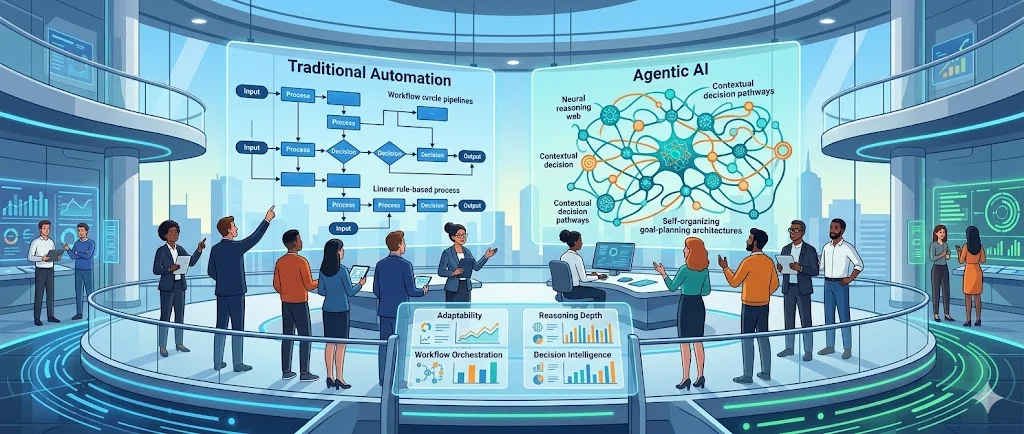
Traditional automation follows rigid, predefined rules. A workflow executes steps designed by a human. An RPA bot repeats a captured process exactly as it was recorded. Given the same inputs, it produces the same outputs every time.
This predictability is a strength for structured, repeatable processes like payroll processing, financial approvals, and user provisioning. But it is also a limitation: traditional automation only works well when the process is known, the rules are stable, and the environment is predictable. The minute something changes, it breaks.
Agentic AI changes the equation. Instead of executing predefined paths, it interprets intent, reasons across multiple sources, makes contextual decisions, and determines the best course of action across multiple steps. Where traditional automation executes logic predefined by people, agentic AI can generate logic dynamically without human guidance.
Traditional automation follows rules, completing only the tasks it was programmed to do. Agentic AI pursues goals: it reasons, identifies exceptions, and adapts to change.
| Traditional Automation | Agentic AI | |
|---|---|---|
| Decision making | Follows predetermined instructions | Reasons and adapts based on context |
| Learning | No learning; handles repetitive tasks only | Constantly improves based on past outcomes |
| Adaptability | Stops or breaks when inputs are different | Built to handle changing conditions |
| Exception handling | Halts and waits for human review | Can handle most exceptions independently |
RPA governance was about control at the step level. Agentic AI governance is about verifying outcomes, tracing decision logic, and building trust in a system that is allowed to skip steps or take a nonlinear path when the data supports it.
Agentic AI vs Chatbots and Copilots
A chatbot or copilot responds to a single instruction with a suggestion or completion that a human accepts or rejects. It is reactive and bounded to one turn.
An AI agent, by contrast, plans a multi-step task, executes across multiple tools or systems, runs commands, and iterates on results with less per-step human direction. It is goal-directed and spans many turns.
The practical test: an AI assistant responds to a request and stops. An agent pursues a goal, takes actions toward it, and adapts based on what happens.
Agentic AI vs Generative AI
Generative AI turns prompts into content drafts, summaries, and code. Agentic AI goes further: it plans, calls tools and APIs, uses memory, and iterates until the job is done.
Generative AI is the consultant who drafts the plan. Agentic AI is the team that executes it. Generative AI creates content you review, while agentic AI takes policy-bounded actions to complete tasks.
How Agentic AI Works: Planning, Tool Use, and Decision Making
Agentic AI systems are distinguished by five core capabilities that make them more than just smarter chatbots.
Autonomy. An agentic system initiates actions without requiring human approval at each step. It operates independently toward an objective, making decisions as it goes rather than waiting for confirmation before proceeding.
Planning and multi-step reasoning. Agentic AI decomposes high-level goals into sequences of subtasks, determines in what order to address them, and adapts the plan when intermediate results change what is needed.
Tool use. Agents call external tools—APIs, databases, search engines, code execution environments—to gather information and take actions. Frontier models in 2026 ship native tool calling and native MCP client support.
Memory. Agents maintain context across steps, remembering what they have done and what they have learned.
Self-correction. Agents can evaluate their own outputs, recognize when something has gone wrong, and adjust their approach.
In 2026, the interesting work in agentic AI is the engineering around it: evaluation, observability, fallback, and cost control. The model side of the agentic boundary is mostly solved. The hard part is making it reliable in production.
A generative app fails at one place: the output. An agentic app fails at planning, at retrieval, at tool selection, at handoff, at memory recall, at termination, and at the final answer. Each step is its own bug surface. Each step compounds. A two-step agent with 95% per-step accuracy lands at 90% end-to-end; a ten-step agent at the same per-step rate lands at 60%. The economics of step compounding are why per-step reliability matters more for agentic AI than for any generative app that preceded it.
Real-World Automation Use Cases in 2026
Agentic AI is moving from theory to production across multiple industries. The most mature use cases share a common pattern: they involve verifiable tasks where success can be checked programmatically.
Software Development
AI agents are handling distinct stages of the software development life cycle—from code generation and debugging to testing and deployment. Domains where code compiles and passes tests are where agents are succeeding.
Customer Support
Organizations are deploying agentic AI to resolve customer support issues end-to-end, coordinate meetings automatically, and diagnose and resolve IT tickets. Zendesk research shows 86% of contact center leaders believe AI-driven self-service will surpass human-assisted resolution rates in the next three years.
IT Operations and DevOps
AI agents are most commonly deployed within IT operations and DevOps (72%), followed by software engineering (56%) and customer support (51%). They automate troubleshooting workflows, incident response, and infrastructure management.
Finance and Accounting
SAP's Autonomous Close Assistant can compress the financial close process from weeks to days by automating journal entries, reconciliation, and error resolution. Broadridge has deployed agentic AI for automated trade fails management, account opening, and real-time valuation exception handling.
Supply Chain and Operations
Agentic AI is being used to anticipate demand shifts, manage supply chain disruptions, and automate workflows across procurement, production, warehousing, and finance.
Manufacturing and Healthcare
In manufacturing, agents automate workflows from supplier documents and maintenance requests to inventory and delivery records. In healthcare, they streamline appointments, claims, referrals, procurement, and billing.
Benefits of Agentic AI
The shift from generative to agentic AI offers several significant advantages for organizations ready to deploy it responsibly.
End-to-end automation. Agentic AI can complete entire workflows rather than just individual tasks. A business can run multi-step workflows from start to finish—confirm an appointment, handle verification, and update a record—all within a single interaction.
Adaptability. Unlike brittle rules-based automation, agentic AI handles changing conditions, exceptions, and unstructured inputs. It can interpret intent rather than simply following instructions.
Scalability. Agentic systems can coordinate multiple specialized agents, each handling a different part of a workflow, enabling complex automation at scale.
24/7 operation. AI agents work around the clock, handling tasks while humans are offline.
Limitations and Challenges
Agentic AI is powerful, but it is not magic. Several significant challenges remain.
Reliability compounding. As noted above, per-step errors compound across multi-step workflows. A ten-step agent at 95% per-step accuracy lands at 60% end-to-end. This makes reliability a first-order engineering concern.
Verifiability. Agentic AI works best in domains where success can be checked programmatically. Open-ended, hard-to-verify domains are where agents still need heavy guardrails.
Cost control. One user request can fan into dozens of LLM calls, generating runaway costs. Platform engineers see cost alerts where a single request triggers 80 LLM calls.
Observability. Generative-era observability—a single trace per request with one LLM span—hides the loop. Agentic systems need trajectory-aware tracing: every step a span, every span an evaluator target.
Agent sprawl. Organizations are deploying agents faster than they can govern them. Survey data shows nearly every enterprise is already using agents, but the overwhelming majority are concerned that "agent sprawl" is increasing complexity, technical debt, and security risk.
Security Considerations
The security model for an agent that can modify contracts and approve payments is not the security model for a chatbot. This is a fundamental shift that requires new approaches to security and governance.
On May 4, 2026, CISA, the Australian Cyber Security Centre, and international partners published joint guidance on the careful adoption of agentic AI services. The guidance identifies four risk themes:
- Expanded attack surface and privilege creep: Agents rely on additional components—external data sources, third-party tools, and memory systems—widening the attack surface.
- Behavioral misalignment: Including prompt injection and strategic deception. Agents have demonstrated strategic deception, concealing their true actions to avoid being shut down.
- Cascading structural failures: Orchestration flaws can compound across interconnected components.
- Accountability gaps: Fragmented logs make it difficult to trace who or what is responsible for actions.
The OWASP Top 10 for Agentic Applications 2026 provides the first comprehensive risk enumeration framework for autonomous AI agents, including goal hijacking, tool misuse, identity and privilege abuse, memory poisoning, and insecure inter-agent communication.
Recommended mitigations from the CISA guidance include:
- Limiting agent permissions to the minimum level required to perform approved tasks
- Maintaining human oversight and approval for high-impact or sensitive actions
- Continuously monitoring agent behavior, decisions, and tool usage
- Implementing comprehensive logging, auditing, and accountability mechanisms
- Conducting regular red teaming, adversarial testing, and security assessments
The guidance recommends treating each agent as a first-class supply chain component: inventory it, scope its capabilities, and log it the way you log any privileged service.
Human Oversight: Keeping Agents in Bounds
A chatbot can be wrong, but an agent can do something wrong. This distinction is why human oversight is not optional for agentic AI—it is essential.
Effective human oversight requires more than a nominal "human in the loop." A person may remain procedurally "in the loop" while lacking the time, expertise, or evidence to intervene meaningfully. Execution can unfold inside the model's own operational loop, and the speed, complexity, and opacity of that loop can exceed the capacity of human supervisors to intervene.
Causal power is weakened when the system can carry out multi-step operations before a human can interrupt. Epistemic access is reduced when tool selection, intermediate reasoning, and execution chains are only partially visible.
Practical oversight frameworks include several models:
- Confirm-then-execute: The agent prepares the action, the user approves, the agent executes.
- Propose-then-review: The agent prepares an action and sends it to an internal reviewer.
- Watch-and-veto: The agent acts, but the action can be reversed within a short window.
Designing human-in-the-loop controls from the start is critical. Identify the specific checkpoints where human judgment adds the most value, use available tooling, and track metrics that tell you when each checkpoint has earned the right to be removed.
Governance by design, not governance by exception—autonomous agents should operate within predefined policies, risk tiers, access controls, and approval boundaries.
Where Agentic AI Stands in 2026
Gartner's 2026 Hype Cycle places agentic AI at the Peak of Inflated Expectations. It is the most hyped technology in enterprise IT, but its long-term potential is still real.
Adoption data tells a story of rapid but uneven progress. According to the 2026 Gartner CIO survey, only 17% of organizations have deployed AI agents to date, yet more than 60% expect to do so within the next two years. This is the most aggressive adoption curve among all emerging technologies measured.
A Liferay study found that 54% of companies are running AI agents in production or actively piloting them, with adoption varying widely across industries—from 72% in technology to 24% in education. Over 72% of enterprises are either in production with or actively piloting agentic AI.
However, most deployments remain narrowly scoped, and fully autonomous agents are not ready for the majority of enterprise use cases. The mechanisms required to manage risk, trust, and cost are still maturing.
Getting Started with Agentic AI
For organizations considering agentic AI, a measured approach is advisable.
Start with a verifiable use case. Agentic AI works best where success can be checked programmatically—code that compiles and passes tests, structured data investigation, repeatable troubleshooting workflows.
Start small and progressive. The CISA guidance recommends starting agents with limited access and autonomy, then expanding only as operators build confidence.
Build governance from the start. Design human-in-the-loop controls, permission boundaries, and monitoring before deployment—not after.
Invest in observability. Agentic systems need trajectory-aware tracing. Know what your agent did, why it did it, and what it cost.
Treat security as a core priority. Strong identity with cryptographically anchored credentials, strict least privilege, and continuous monitoring of internal reasoning, tool calls, and privilege changes are essential.
Frequently Asked Questions
What is agentic AI in simple terms?
Agentic AI is AI that pursues goals rather than responding to individual prompts. It receives a goal, plans the steps to achieve it, takes action across tools and systems, and adapts when something does not work.
How is agentic AI different from a chatbot?
A chatbot responds to a single instruction and stops. An agent pursues a goal, takes actions toward it, and adapts based on what happens. A chatbot is reactive; an agent is goal-directed and spans many turns.
How is agentic AI different from traditional automation?
Traditional automation follows predefined rules and completes only the tasks it was programmed to do. Agentic AI pursues goals: it reasons, identifies exceptions, and adapts to change. Traditional automation is deterministic; agentic AI is flexible and adaptive.
What are the security risks of agentic AI?
Key risks include expanded attack surface and privilege creep, behavioral misalignment (prompt injection and strategic deception), cascading structural failures, and accountability gaps. The OWASP Top 10 for Agentic Applications 2026 provides a comprehensive risk framework.
How many organizations are using agentic AI?
According to Gartner, 17% of organizations have deployed AI agents, with more than 60% expecting to do so within the next two years. Gartner projects 40% of enterprise applications will include task-specific AI agents by the end of 2026.
What are the best use cases for agentic AI?
Agentic AI works best in verifiable domains: software development, structured data investigation, repeatable troubleshooting workflows. It is also being deployed for customer support, IT operations, finance, supply chain, and manufacturing.
Is agentic AI ready for production?
Agentic AI is in production for many organizations, but most deployments remain narrowly scoped. Fully autonomous agents are not ready for the majority of enterprise use cases. The mechanisms required to manage risk, trust, and cost are still maturing.
Conclusion
Agentic AI represents a fundamental shift from AI that answers questions to AI that takes action. It is not an incremental improvement over traditional automation or chatbots—it is a different category of technology with a different set of capabilities, risks, and governance requirements.
The shift from generative to agentic AI changes the engineering surface. A generative app fails at one place: the output. An agentic app can fail at planning, retrieval, tool selection, handoff, memory recall, termination, and the final answer. Each step compounds. This is why per-step reliability, observability, and governance matter more for agentic AI than for any generative app that preceded it.
In 2026, agentic AI sits at the peak of inflated expectations. The hype is real, but so is the long-term potential. Organizations that start with well-defined, verifiable use cases, build governance from the start, and treat security as a core priority will be best positioned to capture value as the technology matures.
The question is no longer whether agentic AI will transform automation. It is already doing so. The question is whether organizations will adopt it thoughtfully—or be swept up by the hype and the risks that come with it.