

In July 2026, Moonshot AI released Kimi K3, a flagship large language model that quickly became one of the most talked-about events in the AI world. From social media to technical forums, the buzz was immediate and intense. But what exactly makes Kimi K3 so noteworthy? This article examines the factors behind the attention, from its technical scale to its open-source availability and community reception.
The Scale That Captured the World's Attention
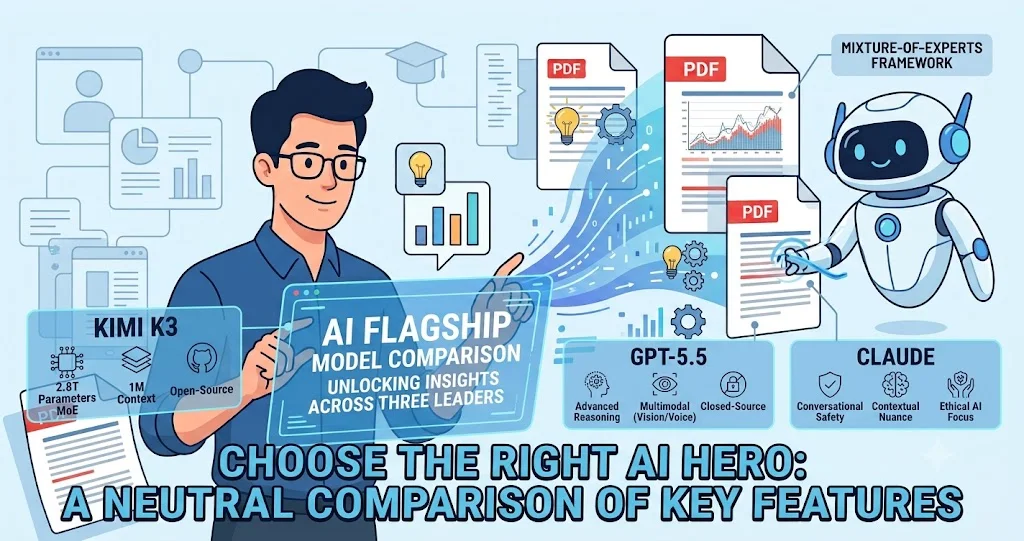
Kimi K3 is the world's first open-source model in the 3-trillion-parameter class, with 2.8 trillion total parameters. This alone would be remarkable, but the model also features a 1-million-token context window, enabling it to process entire books, codebases, or extensive document collections in a single session. The combination of unprecedented scale and open availability is a key reason for the excitement.
To put this in perspective, most open-source models have historically been in the tens or hundreds of billions of parameters. Kimi K3's scale represents a step change in what is accessible to the open-source community. While the model uses a Mixture-of-Experts architecture that activates only 104 billion parameters per inference, the total capacity enables broad knowledge coverage and sophisticated reasoning.
Architectural Innovations That Matter
Kimi K3 introduces several technical innovations that address fundamental challenges in scaling large language models.
Kimi Delta Attention (KDA)
This hybrid linear attention mechanism reduces the computational complexity of processing long sequences from near-quadratic to near-linear growth. This means that as the context length increases to 1 million tokens, the compute required does not balloon exponentially. KDA makes the 1M-token context practical for real-world inference, setting a new standard for long-document processing.
Attention Residuals (AttnRes)
In very deep models, information can degrade as it passes through layers. Attention Residuals act as a stabilizer, ensuring that signals remain intact across the 2.8 trillion-parameter network. This enables stable training and reliable performance at unprecedented scale.
Stable LatentMoE Framework
With 896 routing experts and activation of only 16 per token, Kimi K3 achieves a sparsity ratio of approximately 56x. The Stable LatentMoE framework stabilizes training and inference in this highly sparse configuration, delivering roughly 2.5 times the scaling efficiency of its predecessor, Kimi K2. These innovations are not just academic; they enable the model to perform efficiently on commodity hardware and cloud instances, making large-scale AI more accessible.
Performance That Rivals the Best
Kimi K3 has demonstrated competitive performance on independent benchmarks, ranking among the top models globally.
- Overall Intelligence: According to Artificial Analysis, Kimi K3 ranks third overall, behind Claude Fable 5 and GPT-5.6 Sol, making it the highest-ranked open-weight model.
- Frontend Code Arena: Kimi K3 scored 1679, surpassing Claude Fable 5 (1631) and GPT-5.6 Sol (1618), marking the first time an open-source model has topped this benchmark.
- Agentic Programming: In SuperCLUE's agentic programming dimension, Kimi K3 achieved 75.79 points, ranking first.
- Knowledge Work: On the AA-Briefcase benchmark, Kimi K3 scored 1543, second only to Claude Fable 5.
These results demonstrate that open-source models can compete with, and in some areas surpass, the best proprietary systems. This is a major shift in the AI landscape.
Open-Source Release: A Historic Moment
On July 27, 2026, Moonshot AI released the full model weights, a 47-page technical report, and three supporting infrastructure technologies: MoonEP, FlashKDA, and AgentEnv. This open-source release is unprecedented for a model of this scale. For the first time, researchers, startups, and enterprises can download, run, and adapt a 2.8 trillion-parameter model locally without restrictions.
The community response was immediate. On Hugging Face, Kimi K3 received over 4,000 likes within 30 minutes of upload, reaching the top of the platform's trending charts and setting a record for the fastest growth since its founding. Chinese computing hardware providers, including Huawei and Alibaba, quickly adapted their infrastructure to support Kimi K3 deployment. The release has been described as a watershed moment for open AI, democratizing access to frontier capabilities.
Narrowing the Gap Between Open and Closed Models
Industry observers have noted that the technology gap between Chinese open-source models and global frontier models has compressed from 6-9 months to approximately 2-3 months. Kimi K3's performance, sitting just behind the top closed models, exemplifies this trend. The model's success suggests that open-source development can keep pace with, and occasionally lead, proprietary innovation.
Practical Applications and Accessibility
Kimi K3 is not just a research curiosity; it is readily accessible for practical use.
- Web Interface: Users can try Kimi K3 immediately at kimi.com without any configuration.
- Mobile App: The Kimi AI mobile app provides on-the-go access.
- API Platform: Developers can integrate Kimi K3 via the Kimi API after account top-up.
- Kimi Code: A terminal and IDE coding agent that leverages Kimi K3's capabilities for repository-scale tasks.
- Cloud Providers: Alibaba Cloud and QingCloud's CoresHub offer hosted Kimi K3 services.
This multi-channel availability ensures that the model's power reaches a wide audience, from casual users to enterprise developers.
Comparison: Kimi K3 vs Other Models
The table below highlights key differentiators that contribute to the attention.
| Feature | Kimi K3 | GPT-5.6 Sol | Claude Fable 5 |
|---|---|---|---|
| Parameter Count | 2.8T (open) | Undisclosed (closed) | Undisclosed (closed) |
| Context Window | 1M tokens | Varies | Varies |
| Openness | Full open-weight | Closed | Closed |
| Frontend Code Arena | #1 (1679) | #3 (1618) | #2 (1631) |
| Intelligence Rank | #3 | #2 | #1 |
| API Cost | Lower | Higher | Higher |
Companies and Research Institutions Embracing Kimi K3
Since its release, Kimi K3 has been adopted by a growing number of organizations. Universities are using it for AI research and education. Startups are building applications on top of the open weights. Enterprises are evaluating it for internal knowledge management and software development. The open nature allows for fine-tuning on proprietary data, a significant advantage over closed models.
Selection Checklist for Kimi K3 Adoption
Consider these factors when evaluating Kimi K3 for your projects:
- Do you need long-context processing beyond typical limits (e.g., entire codebases)?
- Is open-source transparency and customization a priority?
- Are coding and software engineering tasks central to your work?
- Do you require cost-effective API access?
- Is local deployment or fine-tuning necessary for your use case?
- Are you comfortable with the computational requirements for self-hosting?
- Do you value independence from proprietary ecosystems?
Tips for Getting Started with Kimi K3
- Begin with the web interface to understand the model's capabilities.
- For development, use the Kimi API for ease and scalability.
- Explore Kimi Code for software engineering tasks.
- If you have the infrastructure, download the weights for custom fine-tuning.
- Engage with the community on Hugging Face and forums to share experiences and get support.
- Stay updated on new releases and optimizations from Moonshot AI.
Frequently Asked Questions About Kimi K3
Why is Kimi K3 getting so much attention?
Kimi K3 has attracted attention due to its unprecedented scale (2.8T parameters), 1M-token context window, open-source release, top-tier coding performance, and the historic community response.
Is Kimi K3 better than GPT-5.5 or Claude?
It depends on the use case. Kimi K3 ranks third in overall intelligence but first in frontend coding. It offers open-source benefits and lower cost.
Can I download and run Kimi K3 locally?
Yes, the weights are freely available. However, it requires substantial GPU resources; many users choose cloud deployment or API access.
What is the context window of Kimi K3?
Kimi K3 supports a 1-million-token context window, enabling processing of very long documents.
Is Kimi K3 truly open-source?
Yes, Moonshot AI released the full model weights, technical report, and supporting infrastructure under open licensing.
How does Kimi K3 compare to Gemini?
Kimi K3 is open-source with a 1M context, while Gemini is closed with a 2M context and broader multimodality. Kimi K3 excels in coding; Gemini excels in ecosystem integration.
What are the main use cases for Kimi K3?
Long-horizon coding, knowledge work, research, document analysis, and agentic tasks.
How do I access Kimi K3?
Through the web interface at kimi.com, mobile app, Kimi API, or cloud providers like Alibaba Cloud.
What hardware is needed to run Kimi K3?
Running the full model locally requires significant GPU resources; cloud instances with multiple GPUs are recommended.
What is the significance of the open-source release?
It democratizes access to frontier AI, enables transparency, and allows customization for specific applications.
Conclusion
Kimi K3 has generated extraordinary attention for good reason. It combines unprecedented scale, a 1M-token context window, architectural innovations that solve key scaling challenges, and top-tier performance in coding and reasoning. The open-source release makes all of this available to the global community, marking a turning point in the democratization of AI. For developers, researchers, and organizations, Kimi K3 offers a powerful, transparent, and cost-effective alternative to closed models. As the AI landscape continues to evolve, models like Kimi K3 will play a crucial role in shaping the future of open, accessible, and innovative artificial intelligence.