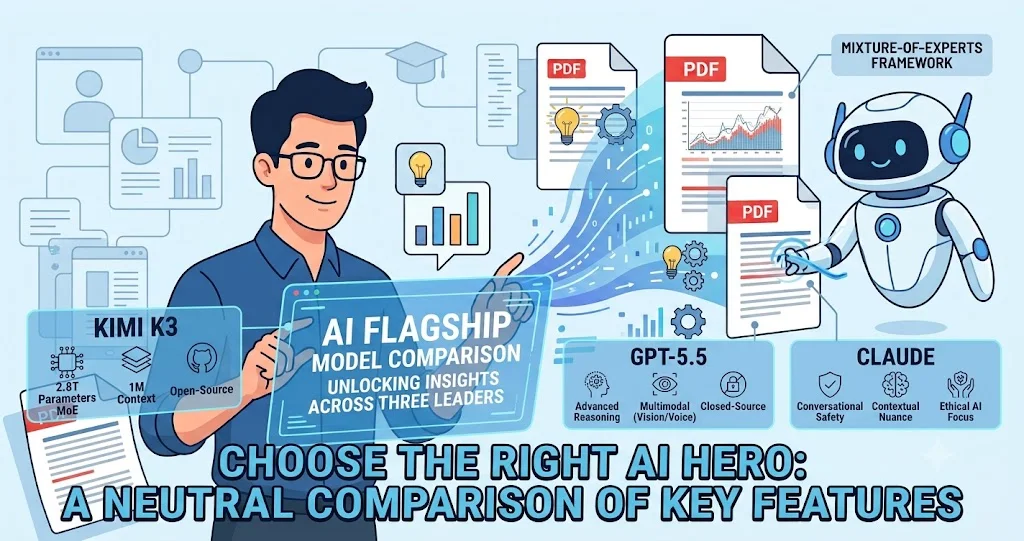

The AI model landscape has become increasingly competitive with the emergence of flagship systems from leading companies. Kimi K3, released by Moonshot AI in July 2026, and Gemini, Google's ongoing series of multimodal models, represent two distinct philosophies in AI development. This comparison explores their features, performance, and practical applications to help you decide which aligns with your needs.
Overview of Kimi K3
Kimi K3 is Moonshot AI's flagship large language model, first announced on July 16, 2026. It is the world's first open-source model in the 3-trillion-parameter class, with 2.8 trillion total parameters built on a Mixture-of-Experts (MoE) architecture. The model features a 1-million-token context window and native visual understanding through the MoonViT-V2 architecture. Its architectural innovations include Kimi Delta Attention (KDA) for efficient long-sequence processing, Attention Residuals (AttnRes) for stable deep-layer training, and a Stable LatentMoE framework that achieves approximately 56x sparsity. Kimi K3 is designed for frontier intelligence scenarios including long-horizon coding, knowledge work, and agentic tasks.
Overview of Gemini
Gemini is Google's family of multimodal AI models, originally introduced in December 2023 and since updated with newer versions. Gemini models are built for multimodality from the ground up, capable of understanding and reasoning across text, images, audio, video, and code. Google has integrated Gemini across its ecosystem, including Search, Workspace (Docs, Gmail, Sheets), and Cloud services. While specific parameter counts are undisclosed, Gemini models are known for their large context windows (up to 2 million tokens in some versions), strong reasoning capabilities, and seamless tool integration. Gemini is closed-source, with access provided through APIs, Google's AI Studio, and consumer products like Gemini Advanced.
Key Comparison Areas
- Architecture and Parameters: Kimi K3 uses MoE with 896 routing experts, activating 16 per token, with 2.8T total parameters. Gemini's architecture is proprietary but is also likely MoE-based with undisclosed parameter counts.
- Context Window: Kimi K3 offers 1 million tokens. Gemini offers up to 2 million tokens in some versions, making it the leader in context length.
- Multimodal Capabilities: Kimi K3 natively supports text, images, and video. Gemini natively supports text, images, audio, video, and code.
- Openness: Kimi K3 is fully open-weight, with model weights and technical reports publicly available. Gemini is closed-source and proprietary.
- Ecosystem Integration: Gemini benefits from deep integration with Google's ecosystem (Search, Workspace, Android). Kimi K3 integrates with the Kimi AI assistant and Kimi Code, with growing third-party support.
- Cost Efficiency: Kimi K3's API pricing is generally lower than Gemini's, though exact figures vary.
Performance Benchmarks
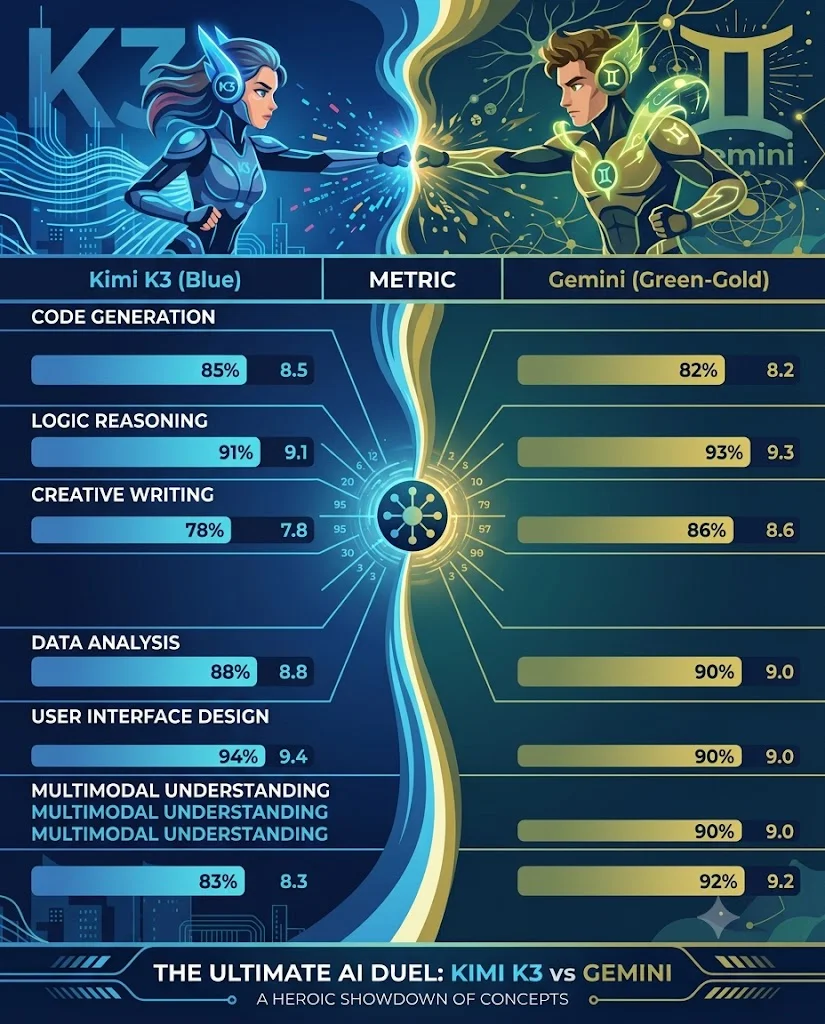
Independent evaluations provide comparative insights. According to Artificial Analysis (as of mid-2026), Kimi K3 ranks third overall in intelligence among all AI models, behind Claude Fable 5 and GPT-5.6 Sol, making it the highest-ranked open-weight model. Gemini's latest versions often rank in the top tier, though specific rankings vary by benchmark. In coding, Kimi K3 scored 1679 on the Frontend Code Arena, outperforming many closed models. Gemini excels in reasoning and general knowledge tasks, with strong performance on MMLU, GSM8K, and other academic benchmarks. Both models demonstrate state-of-the-art capabilities in their respective strengths.
Benefits and Limitations
Kimi K3 Benefits
- Full open-source access enables customization, fine-tuning, and local deployment.
- Exceptional context window (1M tokens) suitable for processing entire codebases and books.
- Top-tier coding performance, especially in frontend development and software engineering.
- Cost-effective API pricing for high-volume usage.
- Native visual understanding integrated into the model architecture.
Kimi K3 Limitations
- Requires significant computational resources for local deployment.
- Less mature ecosystem compared to Google's offerings.
- May have less conversational nuance compared to some closed models.
Gemini Benefits
- Seamless integration with Google's ecosystem (Search, Workspace, Android).
- Very large context window (up to 2M tokens) for ultra-long document processing.
- Broad multimodal support covering text, images, audio, video, and code.
- Strong reasoning and general knowledge capabilities.
- Backed by Google's infrastructure and continuous research investment.
Gemini Limitations
- Closed-source, limiting transparency, customization, and local deployment.
- Higher cost compared to open-source alternatives like Kimi K3.
- Potential vendor lock-in with Google's ecosystem.
- Privacy concerns related to data handling and cloud dependency.
Types of AI Models and Current Trends
Kimi K3 and Gemini represent two major paradigms: open-source behemoths and proprietary ecosystem-integrated models.
Current Trends
- Expanding Context Windows: Both models push context limits, with Gemini reaching 2M tokens and Kimi K3 at 1M, enabling processing of entire books or code repositories.
- Multimodal Integration: Native support for multiple input types is becoming standard, with Gemini leading in breadth (text, image, audio, video) and Kimi K3 focusing on text, image, and video.
- Open-Source Momentum: Kimi K3's open release demonstrates the viability of large-scale open models, challenging the dominance of closed systems.
- Agentic Capabilities: Both models are evolving toward autonomous task execution, tool calling, and multi-step reasoning.
- Cost Optimization: Sparse architectures like MoE (used by Kimi K3) and efficient attention mechanisms are reducing inference costs.
Use Cases: Which Model to Choose?
Choose Kimi K3 If You:
- Need open-source transparency and the ability to customize or fine-tune the model.
- Require long-context processing up to 1M tokens for research, code analysis, or document synthesis.
- Prioritize coding performance, especially in software engineering and frontend development.
- Prefer cost-effective API access for large-scale applications.
- Value independence from proprietary ecosystems.
Choose Gemini If You:
- Need the longest possible context window (up to 2M tokens) for ultra-large document processing.
- Rely heavily on Google's ecosystem (Search, Workspace, Cloud) and want seamless integration.
- Require broad multimodal capabilities including audio and video understanding.
- Prefer a fully managed, enterprise-ready service with strong support.
- Are building applications that benefit from Google's infrastructure and data access.
Comparison Table
| Feature | Kimi K3 | Gemini |
|---|---|---|
| Total Parameters | 2.8 trillion (open) | Undisclosed (proprietary) |
| Architecture | MoE with 896 experts | Proprietary MoE (presumed) |
| Context Window | 1 million tokens | Up to 2 million tokens |
| Multimodal Support | Text, image, video | Text, image, audio, video, code |
| Openness | Open-weight (fully open) | Closed-source |
| Ecosystem Integration | Kimi AI, Kimi Code; growing third-party | Google Search, Workspace, Cloud, Android |
| Coding Performance | #1 on Frontend Code Arena | Strong, but typically behind Kimi K3 in frontend |
| Overall Intelligence Rank | #3 (Artificial Analysis) | Top tier, rank varies |
| Cost Efficiency | Lower API pricing | Higher pricing (typical) |
Companies and Institutions Using These Models
Kimi K3 is adopted by research institutions, startups, and enterprises seeking open-source flexibility. Its open weights enable academic research, custom fine-tuning, and on-premises deployment. Gemini is used by large enterprises, Google Cloud customers, and consumers through Gemini Advanced, Google Workspace, and Android integrations. Both models serve diverse sectors including technology, finance, healthcare, and education.
Selection Checklist for Choosing Between Kimi K3 and Gemini
- Do you require open-source access for customization and local deployment?
- What is the typical length of your inputs (up to 1M or up to 2M tokens)?
- Do you need multimodal capabilities beyond text and images (e.g., audio, video)?
- How important is integration with Google's ecosystem versus platform independence?
- What is your budget for API usage or subscription?
- Are coding and software engineering tasks a primary focus?
- Do you prioritize cost efficiency over managed services?
- Are there privacy or data sovereignty requirements that favor on-premises deployment?
Tips for Evaluating and Using Each Model
- For Kimi K3, start with the free web interface at kimi.com to test capabilities, then explore API access or local deployment for production.
- For Gemini, use Google AI Studio or Gemini Advanced to experiment with features and integration.
- Test both models on your specific tasks (e.g., code generation, document summarization, multi-turn conversations) to compare quality and latency.
- Consider hybrid approaches: use Kimi K3 for coding and long-document analysis, and Gemini for tasks requiring Google ecosystem integration.
- Monitor updates: both models receive regular improvements; stay informed about new versions and capabilities.
Frequently Asked Questions
Which model has the larger context window?
Gemini offers up to 2 million tokens, while Kimi K3 offers 1 million tokens. Gemini has the advantage for ultra-long documents.
Is Kimi K3 truly open-source?
Yes, Moonshot AI released the full model weights, a technical report, and supporting infrastructure on July 27, 2026.
Can I run Kimi K3 locally?
Yes, but it requires substantial GPU resources. Most users leverage cloud deployment or API access for convenience.
Does Gemini support video understanding?
Yes, Gemini natively supports video alongside text, images, and audio, making it more comprehensive in multimodality.
Which model is better for coding?
Kimi K3 ranks first on Frontend Code Arena, outperforming many closed models. Gemini is also capable but generally trails in frontend-specific benchmarks.
Is Gemini available for free?
Gemini offers a limited free tier through Google AI Studio and Gemini Advanced trial; full features require a paid subscription.
How do I access Kimi K3?
Through the web interface at kimi.com, the mobile app, or the Kimi API platform after account top-up. The model weights are also available for download.
Which is more cost-effective?
Kimi K3's API pricing is generally lower than Gemini's, making it a cost-effective choice for high-volume usage.
Can I fine-tune Kimi K3?
Yes, as an open-weight model, you can fine-tune it on custom datasets using appropriate hardware or cloud services.
Does Gemini integrate with Google Workspace?
Yes, Gemini is deeply integrated with Gmail, Docs, Sheets, Slides, and other Workspace applications.
Conclusion
Kimi K3 and Gemini represent two leading edges of AI development, each with distinct advantages. Kimi K3 offers the benefits of open-source transparency, strong coding performance, cost efficiency, and a 1M-token context window, making it ideal for developers, researchers, and organizations seeking customization and independence. Gemini provides the longest context window (2M tokens), broad multimodal support, and seamless integration with Google's ecosystem, making it a powerful choice for enterprises and users deeply embedded in Google services. The decision ultimately hinges on your specific requirements—whether you prioritize openness and cost or ecosystem integration and multimodal breadth. By leveraging the comparison and checklist in this guide, you can make an informed choice that aligns with your technical and business goals.