
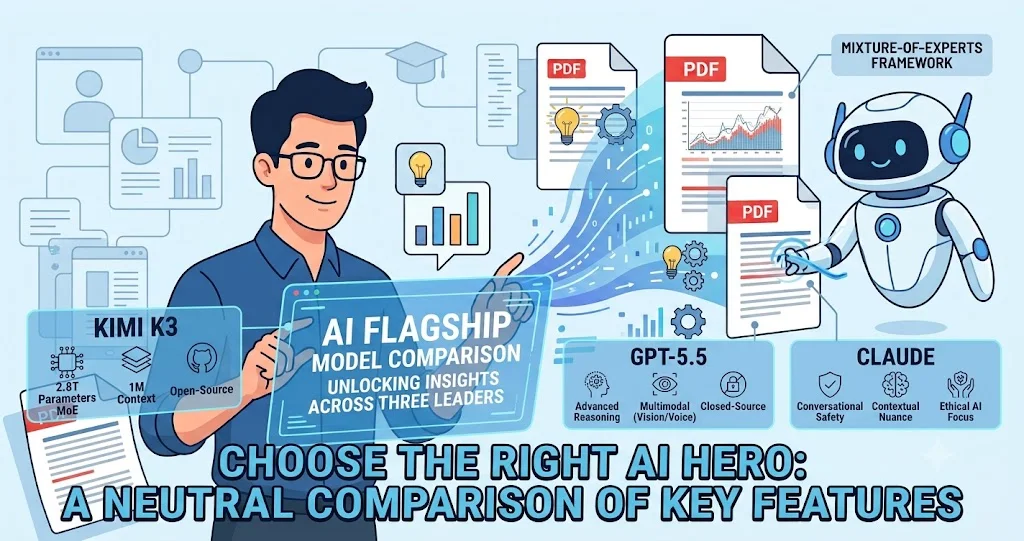
The AI landscape has evolved rapidly with the release of flagship models from leading companies. Kimi K3, GPT-5.5, and Claude represent three distinct approaches to artificial intelligence, each with unique strengths. This comparison examines their features, performance, and use cases to help you determine which model best suits your needs.
Overview of the Three Models
Kimi K3, developed by Moonshot AI, is the world's first open-source model in the 3-trillion-parameter class. GPT-5.5, from OpenAI, continues the GPT lineage with advanced reasoning and multimodal capabilities. Claude, from Anthropic, emphasizes safety, ethical AI, and conversational nuance.
Kimi K3
Kimi K3 features 2.8 trillion parameters in a Mixture-of-Experts architecture, a 1-million-token context window, and native visual understanding. Its architectural innovations include Kimi Delta Attention (KDA), Attention Residuals, and Stable LatentMoE. As an open-weight model, it can be downloaded and deployed locally, offering unprecedented transparency and customization.
GPT-5.5
GPT-5.5 is OpenAI's latest closed-source model, building on the capabilities of previous versions. It offers a large context window (reportedly up to 128K or more), strong multimodal processing (text, image, audio), and excels in creative writing, complex reasoning, and general knowledge tasks. It is available through API and subscription services.
Claude (Flagship)
Anthropic's flagship Claude model (often referred to as Claude 4 or latest version) is known for its natural conversation, ethical alignment, and robust reasoning. It supports large context windows (up to 200K tokens in some versions), file uploads, and multimodal capabilities. Claude emphasizes safety and helpfulness, with a focus on nuanced understanding and coherent dialogue.
Key Comparison Areas
- Parameter Count and Architecture: Kimi K3 has 2.8T total parameters with 104B activated per inference. GPT-5.5's parameter count is undisclosed but estimated to be in the trillions. Claude's parameter count is also proprietary.
- Context Window: Kimi K3 leads with 1M tokens. GPT-5.5 offers up to 128K-200K. Claude offers up to 200K.
- Multimodal Capabilities: All three support text and images; GPT-5.5 and Claude support audio and video in some versions. Kimi K3 natively supports images and video via MoonViT-V2.
- Openness: Kimi K3 is fully open-weight. GPT-5.5 and Claude are closed-source.
- Cost Efficiency: Kimi K3's API pricing is generally lower than closed-source competitors.
Performance Benchmarks
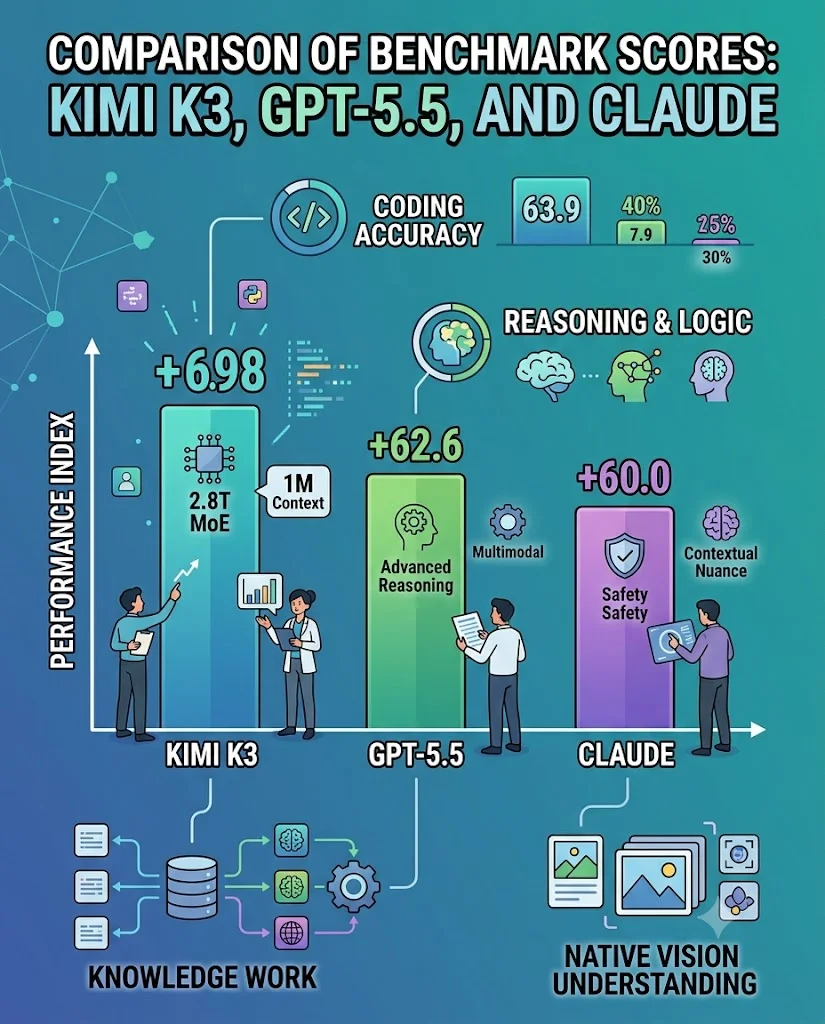
Independent evaluations provide insight into relative performance.
| Benchmark / Aspect | Kimi K3 | GPT-5.5 | Claude (Flagship) |
|---|---|---|---|
| Overall Intelligence (Artificial Analysis) | #3 | #2 | #1 |
| Frontend Code Arena | #1 (1679) | #3 (1618) | #2 (1631) |
| Knowledge Work (AA-Briefcase) | #2 | #3 | #1 |
| Programming & Agentic Coding | Strong, top in some subsets | Strong, general-purpose | Strong, reasoning-focused |
| Multilingual Support | Good (major languages) | Extensive | Strong |
| Ethical Alignment | Standard safety measures | Standard safety | Emphasized safety & Constitutional AI |
Benefits and Limitations
Kimi K3 Benefits
- Largest open-source model with full weight access for customization.
- Exceptional 1M-token context for long-document processing.
- Top-tier coding performance, especially in frontend development.
- Cost-effective API pricing.
- Native visual understanding integrated into the model.
Kimi K3 Limitations
- Requires substantial computational resources for local deployment.
- Less established ecosystem than OpenAI or Anthropic.
- May have less conversational nuance compared to Claude.
GPT-5.5 Benefits
- Broad knowledge base and strong general-purpose performance.
- Extensive ecosystem with plugins, integrations, and community.
- Excellent creative writing and multimodal capabilities.
- Regular updates and improvements.
GPT-5.5 Limitations
- Closed-source, limited transparency and customization.
- Higher cost compared to open-source alternatives.
- Potential for hallucinations and less control over behavior.
Claude Benefits
- Superior conversational ability and ethical alignment.
- Strong reasoning and nuance, suitable for complex analysis.
- Large context window (up to 200K).
- Emphasis on safety and helpfulness.
Claude Limitations
- Closed-source, limited customization.
- May be overly cautious in some responses.
- Performance in coding benchmarks slightly behind Kimi K3.
Types of AI Models and Trends
These three models represent different archetypes: open-source behemoth (Kimi K3), proprietary generalist (GPT-5.5), and safety-focused conversationalist (Claude).
Current Trends
- Scaling Context Windows: All are pushing context limits to handle longer inputs.
- Multimodality: Integration of vision, audio, and video is becoming standard.
- Open vs Closed: The open-source movement is gaining momentum with models like Kimi K3.
- Agentic AI: Models are increasingly capable of multi-step planning and execution.
- Cost Efficiency: Pressure to reduce inference costs is driving innovation in architecture and sparsity.
Use Cases: Which Model to Choose?
Choice depends on specific needs.
Choose Kimi K3 If You:
- Need to process extremely long documents or codebases (1M context).
- Prioritize open-source transparency and customizability.
- Require top-tier coding performance.
- Want cost-effective API access.
- Are developing agentic applications requiring large context.
Choose GPT-5.5 If You:
- Need a general-purpose model with broad knowledge.
- Prefer a mature ecosystem with integrations.
- Value creative writing and diverse content generation.
- Are building applications that leverage OpenAI's API and services.
Choose Claude If You:
- Value conversational quality and nuanced understanding.
- Need strong ethical safety and alignment.
- Work on reasoning-heavy tasks requiring careful analysis.
- Prefer a balance between performance and safety.
Selection Checklist for AI Models
Consider these factors when choosing between Kimi K3, GPT-5.5, and Claude:
- What is the primary use case (coding, research, conversation, creative writing)?
- How large are the documents or inputs you typically process?
- Is open-source access and customization important?
- What is your budget for API usage or subscription?
- Do you need multimodal capabilities beyond text?
- How important is ethical alignment and safety?
- What is the required level of conversational quality?
- Do you need integration with specific tools or platforms?
Tips for Evaluating and Using These Models
- Test each model on your specific tasks using free tiers or trial credits.
- Compare response quality, speed, and cost for your typical workload.
- For Kimi K3, consider using the hosted API for convenience or local deployment for full control.
- For GPT-5.5 and Claude, leverage their respective ecosystems (plugins, assistants).
- Use prompt engineering to optimize performance across all models.
- Stay updated on new versions and feature releases.
Frequently Asked Questions
Which model has the largest context window?
Kimi K3 leads with a 1-million-token context window, surpassing GPT-5.5 and Claude (both up to 200K).
Is Kimi K3 truly open-source?
Yes, Moonshot AI released Kimi K3's full model weights, technical report, and infrastructure on July 27, 2026.
Which model is best for programming?
Kimi K3 ranks first in frontend coding benchmarks. GPT-5.5 and Claude are also strong but slightly behind in that specific area.
Which is more affordable?
Kimi K3's API pricing is generally lower than GPT-5.5 and Claude, making it cost-effective for high-volume usage.
Can I run Kimi K3 locally?
Yes, but it requires substantial GPU resources. Many users opt for cloud deployment or API access.
Does GPT-5.5 support images and audio?
Yes, GPT-5.5 offers multimodal capabilities including image and audio processing.
Is Claude more ethical than the others?
Claude is explicitly designed with Constitutional AI and safety as priorities, but all models have safety measures.
Which model is better for research?
Kimi K3's 1M context and open weights are advantageous for research. Claude and GPT-5.5 are also used widely.
Are there free tiers?
GPT-5.5 may have a limited free tier; Claude offers some free access; Kimi K3 has a free web interface with limitations.
How do I get started with each?
Kimi K3: kimi.com or API; GPT-5.5: OpenAI platform; Claude: Anthropic's website or API.
Conclusion
Kimi K3, GPT-5.5, and Claude each bring distinct strengths to the AI landscape. Kimi K3 excels in open-source accessibility, long-context processing, and coding performance, making it ideal for developers and researchers who need transparency and cost efficiency. GPT-5.5 offers a mature, general-purpose platform with broad capabilities and integration options. Claude stands out for conversational depth, ethical safety, and nuanced reasoning, suitable for applications requiring careful dialogue and analysis. The "best" model ultimately depends on your specific requirements, budget, and values. By evaluating performance, features, and openness against your use case, you can make an informed choice that aligns with your goals.