
Why Difficult Subjects Can Feel Overwhelming
A difficult subject can feel impossible when you look at an entire textbook, a long syllabus, or several chapters that you have not understood yet. The problem is often not just the subject itself. It can also be the number of unfamiliar concepts, uncertainty about where to start, and pressure to make progress quickly.
For example, a student studying mathematics may struggle because a new chapter depends on algebra they have not fully understood. A student learning biology may find a complex process confusing because several unfamiliar terms appear together. In both cases, trying to study everything simultaneously makes it harder to identify the actual problem.
A more practical approach is to treat a difficult subject as a collection of smaller learning tasks. Each task should have a clear purpose, a manageable scope, and a way to check whether you understand it.
1. Break the Subject Into Smaller Topics
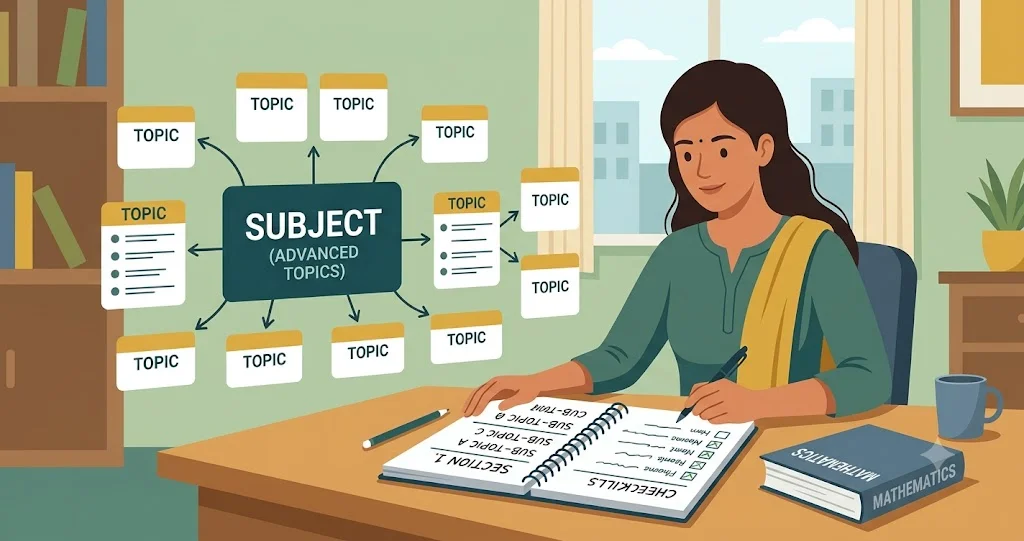
Start by dividing the subject into chapters, concepts, and individual learning objectives. Instead of writing down a broad task such as study physics, identify the specific ideas you need to understand.
For example, a student studying electricity might divide a chapter into these topics:
- Electric charge and its properties
- Electric current and voltage
- Resistance and Ohm's law
- Series and parallel circuits
- Numerical problems involving circuits
This approach makes the workload easier to visualize. It also helps you identify which concepts require more attention instead of treating the entire chapter as equally difficult.
Create a topic checklist
Write down the main topics and divide each one into smaller tasks. Mark each task as not started, learning, or understood. Use a checklist that reflects your actual understanding rather than simply marking a chapter complete after reading it.
For example, completing a chapter on Ohm's law should involve being able to explain the relationship between voltage, current, and resistance and solve representative problems without relying entirely on worked examples.
2. Identify What You Already Know
Before starting a difficult topic, spend a few minutes identifying what you already understand. This prevents you from spending too much time revisiting familiar material while overlooking important knowledge gaps.
Try answering a few basic questions without looking at your notes. You could also solve one introductory problem, explain a concept in your own words, or write down the terms you recognize.
Classify the material into three groups:
- Understood: Concepts you can explain or apply without substantial help.
- Partially understood: Concepts you recognize but cannot confidently explain or use.
- Not understood: Concepts that are unfamiliar or consistently confusing.
Begin with the prerequisites for the topics you find difficult. If a new concept depends on an earlier one, reviewing that foundation may make the new material easier to understand.
3. Set One Clear Goal for Each Study Session
Vague goals such as study chemistry or finish mathematics make it difficult to judge whether a study session was productive. Replace them with specific outcomes that you can check.
For example, instead of planning to study chemical bonding, set a goal to explain ionic and covalent bonding, compare their basic properties, and answer five relevant practice questions.
A useful study goal has three characteristics:
- Specific: It identifies the exact topic or skill.
- Manageable: It can reasonably fit into the time available.
- Measurable: You can check whether you achieved it.
Choose one main learning goal and, if necessary, one smaller review task for each session. If the goal turns out to be too large, divide it further instead of treating unfinished work as a failure.
4. Use Active Learning Instead of Only Reading
Reading a chapter repeatedly can create a sense of familiarity without showing whether you can recall or apply the information independently. Active learning gives you opportunities to check your understanding while studying.
Try active recall
After studying a small section, close the book and write down what you remember. Explain the concept aloud, answer questions from memory, or recreate a diagram without looking at the original.
For example, after reading about the human digestive system, try drawing the main organs and explaining the basic function of each. Compare your explanation with your textbook and identify anything you missed.
Practice with questions
Use exercises that match the subject. Mathematics and physics often require solving problems, while history may require explaining causes and consequences. Programming may involve writing and debugging small pieces of code.
Start with simpler questions and gradually attempt more challenging ones. When you make a mistake, identify whether it resulted from a misunderstood concept, an incorrect method, or a calculation error.
Explain concepts in your own words
Try explaining a difficult concept as if you were teaching it to someone unfamiliar with the subject. If you cannot explain a particular step, return to that part of the material and investigate what is missing.
These techniques turn studying into a process of checking and improving understanding rather than simply spending time with a textbook.
5. Create a Realistic Study Schedule
A study schedule should reflect your available time, energy, existing commitments, and the difficulty of the material. An unrealistic timetable can create additional pressure when tasks repeatedly remain unfinished.
Begin by identifying the subjects that need attention and the amount of time you can actually dedicate to studying. Give challenging topics focused sessions and leave room for review and unexpected delays.
| Study activity | Example duration | Purpose |
|---|---|---|
| Learn one small concept | 25 minutes | Understand a specific idea |
| Practice questions | 20 minutes | Apply what you learned |
| Short break | 5 minutes | Step away from the task |
| Recall and review | 10 minutes | Check what you remember |
This is an example of a study session, not a fixed requirement. Some concepts need longer sessions, while others can be reviewed quickly. Adjust the schedule according to the work rather than forcing every topic into an identical time slot.
Prioritize instead of filling every available hour
When several subjects need attention, prioritize based on upcoming deadlines, prerequisite knowledge, and areas where you are struggling. Avoid scheduling every minute. A little flexibility helps you revisit a concept when it takes longer than expected.
6. Review Difficult Topics at Intervals
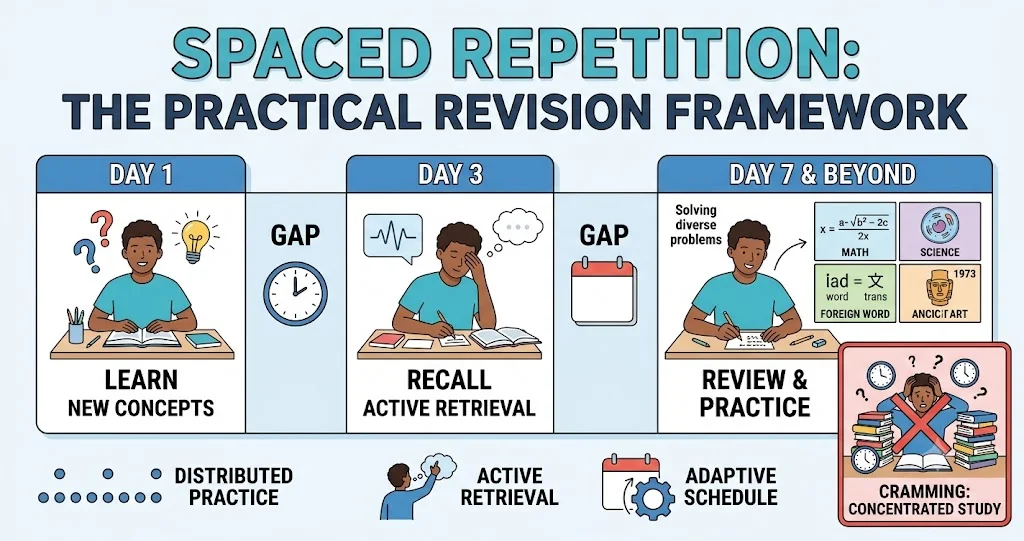
Learning a concept once does not guarantee that you will remember it later. Spaced practice involves revisiting material across multiple study sessions instead of concentrating all your review into one sitting.
For example, after learning a topic, you could review it the next day, revisit it several days later, and test your understanding again the following week. These intervals are a practical starting point rather than a universal schedule.
Use each review to retrieve information from memory before checking your notes. If you can answer the questions confidently, move on to more challenging applications. If you struggle, revisit the specific parts that need work.
Spaced practice is particularly useful when you need to retain concepts over an extended period, such as preparing for examinations that cover several months of material.

7. Deal With Confusing Concepts One at a Time
When a topic remains difficult after several attempts, avoid immediately rereading the entire chapter. First, identify the exact point where your understanding breaks down.
For instance, if you cannot solve a calculus problem, determine whether the difficulty is understanding the question, choosing a formula, applying differentiation rules, or performing the algebra. Each problem requires a different response.
Use a simple troubleshooting process
- Write down the exact question or step you do not understand.
- Identify the prerequisite concept involved.
- Review a short explanation or a worked example.
- Attempt a similar problem without looking at the solution.
- Compare your approach with the correct method and identify the difference.
If you remain stuck, ask a teacher, classmate, or tutor a specific question. Showing the step where you became confused is usually more useful than saying that you do not understand the entire chapter.
8. Reduce Distractions and Make Your Study Space Practical
Your study environment does not need to be elaborate. It should simply make it easier to focus on the task at hand.
- Keep the textbook, notebook, and materials for the current topic within reach.
- Silence unnecessary notifications during focused study sessions.
- Keep unrelated tabs and applications closed when possible.
- Use a written task list so you do not have to repeatedly decide what to do next.
- Take short breaks when concentration begins to decline.
If studying at home is noisy, consider a quieter location such as a library or an available study room. Choose an environment that is practical for your circumstances rather than waiting for perfect conditions.
9. Track Progress Without Obsessing Over Study Hours
Time spent studying is useful information, but it does not tell the whole story. A student may spend two hours reading without being able to explain a concept, while a shorter session involving focused practice may reveal exactly what needs improvement.
Track meaningful outcomes such as:
- Concepts you can explain without notes
- Practice questions you can solve independently
- Errors you have identified and corrected
- Topics that still require review
- Earlier material you can now recall confidently
At the end of each study session, write down one thing you learned and one question that remains unresolved. Use these notes to plan the next session.
Review your progress periodically. If you repeatedly spend too long on a task, divide it into smaller parts. If you finish quickly but struggle during practice, devote more time to applying the material.
10. Adjust Your Strategy When Studying Feels Too Difficult
Feeling overwhelmed can be a signal that your current approach needs adjustment. It does not automatically mean you lack ability or that you need to study for longer hours.
Use the following adjustments according to the problem you encounter:
| What is happening | Possible adjustment |
|---|---|
| You do not know where to begin. | Choose one small topic and define a specific goal. |
| You understand the explanation but cannot solve questions. | Work through an example and then attempt a similar question independently. |
| You forget previously studied material. | Add short retrieval-based reviews at intervals. |
| You spend too much time on one topic. | Identify the precise knowledge gap and ask for targeted help. |
| Your timetable is consistently unfinished. | Reduce the number of tasks and include flexible time. |
| You feel tired and lose concentration. | Take a break and reconsider the length and timing of your sessions. |
If academic stress begins to interfere substantially with daily life, consider talking to a teacher, school counselor, or another trusted person. You do not have to manage every academic difficulty alone.
An Example of a Manageable Study Plan
Suppose you have three days to understand a difficult mathematics chapter containing four main concepts and a set of practice problems. Rather than attempting the entire chapter in one sitting, divide the work into smaller sessions.
| Day | Focus | Expected outcome |
|---|---|---|
| Day 1 | Review prerequisites and learn the first two concepts. | Explain the concepts and solve introductory questions. |
| Day 2 | Learn the remaining concepts and practise mixed questions. | Apply the methods to representative problems. |
| Day 3 | Recall all four concepts and attempt a short practice set. | Identify remaining errors and review weak areas. |
This example can be adjusted to the subject, syllabus, and time available. If the first two concepts are still unclear on the second day, revise the plan rather than moving forward without the necessary foundation.
Frequently Asked Questions
How can I start studying when a subject feels too difficult?
Choose one small topic instead of thinking about the entire subject. Write down what you need to understand, review the relevant prerequisite, and attempt one introductory question. A clearly defined first task can make it easier to begin.
How long should I study a difficult subject each day?
There is no single duration that suits every student or subject. Consider your available time, concentration, deadlines, and the complexity of the material. Begin with manageable sessions and adjust them according to your progress and energy.
Is reading the textbook repeatedly enough to understand difficult topics?
Repeated reading can help with familiarity, but it does not always reveal whether you can recall or apply information. Combine reading with self-testing, practice questions, and explanations in your own words to check your understanding.
What should I do if I cannot understand a topic even after studying it?
Identify the exact step or concept causing the difficulty. Review its prerequisites, examine a worked example, and try a similar question independently. If the confusion remains, ask a teacher or tutor a specific question about the point where you became stuck.
How can I remember difficult subjects for examinations?
Use spaced review and active recall rather than relying only on a final revision session. Practise retrieving concepts from memory, solve representative questions, and revisit areas where you make repeated errors. Include older topics in your study sessions as you progress.
Should I study easy subjects first or difficult subjects first?
Consider your energy level, deadlines, and the amount of concentration a topic requires. Some students prefer to tackle a challenging concept when they are most alert, while others begin with a short, familiar task to establish momentum. Experiment with both approaches and observe which fits your routine.
Conclusion
Studying difficult subjects becomes more manageable when you replace vague, large tasks with specific learning goals. Divide chapters into smaller topics, check your existing understanding, practise recalling concepts, and revisit important material over time. When a topic remains confusing, identify the precise knowledge gap rather than repeating the same study method indefinitely.
Start with one manageable task in your next study session. Once you know what you understand and what still needs work, you can build a realistic plan around your actual progress instead of feeling pressured to master everything at once.