

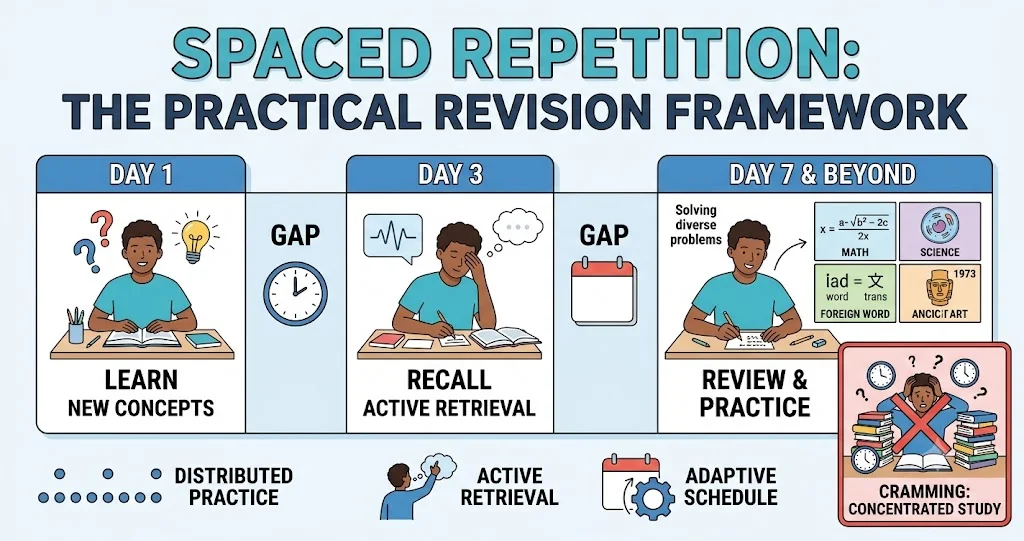
Studying the same material repeatedly in one sitting can make it feel familiar without guaranteeing that you will remember it later. Spaced repetition takes a different approach: review the material, leave a gap, try to recall it again, and return to it later. The spacing between reviews gives you repeated opportunities to retrieve information after some forgetting has occurred.
Research on distributed practice has consistently examined this idea. A major quantitative review analyzed 839 assessments from 317 experiments and found that the timing of repeated learning episodes influences later retention. It also found that the most effective spacing interval depends partly on how long the learner needs to retain the information.
What is spaced repetition?
Spaced repetition is a revision method based on distributed practice: instead of concentrating all study of a topic into one session, you spread reviews across multiple sessions.
A simple example looks like this:
- Learn a set of biology terms today.
- Try to recall them again tomorrow.
- Review them again after several days.
- Return to them the following week.
- Continue reviewing difficult items while reducing attention on material you can reliably recall.
The important part is not simply seeing the information repeatedly. A useful spaced-repetition routine normally combines spacing with active recall. Instead of immediately reading the answer again, the student first attempts to retrieve it.
Why does spacing help memory?
One reason spacing is useful is that a review performed after a delay is different from a review performed immediately after learning. After a gap, recalling the information requires more effort than simply recognizing something that was just studied.
Research on distributed practice suggests that the amount of time between learning episodes matters, and that the useful interval changes depending on the desired retention period. In other words, there is no universal rule such as “review everything exactly every seven days.”
A recent meta-analytic review of classroom learning also found an overall advantage for distributed practice compared with massed practice across applied classroom studies. The review included 22 reports with more than 3,000 learners and reported a moderate overall effect in favor of distributed practice, while also noting variation across studies.
Spaced repetition vs. cramming
| Study approach | How it works | Typical advantage | Potential limitation |
|---|---|---|---|
| Cramming | Large amount of study concentrated into a short period | Can be useful when very little time remains | Less suitable for building durable retention |
| Repeated rereading | Reviewing the same notes or chapter multiple times | Can increase familiarity with the material | Familiarity does not always mean reliable recall |
| Spaced practice | Reviewing material across separated sessions | Supports longer-term retention | Requires planning and returning to material later |
| Spaced retrieval practice | Trying to recall information at separated intervals, then checking the answer | Combines spacing with active retrieval | Can feel harder than rereading and requires feedback |
A major review of learning techniques rated both practice testing and distributed practice highly because their benefits have been observed across different learners, materials, and educational contexts.
Why retrieval matters too
Spacing and retrieval are related but not identical. Spacing determines when you return to the material. Retrieval practice determines what you do when you return.
For example, imagine you are learning the definition of opportunity cost. Simply rereading the definition every few days is one form of spaced study. Covering the definition and asking yourself “What does opportunity cost mean?” before checking the answer adds retrieval practice.
Research on the testing effect has found that taking memory tests can improve later retention. In one study using educationally relevant prose, repeated testing produced stronger delayed retention than repeated studying on later tests, even though repeated studying increased students' confidence in their memory.
This is why a good spaced-repetition session should usually contain a short attempt to remember before looking at the answer.
How to create a spaced-repetition revision schedule
You do not need a complicated system to start. Build the schedule around the exam date and divide your material into manageable units.
Step 1: List what you need to learn
Break the subject into topics, chapters, formulas, definitions, vocabulary, concepts, or question types. Avoid creating one enormous revision item such as “Study Chapter 5.” Smaller units make it easier to identify what you actually remember.
Step 2: Learn the material first
Spaced repetition is primarily a way of organizing subsequent review. Give yourself enough initial study time to understand the concept before scheduling repeated recall.
Step 3: Test yourself after a gap
Close the book or notes and attempt to recall the information. Use flashcards, practice questions, blank-page recall, short-answer questions, or explain the concept from memory.
Step 4: Check your answer
Feedback matters. Compare your response with the correct information and identify what was missing or incorrect. Retrieval practice research has examined the role of feedback as part of effective learning.
Step 5: Schedule another review
Return to the material after another interval. The exact gap should reflect your exam deadline, the difficulty of the material, and how well you can currently recall it.
Step 6: Give more attention to weak items
If you repeatedly forget a formula or definition, do not treat it exactly like something you can recall immediately. Review the difficult item sooner and continue giving it additional retrieval opportunities.
A simple 14-day revision example
Suppose you have an exam in two weeks and need to learn 40 key concepts. Rather than studying all 40 repeatedly every day, divide them into manageable groups and use the following as a practical starting schedule.
| Day | Study activity | Purpose |
|---|---|---|
| Day 1 | Learn Group A and test yourself | Initial learning and retrieval |
| Day 2 | Retrieve Group A; learn Group B | First delayed review plus new material |
| Day 4 | Retrieve Groups A and B; learn Group C | Increase the gap between successful reviews |
| Day 7 | Retrieve difficult items from A–C; add Group D | Longer-delay retrieval |
| Day 10 | Mixed recall across all groups | Check retention and identify weak areas |
| Day 13 | Practice questions and targeted review | Exam-oriented retrieval |
| Day 14 | Light final review | Confirm key material without replacing earlier study |
This is an example framework, not a scientifically fixed universal schedule. Research indicates that the optimal spacing interval depends on the desired retention period and other learning conditions.
How to adapt the schedule to different subjects
Vocabulary and language learning
Use a prompt on one side and the meaning, translation, or example on the other. Try to produce the answer before revealing it. Add an example sentence when knowing the word in context matters.
Science definitions
Turn definitions into questions. Instead of rereading “Mitosis is a type of cell division,” ask yourself, “What is mitosis, and what happens during it?” For processes, try to reproduce the sequence from memory.
Mathematics and formulas
Do not only memorize the formula. Practice recognizing when it applies and solve representative problems without looking at the worked solution. Retrieval should include the decision process, not just the equation.
History
Use prompts about people, causes, dates, consequences, and relationships. For example, instead of memorizing an isolated date, ask yourself what happened, why it happened, and what followed.
Essay-based subjects
Use spaced retrieval to practice outlines, key arguments, evidence, definitions, and connections between topics. Periodically write a short answer without notes to test whether you can turn remembered information into an organized response.
What should you put into a spaced-repetition system?
Good review prompts require you to produce useful information from memory. Examples include:
- “Define photosynthesis in two or three sentences.”
- “What are the three main causes discussed in this chapter?”
- “Solve this equation without looking at the formula.”
- “Explain the difference between mitosis and meiosis.”
- “What is the meaning of this vocabulary word?”
- “List the steps of this process in the correct order.”
Weak prompts can make the method less useful. A card that contains a large paragraph and asks you to recognize whether you have seen it before does not require much retrieval. Smaller, specific questions generally make it easier to see exactly what you know and what you have forgotten.
How often should you review something?
There is no single spacing interval that is optimal for every learner and every subject. A large review found that the relationship between the spacing interval and final retention depends on the length of time over which retention is required.
A practical way to apply that finding is to work backward from your goal. If an exam is tomorrow, a long series of widely separated reviews is impossible. If the exam is six weeks away, you have more opportunities to distribute practice.
You can also use performance to adjust the schedule. Material that is repeatedly recalled correctly can receive a longer gap. Material that is repeatedly forgotten can receive another review sooner.
Common mistakes students make
Only rereading notes
Rereading can be part of learning, but it does not require the same kind of recall as answering a question without looking at the material. Add retrieval to your review sessions.
Using the same interval for everything
Different concepts have different difficulty levels and different retention requirements. A rigid schedule can waste time on material you already know while neglecting weak areas.
Making cards too large
A flashcard containing an entire chapter is difficult to answer consistently. Break large topics into focused questions.
Ignoring mistakes
A wrong answer is useful information if you use it to identify the missing knowledge. Check the answer, correct the misunderstanding, and schedule another attempt.
Starting only a few days before the exam
Spaced practice depends on having multiple learning opportunities separated over time. If you start very late, you have fewer opportunities to distribute those reviews.
Assuming harder always means better
Spacing can make recall feel more difficult than immediate rereading. That difficulty should not be treated as proof that every possible spacing arrangement is better. Research shows that spacing effects vary with task, learner, and retention interval.
How to combine spaced repetition with other study methods
Spaced repetition does not have to replace every other study method. It works particularly well as a scheduling principle around active recall and practice questions.
A study session might look like this:
- Read a new concept until you understand the basic idea.
- Close your notes and explain it from memory.
- Check the explanation and correct gaps.
- Schedule another retrieval session.
- Later, solve a problem or answer a question that requires the concept in context.
- Research reviews have identified spaced practice, retrieval practice, and related learning strategies as useful approaches, while also emphasizing that effectiveness varies with learning conditions, student characteristics, materials, and the outcome being measured.
A practical weekly routine for exam preparation
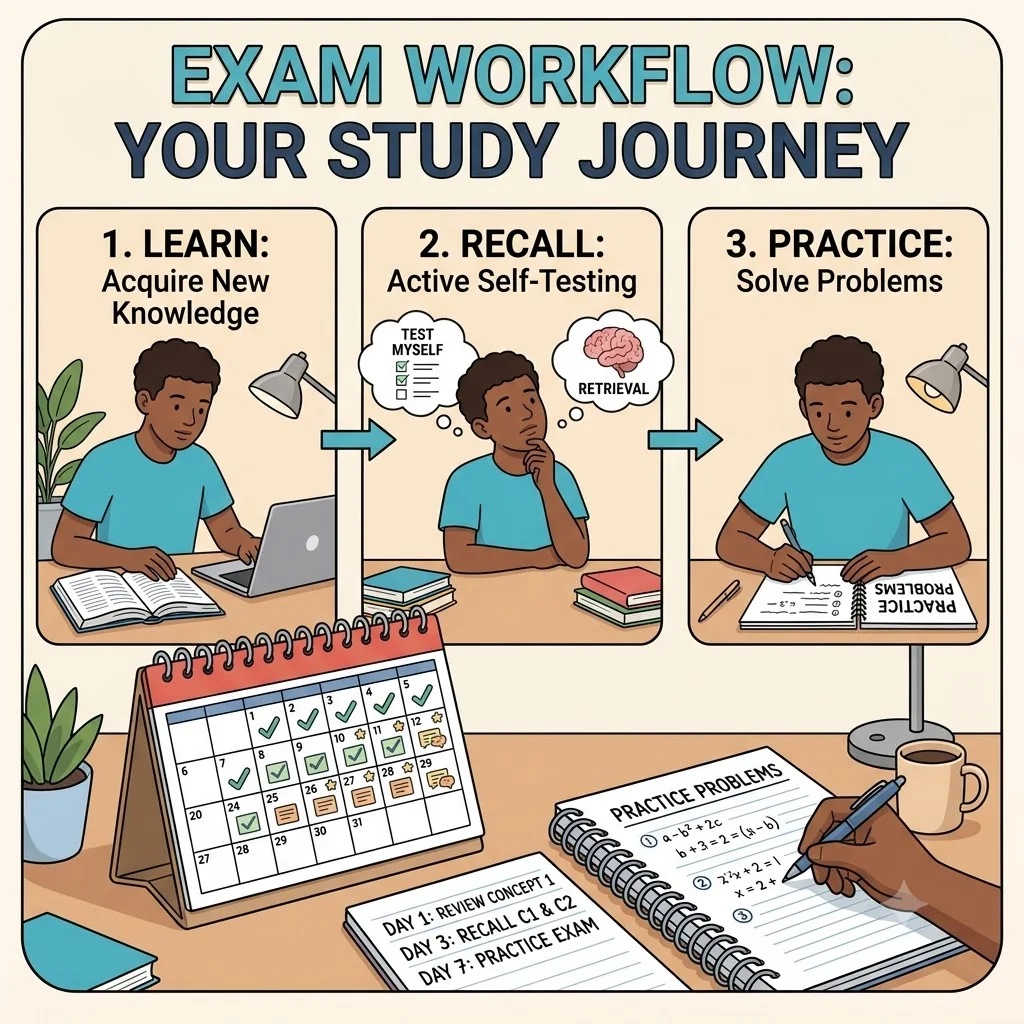
If you want a simple routine rather than a complex flashcard system, divide each study week into three types of work:
- New learning: Learn concepts you have not studied yet.
- Spaced recall: Retrieve older material without looking at your notes.
- Application: Solve problems, write answers, or complete practice questions using the material.
For example, a student might spend the first part of a session learning a new chapter, the next part retrieving material from earlier in the week, and the final part completing exam-style questions. The exact time allocation should depend on the subject and the student's remaining workload rather than a fixed formula.
Frequently asked questions
Is spaced repetition the same as flashcards?
No. Flashcards are one tool that can be used for spaced repetition. The broader idea is to distribute reviews over time. You can use flashcards, practice questions, blank-page recall, oral explanations, or other retrieval activities.
Does spaced repetition guarantee better exam results?
No study technique guarantees a particular result. Research supports distributed practice as a useful learning approach, but outcomes depend on factors including the learner, material, implementation, assessment, and time available.
Should I use expanding intervals such as 1, 3, 7, and 14 days?
Expanding intervals can be a practical way to organize reviews, but they should not be treated as a universal scientific formula. Research comparing different spacing arrangements has produced mixed findings, and the optimal interval depends on factors such as the retention period and learning task.
What should I do when I forget an answer?
Check the correct answer, understand the mistake, and attempt the item again later. Forgetting can identify material that needs more attention; the goal is to use that information to adjust future practice.
Can spaced repetition work for difficult subjects?
Yes, but the prompts should match the subject. Memorizing definitions may be appropriate for some topics, while mathematics, science, and essay subjects often require retrieval combined with problem solving, explanation, or application.
When should I start spaced repetition before an exam?
Starting earlier gives you more opportunities to separate review sessions. If you have limited time, begin with the highest-priority material and use shorter gaps that fit the remaining days. Do not wait for a perfect schedule before starting.
The practical takeaway
Spaced repetition is best understood as a way to organize repeated retrieval over time, not as a magic number of days between flashcards. Research supports distributed practice for improving retention, while also showing that the useful spacing interval depends on the learning task and how long the information needs to be remembered.
For exam preparation, start with the material you need to learn, turn important information into questions, retrieve it without looking at your notes, check your answers, and schedule another attempt after a suitable gap. Give weak material more attention and gradually make successful reviews less frequent. The result is a revision system that uses your available time across multiple study sessions instead of concentrating all of the work into one final burst.