


A good daily study routine should make it easier to decide what to study, when to study it, and how to know whether you actually learned it. The problem with many study plans is not a lack of ambition; it is that they are too rigid, too long, or disconnected from the student's real workload.
A more useful approach is to build a routine around a few priorities: specific learning goals, focused study blocks, active practice, spaced revision, and enough recovery to keep the routine sustainable.
What makes a daily study routine effective?
An effective routine is one you can repeat on ordinary days, not just on days when motivation is high. It should answer three questions before you sit down to study:
- What will I study? Choose a specific topic or task rather than writing only a subject name.
- What will I do with it? Decide whether the session involves learning, solving problems, recalling information, reviewing mistakes, or revising.
- What result should I have at the end? Define a small outcome, such as completing a problem set, explaining a concept without notes, or reviewing a particular chapter.
This changes studying from an open-ended activity into a sequence of manageable tasks.
Step 1: Start with your real schedule
Before creating a timetable, write down the fixed parts of your day: classes, commuting, meals, work, family responsibilities, exercise, and sleep. Only then should you decide how much study time is realistically available.
A student who has four genuinely available hours should not create a timetable requiring eight hours. An unrealistic schedule usually leads to missed sessions, guilt, and repeated attempts to restart.
Instead, identify your minimum study commitment. For example, you might decide that on a difficult day you will complete two focused 30-minute sessions. On a normal day, you can add more blocks.
Step 2: Set weekly priorities before daily tasks
Daily planning works better when it comes from a weekly plan. List the subjects or topics that need attention and classify them by urgency and difficulty.
| Priority | What it means | Typical action |
|---|---|---|
| High | Exam is approaching or the topic is weak | Frequent focused practice and revision |
| Medium | Important material that is progressing normally | Regular study and spaced review |
| Low | Already familiar or less urgent material | Short maintenance reviews |
Do not spend every study session on your favorite subject. A useful routine gives more attention to important weaknesses while still maintaining stronger areas.
Step 3: Divide the day into focused study blocks
Instead of writing “Study Mathematics from 6 to 9,” divide the period into specific activities. For example, a three-hour evening could contain a problem-solving block, a short break, a revision block, and a final recall session.
The ideal length depends on the student and task. Some people work well in 25–30 minute blocks, while others prefer 45–60 minutes. The important point is to choose a duration that allows focused work without making the session unnecessarily exhausting.
During each block, keep the task narrow. “Study chemistry” is vague. “Solve 15 chemical-equilibrium questions and review the errors” is measurable.
Step 4: Put difficult work where your concentration is strongest
Not every subject should automatically be assigned to the morning. Pay attention to when you normally concentrate best.
If you are most alert in the morning, use that period for difficult problem solving or new concepts. If your concentration improves later in the day, reserve those hours for demanding work and use lower-energy periods for review, flashcards, reading, or organizing notes.
The goal is to match the type of work with your available attention rather than following a supposedly perfect timetable.
Step 5: Replace passive rereading with active practice
Reading the same notes repeatedly can create a feeling of familiarity without showing whether you can actually recall the material. Research reviewing common learning techniques has identified practice testing and distributed practice as high-utility techniques across many learning conditions.
Active study can include:
- Answering questions without looking at the answer first.
- Solving practice problems from memory.
- Explaining a concept in your own words.
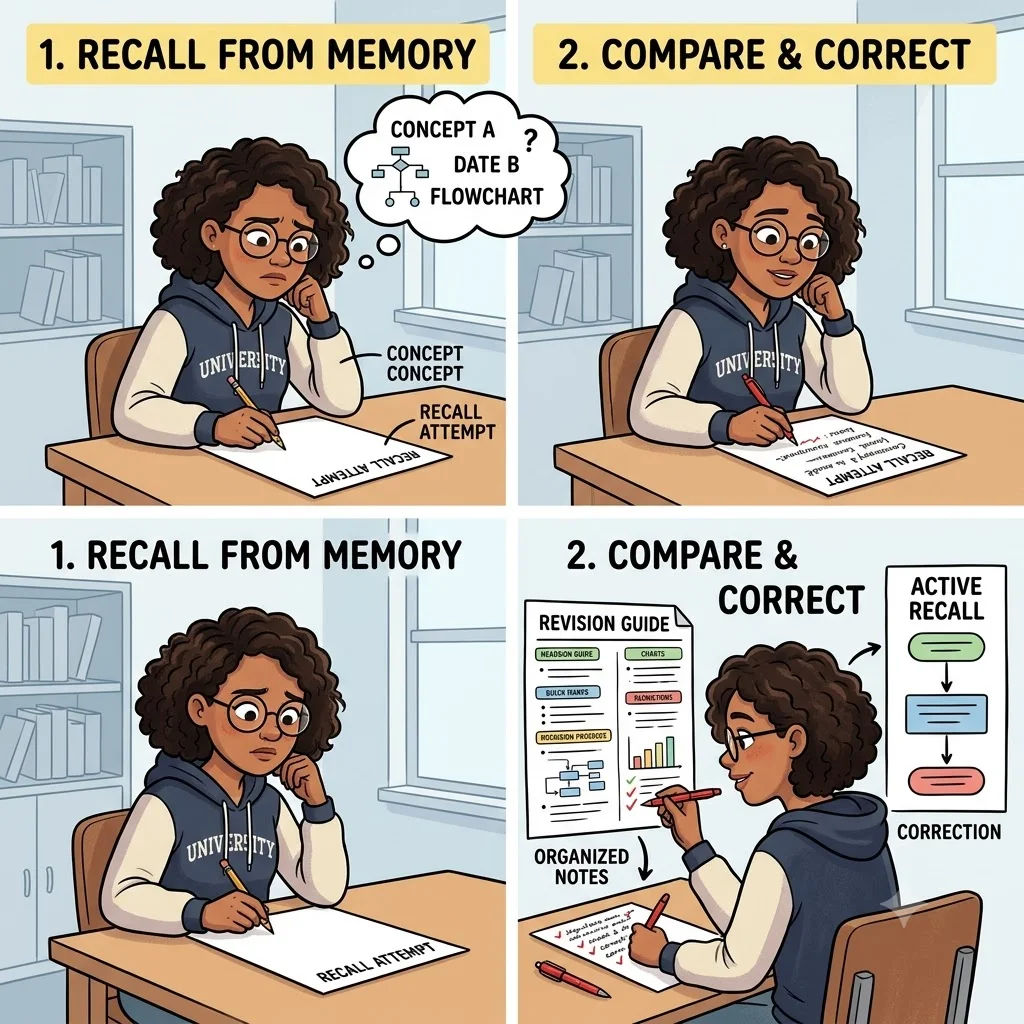
- Writing down everything you remember about a topic before checking your notes.
- Using flashcards for facts, definitions, formulas, or terminology.
- Taking short practice tests and checking the answers afterward.
The key is retrieval: you should sometimes make your brain produce the answer rather than only recognize information on a page.
Step 6: Build spaced revision into the routine
Do not wait until the night before an exam to revisit everything. Spaced or distributed practice means spreading learning opportunities over time instead of concentrating them into one long session. Research reviews have found an advantage for distributed practice over massed study for long-term retention.
A simple routine could look like this:
| Review point | Purpose |
|---|---|
| Same day | Quick recall of the main ideas |
| Next day | Test what you can remember without notes |
| Later in the week | Practice questions and correct weak areas |
| Following weeks | Short maintenance reviews and mixed practice |
The exact spacing does not need to be identical for every subject. The important change is to revisit material across multiple days rather than relying on one concentrated study session.
Step 7: Keep a mistake log
For exam preparation, mistakes are useful information. Instead of simply marking an answer wrong and moving on, record why the mistake happened.
- Knowledge gap: You did not know the concept.
- Conceptual error: You misunderstood how the idea works.
- Calculation error: The method was correct but the calculation went wrong.
- Question interpretation: You misunderstood what was being asked.
- Careless error: You knew the answer but made an avoidable mistake.
Reviewing these patterns can help you decide what deserves the next study block. This is more useful than simply counting how many hours you studied.
Two realistic daily study schedules
Example 1: School or college student
| Time | Activity |
|---|---|
| 6:30–7:00 | Short recall or revision |
| Daytime | School or college classes |
| 17:00–17:30 | Break, food, and reset |
| 17:30–18:20 | Difficult subject or problem solving |
| 18:20–18:35 | Break |
| 18:35–19:25 | Second subject or new concept |
| 19:25–20:15 | Dinner and rest |
| 20:15–21:00 | Practice questions and error review |
| 21:00–21:15 | Plan the next day |
This is an example, not a rule. A student's actual timetable should account for school hours, travel, family responsibilities, and individual concentration patterns.
Example 2: Exam aspirant with a flexible day
| Session | Focus |
|---|---|
| Morning Block 1 | New or difficult topic |
| Morning Block 2 | Problem solving or written practice |
| Afternoon Block 1 | Second subject |
| Afternoon Block 2 | Spaced revision of older material |
| Evening Block 1 | Practice test or mixed questions |
| Evening Block 2 | Error review and next-day planning |
Rather than trying to make every block equally long, allocate more time to subjects that are both important and difficult.
How much should you study each day?
There is no single number of daily study hours that guarantees good results. The useful amount depends on your age, course workload, exam schedule, existing knowledge, and the quality of the study itself.
A better question is: How much focused study can I consistently complete while still meeting my other responsibilities?
If you currently study inconsistently, start with a manageable schedule and increase it gradually if your workload requires it. A routine that you follow for weeks is generally more useful than an ambitious timetable that collapses after several days.
Common mistakes that make study routines fail
1. Planning every minute
A schedule with no buffer leaves no room for delays, difficult assignments, fatigue, or unexpected responsibilities. Keep some flexibility.
2. Measuring success only by hours
Eight hours of distracted reading is not necessarily better than several focused sessions containing retrieval and problem solving. Track completed learning tasks as well as time.
3. Trying to study every subject every day
Some subjects need frequent practice, while others can be reviewed less often. Use your weekly priorities instead of forcing equal daily time for everything.
4. Making the plan too difficult
If your routine assumes perfect concentration, zero interruptions, and maximum motivation every day, it is not a sustainable routine. Create a smaller fallback version for difficult days.
5. Ignoring sleep
Study time should not routinely come at the expense of adequate sleep. The CDC notes that sufficient sleep supports attention and memory, and recommends 8–10 hours for teenagers aged 13–18 and at least 7 hours for most adults aged 18–60.
For younger students, sleep requirements are higher. The CDC reports 9–12 hours per 24 hours for children aged 6–12.
What to do when you miss a study day
Do not try to compensate automatically by doubling the next day's workload. First identify why the session was missed. Was the plan too long? Was the task unclear? Did another responsibility take priority?
Then restart with the next planned block. If necessary, reduce the workload temporarily and rebuild consistency. A missed day is a scheduling problem to solve, not evidence that the entire routine has failed.
A simple weekly review
Spend 10–15 minutes at the end of each week reviewing your routine. Ask:
- Which subjects received enough attention?
- Which topics are still weak?
- Did I actually practice recalling information?
- Which study sessions were consistently missed?
- Was my schedule realistic?
- What should change next week?
Use the answers to adjust the next week's plan. The routine should evolve with your syllabus and exam timeline rather than remaining fixed for months.
FAQ
Should I study at the same time every day?
A consistent study window can make it easier to establish a routine, but it does not have to be identical every day. If your schedule changes, keep the sequence of priorities and study methods consistent instead.
Is studying for long hours better?
Longer study time is not automatically better. Focused practice, retrieval, spaced revision, and useful feedback can make study time more productive. The right amount also depends on your workload and circumstances.
Should I study one subject at a time?
For learning a new difficult concept, a focused block can be useful. For revision and practice, mixing related topics or problem types can also be useful in some subjects. The learning research literature describes this as interleaved practice and finds evidence of benefits under some conditions.
How can I study when I have very little time?
Choose one high-priority task and use a short focused block. Retrieval questions, practice problems, and reviewing mistakes can often provide more useful feedback than spending the entire period rereading notes.
What should I do during a study break?
Use the break to step away from the immediate task. Stretching, walking, getting water, or simply resting can help create a clear separation between study blocks. Avoid turning a short break into an unplanned long social-media session.
Should I make a new timetable every day?
Usually, no. A weekly structure with small daily adjustments is easier to maintain. Keep recurring study windows and priorities, then choose the exact tasks based on your progress.
The practical takeaway
A daily study routine works best when it is treated as a system rather than a perfect timetable. Start with the time you genuinely have, set weekly priorities, turn each study period into a specific task, use retrieval and spaced practice, keep track of mistakes, and protect enough time for sleep and recovery.
The strongest routine is not the one that looks impressive on paper. It is the one you can follow consistently, evaluate honestly, and adjust as your subjects and exam deadlines change.