

Good lecture notes are not a transcript of the class. They are a working record of the ideas, relationships, examples, questions, and explanations that you are most likely to need later. Research on university students suggests that note taking can support learning, but the way notes are created and reviewed matters.
What Makes Lecture Notes Effective?
Effective notes should make it easier to answer three questions after class: What was taught?, How do the ideas connect?, and What do I still need to understand?
That means useful notes usually contain more than isolated facts. They may include definitions, explanations in your own words, examples, diagrams, comparisons, formulas, questions, and connections to earlier material.
Research has also highlighted an important distinction: taking more notes is not automatically the same as learning more. A 2014 study found that students taking notes on laptops were more likely to transcribe lectures verbatim, while students taking notes longhand performed better on conceptual questions in the studies examined. Later research in natural university settings has produced a more nuanced picture, finding differences in how paper and computer users reformulate and revise notes.
Choose a Note-Taking Method That Fits the Lecture
There is no single method that works equally well for every subject. A fast mathematics lecture, a history discussion, and a programming class may require different structures.
| Method | How it works | Useful for |
|---|---|---|
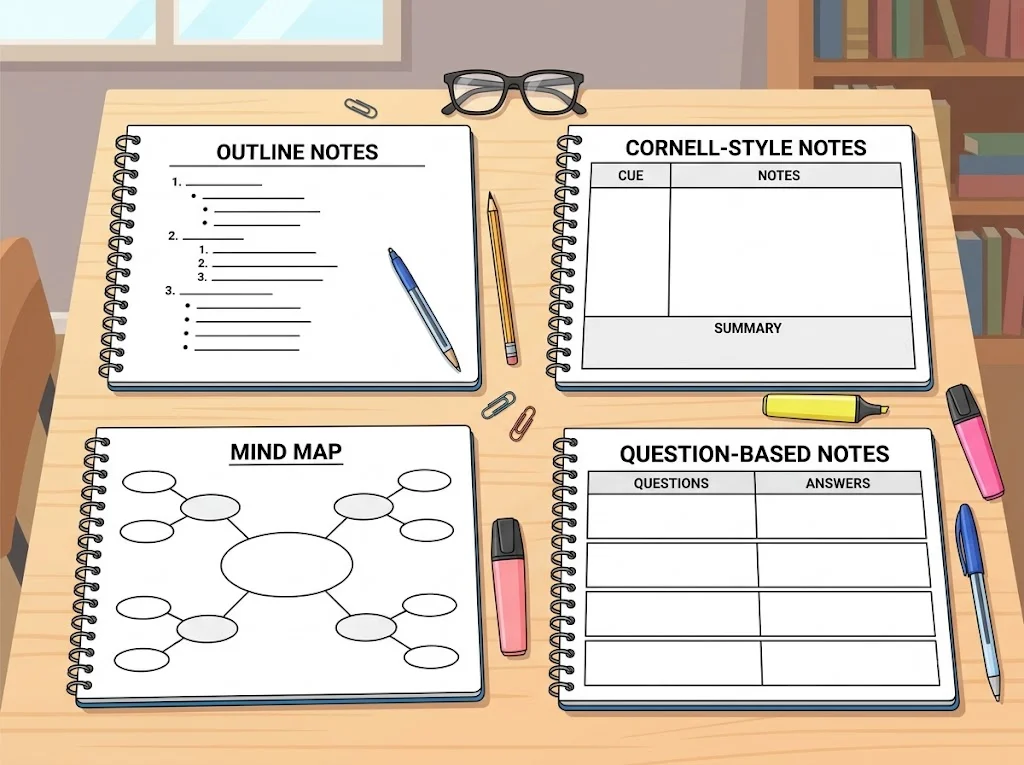
| Outline notes | Organize main ideas, supporting points, and details in levels. | Structured lectures and theory-heavy subjects |
| Cornell-style notes | Separate the page into notes, cues/questions, and a summary. | Lectures that need later review and self-testing |
| Mind mapping | Place the central concept in the middle and connect related ideas visually. | Subjects with relationships, processes, or interconnected concepts |
| Question-based notes | Turn important ideas into questions and record the answers. | Exam preparation and conceptual learning |
| Two-column notes | Use one side for concepts and another for explanations, examples, or applications. | Technical and problem-solving subjects |
| Summary notes | Capture the lecture and periodically restate its meaning in your own words. | Content-heavy lectures and long-term retention |
Research on note-taking format suggests that more demanding note structures can sometimes encourage deeper processing. In one experiment, outline-style notes produced better performance than cloze-style notes on free-recall and inference questions, particularly when the outline required students to process relationships among ideas.
1. Use Outline Notes for Structured Lectures
Outline notes work well when the lecturer clearly moves from a main concept to supporting ideas and examples.
Start with the lecture topic. Under each major idea, indent the supporting concepts. Put examples or details below the concept they explain.
Main topic
 Main concept
 Explanation
 Example
 Second concept
 Comparison
 Important exception
The key is to avoid copying every sentence. Record the relationship between ideas. For example, instead of writing a long explanation word for word, write the concept followed by a short explanation in language you understand.
2. Try the Cornell Method for Review-Friendly Notes
The Cornell approach divides a page into a larger notes area, a narrower cue or question area, and a summary section.
- During the lecture, use the main area for concepts, explanations, examples, and diagrams.
- After the lecture, add questions or keywords in the cue area.
- Write a short summary that explains the main idea without copying the lecture.
- Cover the notes area and use the questions to test yourself.
This changes the notes from a storage document into a study tool. The questions can also reveal which parts of the lecture you do not yet understand.
3. Use Mind Maps When Relationships Matter
Mind mapping is useful when a lecture contains interconnected concepts rather than a simple sequence of facts. Put the central topic in the middle and connect related concepts around it.
For example, in a biology lecture, a central process could connect to inputs, stages, outputs, examples, and exceptions. In a software lecture, a central architecture concept could connect to components, data flow, dependencies, and common problems.
Do not turn every lecture into an elaborate drawing. A quick relationship map is enough if it helps you understand how ideas fit together.
4. Turn Important Points Into Questions
One of the most useful improvements you can make is to convert passive notes into questions.
Instead of writing only:
Photosynthesis converts light energy into chemical energy.
add a question such as:
How does photosynthesis convert light energy into chemical energy?
For a programming lecture, you might write:
Why would we use dependency injection here?
Question-based notes make later review more active. Research comparing self-questioning, summarizing, and simple note review found that generative strategies such as questioning and summarizing produced better retention outcomes than simply reviewing notes in the study examined.
5. Summarize While the Lecture Is Still Fresh
Do not wait until exam week to discover that your notes make sense only while you remember the lecture.
At a natural pause, stop and write two or three sentences explaining what you just learned. The summary should answer: What is the main idea, why does it matter, and how does it connect to what came before?
Research on summary writing during lectures found that students who wrote summaries during planned pauses showed better performance on delayed measures than students who only took notes without those summary activities.
6. Do Not Try to Capture Every Word
Verbatim transcription can feel productive because the page fills quickly, but it can leave less attention available for understanding.
Instead, listen for signals that identify important information:
- Definitions
- Cause-and-effect relationships
- Examples that clarify difficult concepts
- Comparisons and contrasts
- Steps in a process
- Exceptions or limitations
- Formulas and what each variable represents
- Questions the lecturer emphasizes
If the lecturer provides slides or handouts, use them as a framework rather than rewriting everything displayed on the screen.
7. Add Context Instead of Just Keywords
A page full of keywords may look efficient immediately after class but become difficult to understand several weeks later.
For every important concept, try to capture at least one of the following:
- Meaning: What does it mean?
- Reason: Why does it matter?
- Example: Where does it apply?
- Connection: What earlier concept does it relate to?
- Contrast: How is it different from a similar idea?
This approach is particularly useful for subjects where understanding relationships matters more than memorizing isolated facts.
8. Build a Simple Before-During-After System
Before the lecture
- Review the previous lecture briefly.
- Open the relevant slides, textbook section, or course outline.
- Write down anything you already know about the topic.
- Prepare a few questions you expect the lecture to answer.
During the lecture
- Capture main ideas rather than every sentence.
- Use abbreviations consistently.
- Mark unclear points with a symbol such as ?.
- Separate examples from definitions.
- Record connections between concepts.
- Leave space when the lecturer moves too quickly.
Immediately after the lecture
- Fill obvious gaps while the material is still familiar.
- Write a short summary.
- Convert important concepts into questions.
- Mark topics that require textbook or instructor clarification.
This workflow matters because note taking and note review serve different purposes. Research has found that active note taking can support deeper understanding, while separate review provides an opportunity to use those notes for later learning.
9. Review Notes by Retrieving, Not Just Rereading
Rereading can make material feel familiar without requiring you to produce the information yourself. A stronger review routine is to close the notebook and try to reconstruct the important ideas from memory.
- Read a small section of your notes.
- Cover the page.
- Explain the concept from memory.
- Answer your questions without looking.
- Check the notes and correct missing or incorrect information.
- Repeat the difficult material later rather than reviewing everything equally.
Lecture research has also found benefits from retrieval activities. In one study, students who practiced retrieving essential lecture material at the end of lectures performed better on later statistics exams than students who did not receive the retrieval-practice procedure.
10. Organize Notes So You Can Find Them Later
A good note-taking system should make revision easier, not create another organizational task.
Use a consistent structure such as:
| Item | Example |
|---|---|
| Course | Database Systems |
| Lecture | Indexes and Query Optimization |
| Date | Lecture date |
| Main concepts | Clustered index, nonclustered index, selectivity |
| Questions | When should an index be avoided? |
| Follow-up | Review execution plans |
For digital notes, use consistent file or notebook names. For handwritten notes, keep related lectures together and number pages when a topic spans multiple sessions.
Handwritten vs. Digital Notes
Choosing paper or a laptop should depend on whether the method helps you pay attention, process ideas, and review effectively.
Handwriting may naturally slow you down, which can encourage summarizing rather than copying. Digital notes make searching, reorganizing, linking, and correcting information easier. A 2024 study of university students found differences in the strategies used by paper and computer note takers, including more reformulation and less multitasking reported among paper users, while computer users were more likely to reformat notes later.
The practical lesson is not that one medium should always replace the other. Choose the format that allows you to stay engaged with the lecture and produce notes you can actually use afterward.
Common Note-Taking Mistakes
Writing everything down
Trying to produce a transcript can reduce the attention available for understanding. Focus on ideas, relationships, and useful details.
Never reviewing the notes
Notes that remain untouched until the night before an exam are functioning mainly as storage. Build short review sessions into your study routine.
Using too many colors and formatting tricks
Visual organization can help, but elaborate formatting should not become the main activity. Use highlighting, symbols, or colors only when they communicate something useful.
Leaving questions unresolved
Mark confusing points during class and resolve them later using the textbook, reliable course material, classmates, or the instructor.
Confusing neatness with usefulness
A beautifully formatted page can still be a weak learning tool. Prioritize accurate explanations, meaningful connections, questions, and examples.
A Practical Note-Taking Template
You can use this simple structure for almost any lecture:
- Topic: Write the lecture title and date.
- Main idea: Summarize the central concept in one sentence.
- Key points: Capture the major ideas underneath it.
- Examples: Record examples that make difficult concepts clearer.
- Connections: Note relationships with earlier topics.
- Questions: Turn important or unclear points into questions.
- Summary: Explain the lecture in your own words.
- Review: Test yourself without looking at the notes.
How to Improve Your Notes Over Time
Do not try to perfect your system in one week. After each major lecture or study session, ask yourself three questions:
- Could I understand these notes without remembering the lecture?
- Could I use these notes to test myself?
- Which important ideas did I miss or misunderstand?
If your notes are too long, practice summarizing. If they are too short, add explanations and examples. If you cannot study from them, add questions. If you cannot find anything later, improve your organization.
Recent research also shows that collaborative review can help students add overlooked ideas to their notes, although adding more ideas did not automatically produce better cued-recall performance in the study. This is a useful reminder that better notes are not simply longer notes.
Frequently Asked Questions
What is the most effective note-taking method?
There is no single method that is best for every lecture. Outline notes work well for hierarchical material, Cornell-style notes are useful when review and self-testing are important, and mind maps can help when relationships between concepts are central. The most useful method is the one that helps you process and later retrieve the material.
Should I take notes by hand or on a laptop?
Both can work. Research has raised concerns about verbatim transcription on laptops, while more recent research suggests that paper and computer users may use different strategies during note taking and revision. Focus on whether your chosen method keeps you engaged and encourages reformulation rather than copying.
How soon should I review lecture notes?
A useful approach is to review and complete them soon after the lecture, while the context is still familiar. Then use later study sessions for retrieval rather than repeatedly reading the same pages.
Is the Cornell method better than ordinary notes?
The Cornell format can be useful because it explicitly creates space for questions and summaries, but the format itself does not guarantee learning. Its value comes from using those sections for active review and self-testing.
How can I take notes when the lecturer speaks too quickly?
Stop trying to capture complete sentences. Use abbreviations, keywords, arrows, symbols, and blank spaces. Mark uncertain sections with a question mark and complete them after class using available course materials.
Should I rewrite my notes after every lecture?
Not necessarily. Rewriting can be useful when it requires you to reorganize and explain ideas, but copying the same information into a cleaner format may add little learning value. Prefer summarizing, questioning, connecting, and retrieving the material.
Practical Takeaway
The strongest lecture notes are not necessarily the longest or neatest. They are notes that capture the important ideas, explain relationships, preserve useful examples, identify unanswered questions, and make later retrieval easier.
A simple system is enough: listen for ideas, write in your own words, mark questions, summarize after class, and test yourself during review. Experiment with outline notes, Cornell-style notes, mapping, or question-based notes until you find a structure that fits the subject and the way your lectures are delivered.