
A business can grow quickly and still have an unsustainable business model. High sales do not automatically mean that the economics work, customers receive enough value, or the company can keep operating when costs rise or market conditions change. A sustainable business model connects customer value with a repeatable revenue mechanism, sensible costs, manageable operations, and enough financial resilience to support the business over time.
What does a sustainable business model mean?
A sustainable business model is a way of creating, delivering, and capturing value that can remain economically viable over the long term. The model needs to work not only for today's customers, but also as the company grows, competitors respond, costs change, and customer expectations evolve.
The idea is broader than profitability in a single month or year. A business may report accounting profit while experiencing weak cash flow, excessive dependence on one customer, rising acquisition costs, or operational problems that make further growth difficult. The U.S. Small Business Administration recommends looking at financial statements, costs, cash flow, assets, liabilities, and business segments when managing a company because these measures provide different views of financial health.
Business-model research also treats the model as a system rather than a single revenue idea. It includes elements such as the value proposition, customer segments, relationships, resources, activities, partners, cost structure, delivery mechanism, and revenue streams.
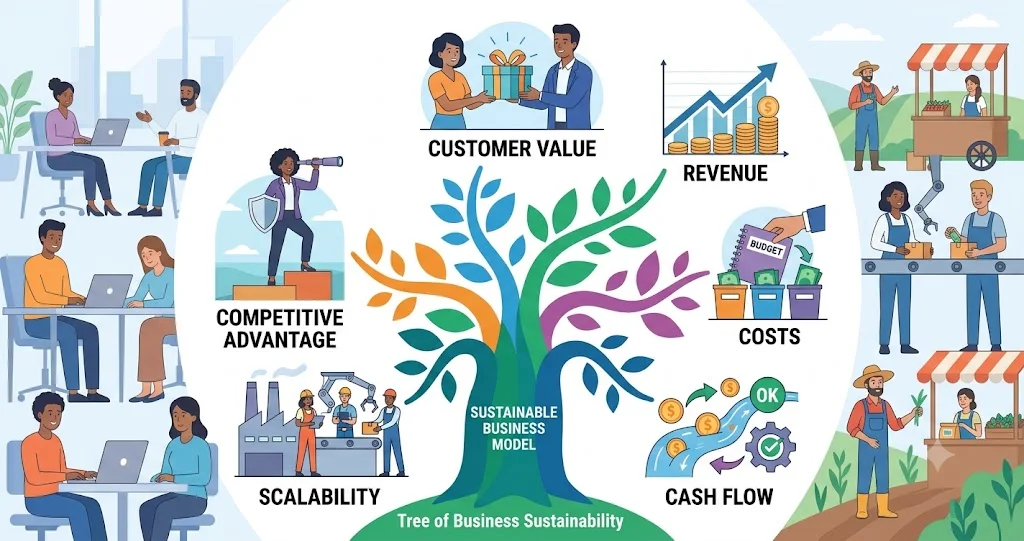
The six building blocks of long-term sustainability
| Building block | Question to ask | What sustainability looks like |
|---|---|---|
| Customer value | Why should customers continue choosing the business? | The product or service solves a meaningful problem at an acceptable value-to-price relationship. |
| Revenue | How does the business reliably make money? | Revenue streams are understandable, repeatable, and connected to genuine customer demand. |
| Costs | What does it cost to deliver the value? | Costs remain manageable as sales grow and the business understands its major cost drivers. |
| Cash flow | Can the business meet obligations when payments and expenses occur? | Cash inflows and outflows are monitored rather than relying only on reported profit. |
| Scalability | Can the company serve more customers without costs and complexity growing uncontrollably? | Processes, technology, people, and suppliers can support growth efficiently. |
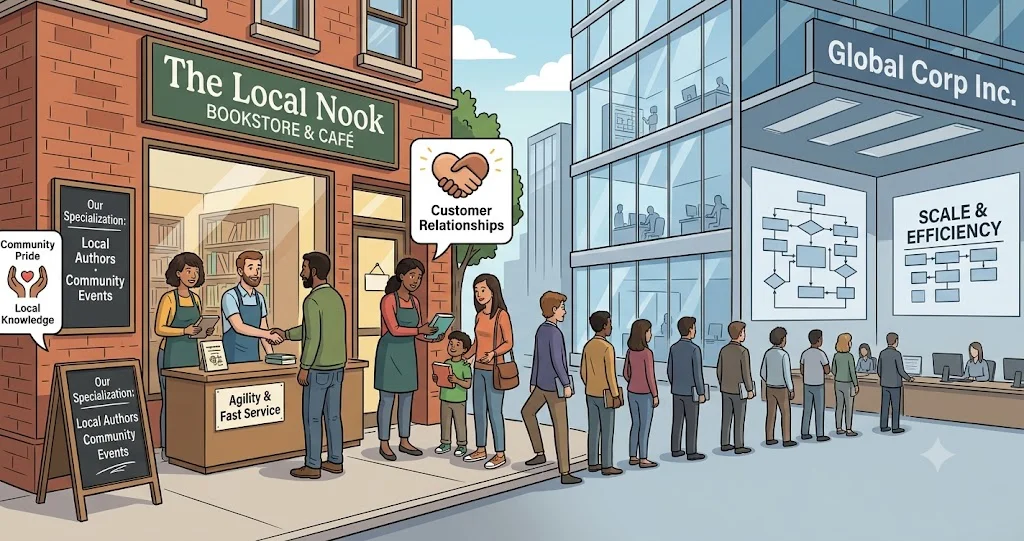
| Competitive advantage | Why can the business continue to compete? | The company has capabilities, relationships, differentiation, efficiency, or other advantages that are difficult to replace quickly. |
1. Customer value comes before revenue
Revenue is a consequence of customers deciding that an offering is worth paying for. A sustainable model therefore starts with a clear value proposition: a specific customer problem, need, or desired outcome that the business can address better or more conveniently than available alternatives.
This does not necessarily mean having the cheapest product. Value can come from convenience, reliability, quality, speed, specialized expertise, lower risk, better service, or a combination of factors. The important question is whether customers have a reason to keep buying when alternatives are available.
A useful test for entrepreneurs is to ask:
- Which customer problem are we solving?
- How frequently does that problem occur?
- What makes customers willing to pay?
- What would make them leave?
- Can the business continue improving the value as customer expectations change?
If the answer to these questions is unclear, increasing marketing spend may produce temporary sales without fixing the underlying business model.
2. Revenue needs a repeatable economic engine
A sustainable business needs a clear mechanism for converting customer value into revenue. Depending on the business, this could involve one-time purchases, subscriptions, usage-based fees, licensing, transaction fees, services, recurring contracts, or a combination of revenue streams.
The important distinction is between revenue growth and economically useful revenue. A company can increase sales while simultaneously increasing acquisition costs, support requirements, discounts, returns, infrastructure costs, or working-capital requirements.
For example, imagine a software company that doubles its customers but must also double its support staff and infrastructure while offering increasingly large discounts to acquire each customer. Revenue has grown, but the underlying economics may not have improved proportionally.
Owners should therefore examine revenue alongside gross margin, operating expenses, customer acquisition costs, retention, payment timing, and cash flow rather than treating sales growth as the only measure of progress. SBA guidance similarly emphasizes understanding profit, cash flow, expenses, and financial statements when making business decisions.
3. Costs must remain connected to value
Cost control does not mean cutting every expense. Some costs create capabilities that allow a company to deliver better value or grow more effectively. The sustainability question is whether spending contributes enough value to justify its financial and operational burden.
It helps to separate costs into categories such as:
- Direct costs: expenses directly associated with delivering a product or service.
- Operating costs: employees, software, facilities, administration, marketing, and other ongoing expenses.
- Growth costs: investments in technology, hiring, market expansion, or new products.
- Fixed and variable costs: expenses that behave differently as sales volume changes.
SBA guidance recommends categorizing expenses and using cost-benefit analysis to understand recurring and nonrecurring costs and the potential benefits of business decisions.
A sustainable model does not require permanently low costs. It requires management to understand which costs scale with revenue, which create leverage, and which can become dangerous when revenue falls.
4. Profitability and cash flow are different
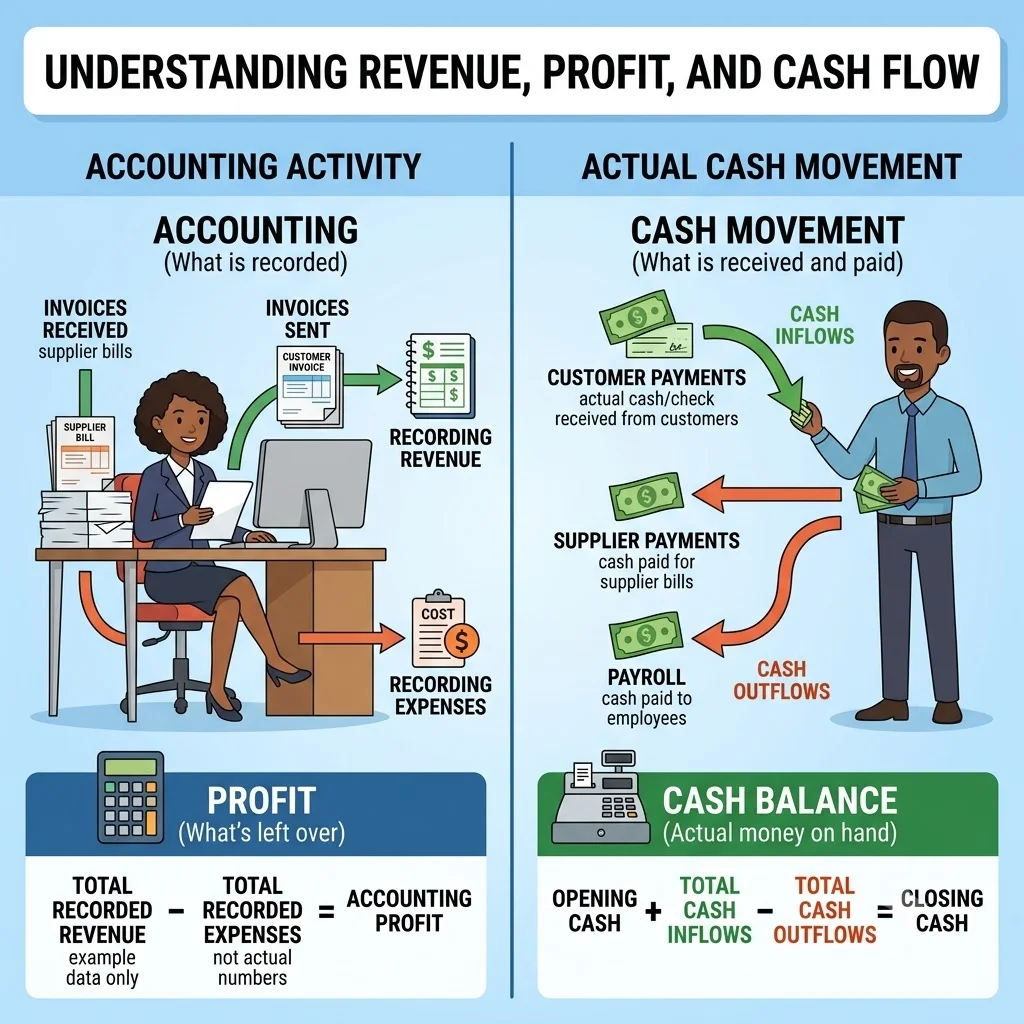
One of the easiest ways to misunderstand business sustainability is to treat profit and cash as the same thing. They are not.
A company can record revenue today while collecting the money later. At the same time, it may need to pay employees, suppliers, taxes, rent, technology providers, or lenders before customer payments arrive. This timing difference can create a cash shortage even when the business appears profitable.
That is why a sustainable business model needs visibility into both profitability and cash flow. SBA resources specifically emphasize cash-flow management, projections, accounts receivable and payable, and the difference between profit and cash available to operate.
For an owner, a useful monthly review can include:
- Revenue and revenue growth
- Gross profit and gross margin
- Operating expenses
- Accounts receivable and payment delays
- Accounts payable and upcoming obligations
- Available cash
- Cash-flow forecast
5. Scalability should improve economics, not just volume
Scalability means the business can handle additional demand without a proportional increase in every resource required to deliver it. But growth is not automatically scalable.
Consider two businesses that each add 1,000 customers. In the first, serving those customers requires almost exactly the same amount of manual work as before. In the second, automated systems handle onboarding, billing, support triage, reporting, and delivery. The second model has more potential operating leverage because additional customers can be served without adding every resource at the same rate.
Scalability can come from technology, standardized processes, reusable intellectual property, supplier relationships, distribution networks, training systems, or product design. It can also create new risks: infrastructure costs, quality problems, management complexity, or dependence on a small number of systems and partners.
Business-model research suggests that successful business-model innovation depends on how elements such as novelty, efficiency, customer lock-in, and partnerships work together rather than on novelty alone.
6. Competitive advantage must survive change
A business model can be profitable today without having a durable competitive advantage. Competitors may copy a product, lower prices, adopt similar technology, reach the same customers, or change the basis of competition.
Competitive advantage can come from several sources, including:
- Strong customer relationships and retention
- Specialized knowledge or intellectual property
- Efficient operations or supply chains
- Brand trust built over time
- Distribution or partner networks
- Data and organizational capabilities
- Switching costs or workflow integration
- A cost structure competitors struggle to match
The important question is not simply, “What makes us different?” It is, “What prevents that difference from disappearing quickly?”
Strategy research has also challenged the assumption that one permanent competitive advantage is always realistic. In rapidly changing markets, companies may need to develop, exploit, and replace advantages as conditions change.
7. Customer retention can strengthen the economics
For many business models, long-term sustainability depends on whether customers continue to see value after the first transaction. Retention can make the economics of acquiring customers more attractive because the business has more opportunities to recover acquisition and onboarding costs through subsequent purchases.
Retention does not necessarily mean subscriptions. A retailer, professional-services firm, manufacturer, marketplace, or software company can all benefit from repeat relationships, although the mechanism differs.
Useful questions include:
- How often do customers return?
- Why do they stay?
- Why do they leave?
- How much does serving an existing customer cost?
- Does the business become more valuable to customers over time?
A model that depends on constantly replacing customers who leave may require a very different acquisition and cost structure from one with strong repeat demand.
8. Sustainability requires the ability to adapt
Long-term sustainability is not the same as keeping today's business model unchanged forever. Customer preferences, technology, regulations, suppliers, competitors, and distribution channels can change.
This makes adaptability part of business-model resilience. A company should periodically test whether its assumptions remain valid rather than waiting for declining sales to force a response.
Business-model innovation can involve changing the revenue mechanism, distribution approach, customer segment, partnership structure, cost model, or product-service combination. Research on business-model innovation emphasizes designing the overall system rather than assuming that a novel idea alone will produce strong performance.
The objective is not constant reinvention. It is maintaining enough organizational flexibility to respond when an important assumption changes.
A practical sustainability check for business owners
Instead of asking whether a business is simply “profitable,” evaluate the model across several connected questions.
- Customer value: Is the business solving a problem customers continue to care about?
- Revenue: Is there a repeatable and understandable way to capture value?
- Margins: Does each additional sale contribute appropriately after the costs required to deliver it?
- Cash flow: Can the company meet financial obligations when they become due?
- Scalability: Can demand increase without operational complexity growing faster than the business can manage?
- Retention: Do customers have reasons to continue the relationship?
- Competition: What protects the business from easy imitation or substitution?
- Adaptability: Can the model change when customer, technology, or market conditions change?
The answers should be considered together. Strong customer demand with poor margins is a problem. Good margins with weak retention can be a problem. Rapid growth with inadequate cash management can create financial pressure. A strong product without an effective distribution system may struggle to reach customers.
Example: comparing two growing businesses
Imagine two businesses that each generate the same annual revenue.
Business A depends heavily on one large customer, has substantial manual delivery work, and receives payment several months after completing projects. Its revenue is healthy, but concentration risk, labor intensity, and working-capital requirements create vulnerabilities.
Business B serves many customers, uses standardized delivery processes, receives payments more predictably, and has a product that can be delivered repeatedly without adding the same amount of labor for every new customer. It may still face competitive and market risks, but its operating model has different characteristics.
This example does not mean Business B is automatically more sustainable. The point is that revenue alone cannot answer the sustainability question. The underlying mechanics of customer value, margins, cash conversion, concentration, scalability, and competitive position matter.
What can make a business model fragile?
Several warning signs deserve closer examination:
- Revenue growth consistently requires disproportionately higher spending.
- A large share of revenue depends on one customer, channel, supplier, or product.
- Customers buy once but rarely return when repeat business is important to the economics.
- Prices are too low to cover the full cost of delivering the offering.
- Cash collections regularly lag behind major operating expenses.
- Critical processes depend on one person and cannot be transferred easily.
- Growth increases operational complexity faster than management capacity.
- The company's competitive advantage is based mainly on a feature competitors can quickly copy.
None of these factors automatically means that a business will fail. They are signals that deserve investigation and measurement.
How to improve a sustainable business model
Improvement usually starts with identifying the weakest part of the economic system rather than making random changes.
- Map the model: document customers, value proposition, channels, revenue streams, major costs, partners, and key activities.
- Measure unit economics: understand what revenue and contribution remain after the costs directly associated with acquiring and serving customers.
- Review cash conversion: identify how long money takes to move from customer demand to collected cash.
- Find operational bottlenecks: identify activities that become increasingly expensive or slow as volume rises.
- Strengthen customer retention: investigate why customers stay, leave, expand, or reduce their relationship.
- Protect the competitive advantage: invest in capabilities that are valuable and difficult to replicate rather than relying only on temporary differentiation.
- Test important assumptions: use customer feedback and financial data to check whether the model still matches market reality.
Financial management should support this process. SBA guidance recommends using financial statements and financial data to understand profitability, financial position, cash flow, costs, and business performance rather than relying on sales figures alone.
Does sustainability also include environmental and social factors?
Yes, the word “sustainable” can refer both to economic durability and to environmental or social sustainability. These concepts can overlap, but they are not identical.
Environmental or social issues can affect a business model through resource costs, supply-chain resilience, regulation, customer expectations, employee relationships, reputation, and access to markets. OECD research describes situations in which sustainability-related actions can contribute to competitive advantage through factors such as stronger resilience, lower costs, or increased revenue.
For a business owner, the practical question is how relevant these factors are to the company's specific industry and value chain. Sustainability initiatives should be evaluated as part of the business system rather than treated as a separate label with no connection to operations or economics.
Frequently asked questions
Is profitability enough to make a business sustainable?
No. Profitability is important, but long-term sustainability also depends on cash flow, customer demand, competitive position, operational resilience, and the ability to adapt. A profitable business can still face cash shortages or become vulnerable to changes in its market.
What is the difference between a profitable and sustainable business model?
Profitability describes whether the business earns more than it spends over a defined period. A sustainable business model asks whether that economic relationship can continue while the business manages customers, costs, cash flow, competition, growth, and changing conditions.
Can a small business have a sustainable business model?
Yes. Sustainability is not determined by company size. A small business can have a sustainable model if it provides valuable products or services, has workable economics, manages cash responsibly, and can continue operating without depending on unrealistic growth assumptions.
Does rapid growth mean a business model is sustainable?
Not necessarily. Rapid growth can increase revenue while also increasing hiring, inventory, infrastructure, customer-support, working-capital, and management requirements. Growth becomes more useful when the underlying economics and operations can support it.
How often should a business review its business model?
There is no universal schedule. Financial performance and cash flow should be monitored regularly, while the broader business model can be reviewed whenever there are meaningful changes in customers, competitors, technology, costs, regulation, or strategy.
What is the most important part of a sustainable business model?
There is no single component that works independently. Customer value creates demand, revenue captures economic value, cost control protects margins, cash flow supports operations, scalability enables growth, and competitive advantage helps the business remain relevant. Sustainability comes from how these pieces work together.
The practical takeaway
A sustainable business model is best understood as a system that repeatedly creates customer value while producing workable economics and remaining adaptable over time. Revenue matters, but it is only one part of the equation. Entrepreneurs and business owners should look at the relationship between revenue, costs, margins, cash flow, retention, scalability, competitive advantage, and changing market conditions.
The strongest model for one business may look very different from the strongest model for another. The useful test is whether the company's specific assumptions continue to hold as it serves customers, pays its costs, grows, competes, and responds to change.