

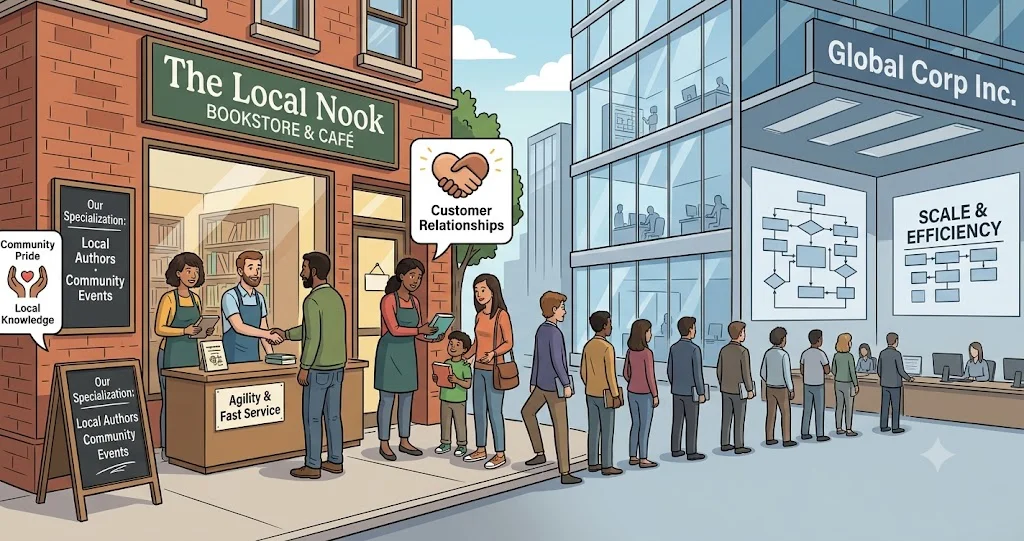
A small business rarely wins by trying to look like a smaller version of a large company. A national chain may have greater purchasing power, a larger marketing department, and more resources, but a local or specialized business can often make decisions faster, understand a narrow customer group better, and provide a more personal experience.
That changes the question from “How can a small company beat a large company?” to “Where can a small company create more value than a large competitor?” A useful small business competition strategy is built around the strengths that scale does not automatically provide: specialization, relationships, agility, local knowledge, and efficient use of technology.
Compete on a strength, not on size
Larger companies often benefit from economies of scale, broad distribution networks, established brands, and substantial resources. Trying to copy all of those advantages can put a small business under unnecessary financial and operational pressure.
A better starting point is to identify a customer need that can be served particularly well. That might mean serving a specific industry, geographic area, customer type, product category, or use case.
For example, a general marketing agency may compete with national agencies on many services. A smaller agency could instead specialize in marketing for independent restaurants, dental practices, manufacturers, or local professional firms. Specialization can make the business easier for the intended customer to understand and can help the company develop deeper knowledge of a particular problem.
1. Build a clear specialization
Specialization is one of the most practical ways for a small business to avoid direct competition with much larger companies.
Instead of asking what products or services the business can sell to everyone, ask:
- Which customers have a specific problem that we understand well?
- Which part of our industry do we know better than most competitors?
- Which customers are poorly served by large providers?
- Can we become known for one particular outcome or type of service?
A narrow market does not necessarily mean a permanently small business. It can provide a starting point for developing expertise, referrals, repeat business, and a strong reputation in a defined segment.
2. Turn customer relationships into a competitive advantage
Customer relationships are valuable when they lead to better understanding and better service, not merely more frequent communication.
A small business can often create shorter feedback loops. The owner or manager may speak directly with customers, notice recurring complaints, and change a process without going through multiple management layers.
Use that proximity deliberately. Keep track of recurring customer questions, reasons for lost sales, common service problems, frequently requested features, and feedback after purchases. These observations can reveal opportunities that are easy to miss when customer information is spread across a large organization.
The goal is not to promise that every customer will receive unlimited personal attention. Instead, build simple systems that preserve useful customer knowledge as the business grows.
3. Use agility as a business capability
Being small does not automatically make a company agile. Agility comes from having the authority, information, and processes needed to make sensible decisions quickly.
A small business can strengthen this advantage by keeping decision-making close to the people who understand the customer and by reviewing a limited set of meaningful business indicators regularly.
For example, if a particular service is receiving repeated requests, a small company may be able to test a revised offering quickly. If customers consistently abandon a particular step in the buying process, the business can investigate and change it without rebuilding an entire corporate system.
Agility should still include discipline. Fast decisions are useful only when they are based on customer evidence, financial realities, and clear business priorities.
4. Make local knowledge difficult to copy
For businesses serving a defined geographic market, local knowledge can be more valuable than broad national reach.
A local business may understand neighborhood demand, seasonal patterns, regional preferences, community networks, nearby suppliers, and the practical concerns of customers in that area. That knowledge can influence inventory, service design, partnerships, communication, and delivery.
Local positioning is strongest when it represents a genuine operational advantage. Simply adding a city name to marketing material does not create meaningful differentiation.
Consider building relationships with complementary local businesses, community organizations, professional networks, and suppliers where appropriate. These relationships can create referral opportunities and market knowledge that large competitors may find harder to reproduce at the local level.
5. Use technology to remove operational friction
Technology can help small businesses narrow some of the operational gaps between them and larger companies. OECD research identifies digitalisation as a potential source of improved efficiency, innovation, market access, and competitiveness for SMEs. At the same time, the OECD notes that smaller firms can face barriers involving skills, resources, financing, and the complexity of adopting more advanced technologies.
The practical lesson is simple: do not adopt technology because it is fashionable. Adopt it when it solves a measurable business problem.
| Business problem | Potential technology approach | What to evaluate |
|---|---|---|
| Repetitive administration | Workflow automation | Time saved and error reduction |
| Scattered customer information | CRM system | Customer visibility and follow-up |
| Manual invoicing | Accounting or billing software | Processing time and accuracy |
| Difficulty tracking performance | Simple reporting dashboards | Decision-making usefulness |
| Slow customer responses | Shared communication and knowledge tools | Response time and service quality |
Recent OECD research also shows that AI adoption among SMEs is increasing, while strategic implementation remains uneven and businesses continue to face time, maintenance, skills, and cybersecurity challenges.

6. Choose technology for leverage, not complexity
A small company does not need the same technology stack as a large enterprise. In many cases, a smaller set of well-integrated tools is more useful than a collection of advanced systems that employees rarely use.
Before buying or implementing a tool, define the problem first. Estimate how much time the current process consumes, identify where errors occur, and determine what improvement would justify the change. Then evaluate whether an existing system can solve the problem before adding another application.
This matters because technology adoption itself has a learning and maintenance cost. World Bank research on firm technology adoption emphasizes that effective technology use depends not only on access to tools but also on a firm's ability to select appropriate technologies and use them effectively.
7. Make the customer experience easier, not merely more personalized
Customer experience is broader than friendliness. It includes how easily someone can understand an offer, ask a question, place an order, receive an update, solve a problem, and return to the business later.
A small company can improve these points with relatively simple changes:
- Explain products or services in plain language.
- Make important business information easy to find.
- Set realistic response expectations.
- Keep customers informed when something changes.
- Make common support questions easy to answer.
- Record useful customer preferences or requirements where appropriate and lawful.
The competitive advantage comes from reducing friction consistently rather than trying to create an elaborate experience that the business cannot maintain.
8. Compete through focused value
Price is often the most obvious comparison between businesses, but it is rarely the only one that matters. A smaller business can compete through a combination of expertise, convenience, responsiveness, reliability, customization, location, or service.
For example, a specialized supplier may not offer the largest catalog, but it may help a particular customer group select the right product more quickly. A local service provider may not have the broadest geographic coverage, but may offer faster scheduling within its service area.
The key is to identify what customers actually value and build the business around that value. Competing on every possible dimension usually spreads limited resources too thin.
9. Build a repeatable referral engine
Referrals can be particularly useful for businesses whose customers have strong relationships with other potential buyers. But a referral strategy works better when the business is clear about who it serves and what problem it solves.
After delivering a successful outcome, make it easy for satisfied customers to describe the business accurately. Maintain useful partnerships with complementary businesses where there is a genuine reason to refer customers to one another.
Do not assume every customer is equally likely to provide valuable referrals. Look for patterns in where strong customers originally came from and which customer segments tend to stay longer, purchase repeatedly, or require fewer resources to serve.
10. Measure the advantages that actually matter
A competitive strategy needs evidence. Small businesses do not need dozens of metrics, but they should monitor indicators connected to their chosen strategy.
| Competitive focus | Useful questions to measure |
|---|---|
| Specialization | Which customer segment generates the strongest demand or repeat business? |
| Customer relationships | Why do customers return, leave, or recommend the business? |
| Agility | How quickly can the business respond to a meaningful customer or market change? |
| Local advantage | Which local relationships, knowledge, or service capabilities create measurable value? |
| Technology | Which processes are becoming faster, more accurate, or easier to manage? |
The exact metrics will vary by business model. A restaurant, software company, contractor, retailer, and professional service firm should not be judged using the same dashboard.
A practical small-business competition framework
A useful way to turn these ideas into action is to work through five questions:
- Choose: Which customer group or problem can the business serve particularly well?
- Differentiate: What can the business offer that is genuinely valuable to that group?
- Strengthen: Which customer, local, or operational capabilities support that advantage?
- Automate: Which repetitive processes can technology handle more efficiently?
- Measure: What evidence will show whether the strategy is working?
This approach avoids a common mistake: adopting isolated tactics without deciding what the business is actually trying to be better at.
Common mistakes small businesses should avoid
Trying to serve everyone
A broad target market can make the business difficult to differentiate. A clearer customer focus can make product decisions, marketing, service design, and partnerships more coherent.
Competing mainly on price
A small company may not have the purchasing scale needed to sustain a price war. If lower prices are part of the strategy, the business should understand exactly how the model remains financially viable.
Buying technology without a process problem
New software does not automatically improve operations. If the underlying process is unclear, technology can simply make an inefficient process more complicated.
Confusing personalization with unlimited service
Personal attention can be valuable, but a business that depends entirely on the owner answering every question may struggle to scale. Documenting common processes helps preserve service quality as the team grows.
Copying large competitors too closely
A large company's strategy is shaped by its scale, systems, market coverage, and resources. A small business should study competitors, but it does not need to reproduce their entire operating model.
Frequently asked questions
Can a small business really compete with a large company?
Yes, but competition does not have to mean matching a larger company's scale. A small business can focus on a specific customer group, specialized expertise, local knowledge, responsiveness, service quality, or another advantage that matters to its target market.
Is specialization better than offering many products or services?
Not automatically. Specialization can make differentiation easier and help a business develop deeper expertise, but a broader offering can make sense when customers genuinely value convenience or when products and services complement one another.
How can technology help a small business compete?
Technology can reduce repetitive work, organize customer information, improve reporting, support communication, and provide access to capabilities that previously required larger internal teams. The appropriate technology depends on the specific business problem.
Should small businesses use AI to compete with larger companies?
AI can be useful for selected tasks such as drafting, summarizing, analysis, customer-support workflows, or internal knowledge work, but adoption should be based on a clear use case. Businesses should also consider accuracy, privacy, cybersecurity, human review, and ongoing costs.
What is the biggest advantage of a small business?
There is no single advantage that applies to every small company. In many cases, the strongest potential advantages are proximity to customers, focused expertise, local knowledge, and the ability to make decisions without the complexity of a large organization.
The goal is not to become a smaller large company
Successful small-business competition is usually less about overcoming every disadvantage of being small and more about choosing where size matters less.
A focused market position, strong customer relationships, local knowledge, responsive decision-making, and carefully selected technology can reinforce one another. Technology can reduce administrative friction; better customer knowledge can improve the offering; specialization can make that offering easier to understand; and agility can help the business respond when customer needs change.
The most useful first step is therefore not to copy the largest competitor. Identify the customers you can serve particularly well, determine what they value, and build a simple operating model around delivering that value consistently.