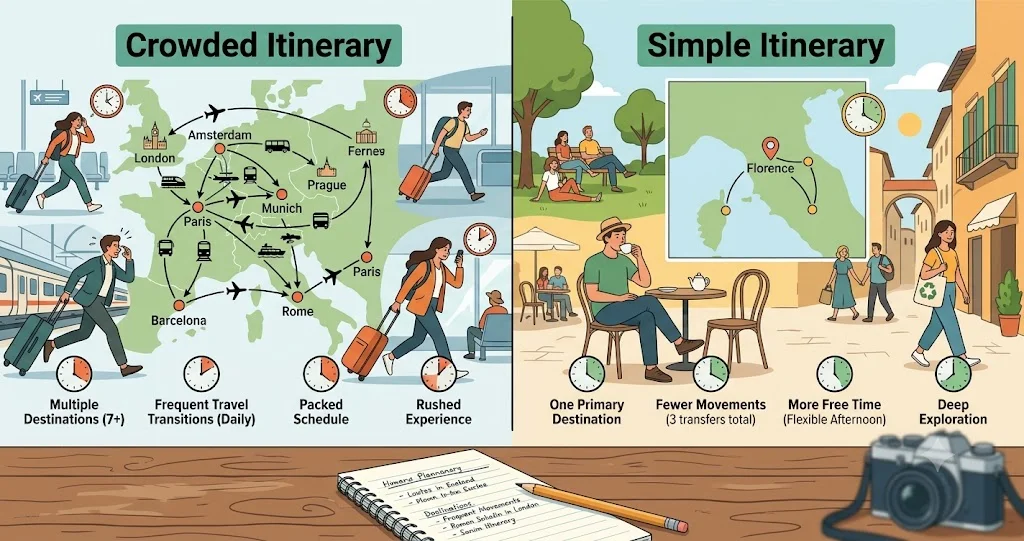

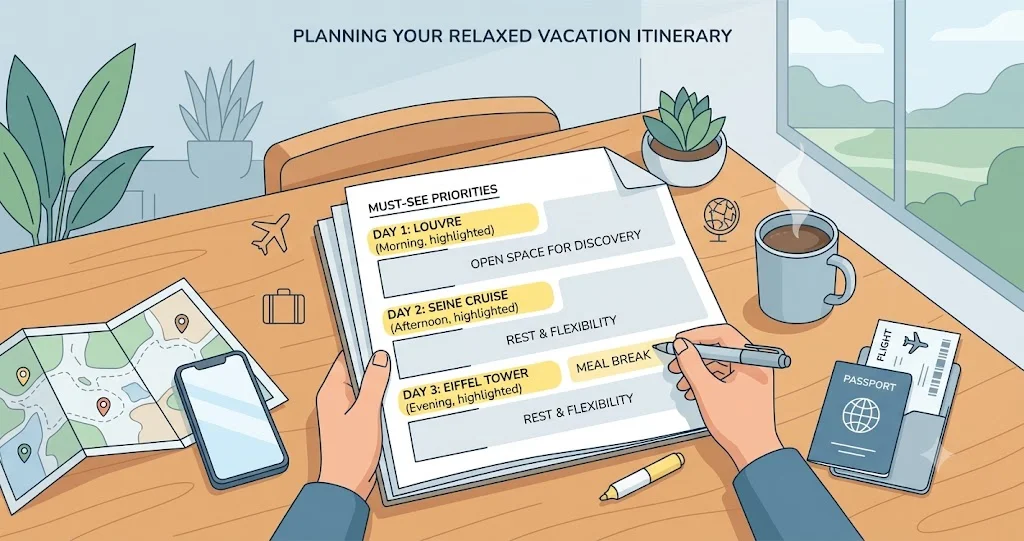
A relaxed trip does not mean seeing fewer places simply for the sake of slowing down. It means building a schedule that leaves enough time to experience the places you choose without turning every day into a race against the clock. The key is to decide what matters most, group activities intelligently, allow for travel and waiting time, and deliberately leave some space unplanned.
What makes an itinerary exhausting?
An itinerary becomes exhausting when the number of planned activities leaves little room for the time required to actually complete them. A sightseeing plan might look reasonable on paper but become unrealistic once transportation, queues, meals, hotel check-in, navigation, breaks, weather, and unexpected delays are included.
Transportation is particularly easy to underestimate. The U.S. Department of Transportation notes that airline schedules can be affected by weather, air-traffic delays, mechanical problems, and other factors, and recommends allowing enough time when a delay could affect an important part of a trip.
The same principle applies after you arrive. A 30-minute journey on a map is not necessarily a 30-minute door-to-door experience. Finding a station, waiting for transport, navigating an unfamiliar area, parking, walking between locations, or traveling with children can all add time.
Start with priorities, not a list of attractions
The easiest way to create a relaxed itinerary is to avoid treating every interesting place as equally important.
Before assigning anything to a particular day, divide potential activities into three groups:
- Must experience: the attractions, activities, or experiences that would make the trip feel worthwhile to you.
- Would like to experience: worthwhile options that can be added if time, energy, and conditions allow.
- Optional: interesting possibilities that do not need to happen on this trip.
This simple prioritization creates flexibility before the itinerary becomes crowded. If rain, a delayed train, tired children, or an unexpectedly enjoyable lunch takes longer than expected, you already know which activity can be dropped without feeling that the entire day has failed.
Use a daily priority instead of a daily checklist
A checklist encourages you to ask, “How many places can we fit in?” A priority-based itinerary asks, “What do we most want from today?”
For example, a family visiting a large city might make a historic district the main experience for one day. Instead of adding five unrelated attractions afterward, the family can explore the district at a comfortable pace, stop for lunch, visit one additional nearby attraction, and keep the rest of the afternoon flexible.
This approach also makes the trip easier to adjust. If the main activity takes longer than expected, you have not automatically created a chain reaction that causes every later reservation to be missed.
Group activities by location
Geography is one of the most useful tools for planning a relaxed itinerary.
Put attractions that are close to each other on the same day whenever practical. A day organized around one neighborhood or area can eliminate repeated cross-city journeys and make unexpected stops easier.
| Planning approach | Typical effect |
|---|---|
| One area per day | Less repeated transportation and easier local exploration |
| Scattered attractions | More transfers and more dependence on transport schedules |
| Nearby backup options | Easier to change plans when weather or energy changes |
| Multiple distant reservations | Less flexibility because delays can affect later bookings |
Maps and travel-planning apps are useful for identifying clusters, but do not treat map travel times as the entire time required. Add practical time for getting from your accommodation to the transport point, finding entrances, waiting, and moving around the destination.
Calculate the real time for each activity
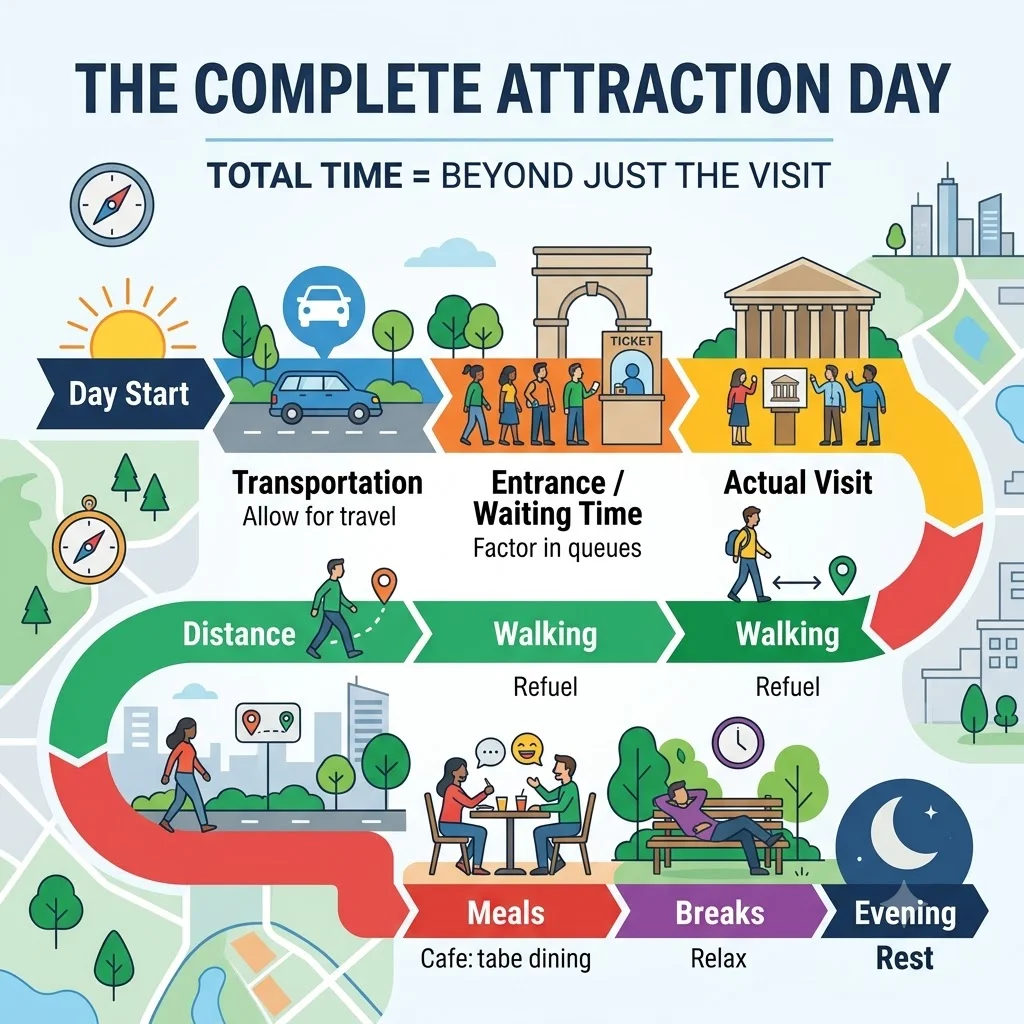
An attraction's advertised visit duration is only one part of the schedule. A realistic block may include:
- Travel to the location.
- Finding the entrance or parking.
- Waiting or passing through security.
- Time inside the attraction.
- Walking to the next location.
- Food, bathroom, and rest breaks.
For families, the gap between theoretical and actual timing can be even larger because children may need more breaks, meals may take longer, and the group may move at different speeds.
Instead of scheduling an attraction from 10:00 to 11:00 because you expect to spend an hour inside, think in terms of the complete block of time it will occupy. This makes the itinerary less precise on paper but much more realistic in practice.
Do not schedule every hour
One of the most useful rules for a relaxed itinerary is to leave genuine unscheduled time.
Unplanned time can be used for a slow breakfast, a longer lunch, an afternoon nap, shopping, a playground, a scenic walk, a café, hotel downtime, or simply doing nothing. It also acts as a buffer when the planned day takes longer than expected.
For many trips, it is more useful to think in terms of anchors and open space. An anchor is something you definitely want to do or something that requires a fixed reservation. Open space surrounds those anchors and can be filled according to the day's conditions.
For example, a day could have one fixed morning reservation, one flexible afternoon area to explore, and an open evening. That is still a planned day, but it does not require every hour to go according to plan.
Protect travel days from becoming sightseeing days
Arrival and departure days deserve special treatment. A flight, train, long-distance drive, airport transfer, hotel check-in, luggage handling, or border procedure can consume much of the day even when the transportation itself looks short.
Airline schedules can also change, and the Department of Transportation specifically advises travelers to recheck flight information because schedules may change. It also recommends allowing additional time when a delay could affect an important event or connection.
That makes arrival day a poor place for a long chain of non-refundable or time-sensitive activities. A better approach is to choose something close to the accommodation or transportation hub, or simply keep the first part of the trip open.
Build buffers around important reservations
Not every activity needs the same amount of flexibility. A museum you can enter throughout the afternoon is different from a timed train, airport departure, or prepaid tour.
For fixed-time activities, plan backward from the required arrival time. Consider the consequences if the previous activity runs late. If missing the reservation would cause a significant problem, give yourself more separation between the two commitments.
The Department of Transportation recommends checking connection times and considering what happens if the first flight is delayed before selecting a connecting itinerary.
The broader lesson is simple: the more important an appointment is, the less you should depend on perfect timing beforehand.
Plan around energy, not just geography
Two attractions can be close together and still make a difficult day if both require several hours of walking, concentration, queues, or physical effort.
Think about the energy pattern of the group. A morning cultural attraction followed by a long lunch and an easy neighborhood walk may work better than scheduling two large attractions followed by an evening tour.
Families should also consider the ages and routines of children. A day that looks efficient for two adults may be unrealistic for a family that needs regular meals, naps, playground time, or earlier evenings.
There is no universal number of attractions that makes an itinerary relaxed. The appropriate pace depends on the destination, travelers, transportation, weather, mobility, interests, and the type of activities involved.
Use a simple daily structure
A flexible daily structure can be more useful than a detailed timetable.
| Part of day | Planning approach | Example |
|---|---|---|
| Morning | One priority activity | Timed attraction or major sightseeing area |
| Midday | Meal and recovery time | Lunch near the morning location |
| Afternoon | Flexible activity | Nearby museum, market, park, or neighborhood |
| Evening | Optional plan | Dinner, short walk, or free time |
This is not a formula that every trip must follow. It is a way to prevent the common mistake of filling morning, afternoon, and evening with fixed commitments every day.
Keep one or two backup options for each day
Flexibility works better when it is planned rather than improvised.
For each day, identify a few alternatives that fit the same general area or can be reached easily. If an outdoor attraction becomes impractical because of rain, you can switch to an indoor option without rebuilding the entire itinerary.
National Park Service guidance for Isle Royale National Park illustrates why flexibility matters in real travel: weather, emergencies, and changing conditions can affect even well-prepared plans, and visitors are advised to be flexible with their itineraries.
The same principle applies outside national parks. A backup plan is not an admission that the original plan will fail. It is a way to reduce the pressure to force the original plan to happen.
Leave room for local information
A rigid itinerary assumes that everything worth doing can be identified before departure. That is rarely necessary.
Local recommendations, weather changes, temporary events, neighborhood discoveries, and conversations with people at your accommodation can reveal options that were not part of your original plan. Leaving open space allows those discoveries to become part of the trip instead of becoming another source of scheduling stress.
For international travel, however, flexibility should not replace basic preparation. The U.S. Department of State recommends checking destination-specific travel advisories, entry and exit requirements, local laws and customs, and relevant travel needs before international trips.
Be careful with hotel changes
Changing accommodation can make a multi-city trip possible, but every move has a hidden time cost. Packing, checking out, traveling to the next property, storing or carrying luggage, checking in, and getting oriented can consume a substantial part of the day.
For shorter vacations, staying in one well-located base can sometimes create a more relaxed experience than changing hotels repeatedly. For longer trips, moving between cities may be worthwhile when the destinations themselves are a major part of the experience.
The decision should therefore consider not only accommodation price or distance, but also the time and energy required to relocate.
Create a relaxed itinerary for a five-day family trip
Imagine a family visiting a city for five days. Instead of assigning several attractions to every day, they could structure the trip around a few priorities:
- Day 1: Arrival, check-in, nearby meal, and an easy local walk.
- Day 2: One major attraction, lunch nearby, and flexible neighborhood exploration.
- Day 3: A slower morning, family-friendly activity, and an open evening.
- Day 4: Another major attraction followed by nearby optional activities.
- Day 5: Flexible morning, final shopping or sightseeing, then departure preparation.
This example is intentionally incomplete. A relaxed itinerary should leave room to decide what to do with part of the day after seeing how the group feels and what conditions are like.
Common itinerary mistakes to avoid
Trying to visit every famous attraction
Popularity does not mean every attraction belongs on the same trip. Choose the places that fit the interests of your group rather than collecting destinations for the sake of completeness.
Ignoring transportation between attractions
Travel time is part of the itinerary. A schedule that excludes it will almost always look more relaxed on paper than it feels in reality.
Booking too many timed activities
Multiple fixed reservations create a chain of dependencies. If one activity runs late, the rest of the day may become stressful.
Making every day equally full
Travelers often underestimate the cumulative effect of several busy days. A lighter day in the middle of a trip can provide useful recovery time.
Using the same pace for every traveler
A family with young children, older travelers, people with mobility limitations, and two energetic adults may need very different schedules. Plan around the needs of the actual group.
A practical checklist before finalizing your itinerary
- Have you identified the two or three experiences that matter most?
- Are activities grouped geographically where practical?
- Have you included transportation time rather than only attraction time?
- Does each day contain genuine open space?
- Have you allowed recovery time after long travel?
- Are important reservations separated by enough time to handle delays?
- Do arrival and departure days avoid overly ambitious plans?
- Do you have alternatives for bad weather or changed conditions?
- Does the schedule match the group's age, mobility, energy, and interests?
- For international travel, have you checked current destination requirements and advisories?
Frequently asked questions
How many activities should I plan for one day?
There is no universal number because activity duration, travel time, destination size, and traveler needs vary. A better approach is to choose one or two priorities and treat additional activities as flexible options rather than mandatory appointments.
Should I plan every day of a vacation?
You can plan the important parts without scheduling every hour. Reservations, transportation, and must-see experiences should be organized in advance when necessary, while some meals, walks, shopping, rest periods, and optional activities can remain open.
How much free time should I leave in an itinerary?
There is no evidence-based universal percentage that works for every trip. The appropriate amount depends on the destination and travelers. A useful practical test is whether the schedule still works if one activity takes longer than expected without forcing you to cancel everything afterward.
Is it better to stay in one hotel or move between cities?
It depends on the trip. One base reduces packing and relocation time, while changing locations can make a multi-destination journey more efficient when the distances are large. Compare the sightseeing benefit of moving with the time and energy required to relocate.
How can families make an itinerary less tiring?
Prioritize fewer major activities, schedule regular meal and rest periods, keep some afternoons or evenings flexible, and choose attractions that are geographically close. Consider the routines and energy levels of children rather than using an adult-oriented schedule.
What should I do if weather changes my plans?
Keep a short list of alternative indoor or weather-tolerant activities, preferably near the original area. Avoid making every activity dependent on a specific weather condition unless it is central to the trip.
The goal is a trip you can actually enjoy
The best itinerary is not the one containing the most attractions. It is the one that gives you enough structure to reach the experiences you care about while leaving enough flexibility to deal with real travel.
Start with priorities, group activities by location, estimate the complete time required for each plan, protect breaks, build buffers around important reservations, and leave some decisions open. For international trips, combine that flexibility with current destination research and practical preparation. Official travel guidance emphasizes checking destination requirements and allowing for disruptions, while transportation guidance recognizes that schedules can change.
A relaxed itinerary is therefore not an absence of planning. It is planning that leaves room for the trip itself.