

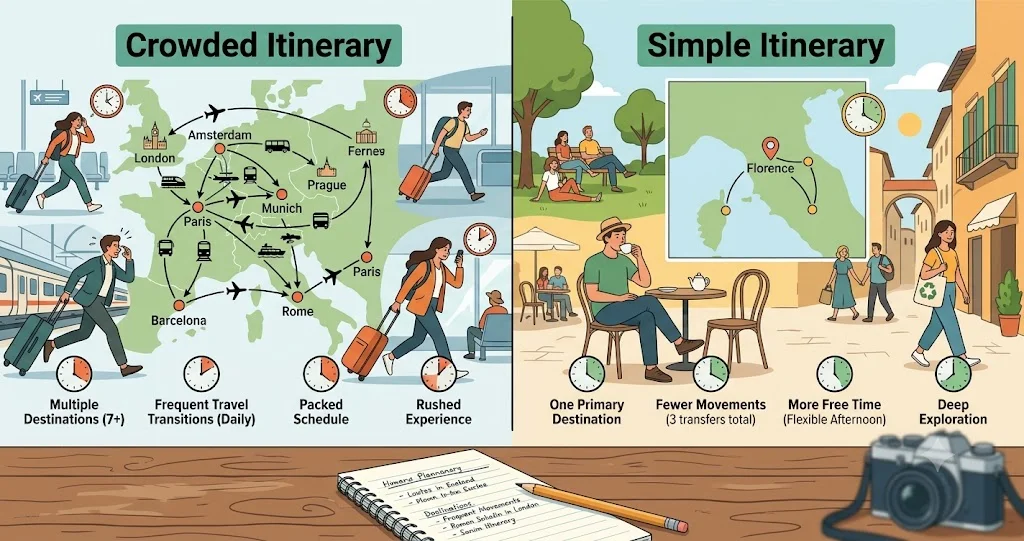
Slow travel is less about traveling slowly in a literal sense and more about changing how much you try to fit into a trip. Instead of moving from one destination to another every day, you choose fewer places and give each one enough time to become familiar. That might mean staying several nights in one neighborhood, using local transport, eating where residents eat, walking without a strict destination, or leaving an afternoon completely unscheduled.
The idea has attracted growing attention in tourism research because slower travel can create more immersive experiences and stronger connections with local communities and places. Recent research describes slow tourism through themes such as sustainability, authenticity, mindfulness, and meaningful engagement rather than simply the number of destinations visited.
What does slow travel actually mean?
There is no single itinerary formula that makes a trip "slow." The concept is better understood as a set of choices about pace, mobility, attention, and depth.
A fast-paced trip might involve three cities in five days, multiple transfers, and a checklist of major attractions. A slower version might use those same five days in one city and its surrounding area, with time for a market, neighborhood walk, museum, local meal, day trip, and ordinary downtime.
Academic literature also notes that the boundaries of slow travel and slow tourism are not perfectly fixed. Researchers commonly associate the concept with reduced pace, flexible planning, responsible travel, local culture, and more attentive experiences.
Why spending longer in one place can be better
1. You spend less of the trip moving between destinations
Changing hotels, reaching stations or airports, checking in, packing again, and navigating unfamiliar transport can consume substantial portions of a short trip. Fewer base changes simplify the practical side of travel.
This does not mean every journey should avoid transportation. Instead, slow travel asks whether each transfer adds enough value to justify the time and effort it requires.
2. You can experience a destination beyond its highlights
A short visit often concentrates attention on the attractions that appear on every itinerary. A longer stay makes room for a different layer of the destination: a residential neighborhood, a local market, a public park, a small cultural event, or a familiar café visited more than once.
Research on long-stay tourists has found that their behavior can become more similar to neighborhood activity than conventional tourist behavior, with greater emphasis on everyday interaction and relationship-building.
3. The itinerary has room for unexpected experiences
A tightly scheduled holiday leaves little space for something discovered after arrival. If every morning and afternoon already has a booking, an interesting local recommendation can become an inconvenience rather than an opportunity.
Slow travel deliberately protects some unplanned time. You might discover a small gallery, a walking route, a local festival, or a food tradition simply because you had an afternoon available.
4. Local spending can become more varied
Staying longer can shift some travel spending away from a sequence of major attractions and toward everyday services such as independent restaurants, neighborhood shops, local guides, markets, and cultural activities.
Research on slow tourism has linked longer, more engaged visits with opportunities for local businesses and entrepreneurs, although the economic effects depend heavily on the destination and how tourism is organized.
5. Travel can feel less like a checklist
There is a practical difference between seeing a place and becoming familiar with it. Returning to the same street, recognizing a neighborhood, understanding a transit route, or learning a few local customs can create a sense of place that is difficult to develop during constant movement.
That is one reason slow travel appeals to experience-focused travelers: the goal is not necessarily to maximize the number of sights visited, but to make the time spent in a destination more meaningful.
Slow travel can also have environmental advantages
Fewer destination changes can mean fewer journeys between places. Research on slow tourism frequently connects the concept with lower-impact forms of mobility and sustainability. One recent review specifically highlights green mobility as an area of ongoing research and identifies longer stays and place-based experiences as potentially useful components of sustainable tourism planning.
However, slow travel should not automatically be described as sustainable. A traveler can stay in one destination for a long time while relying heavily on resource-intensive transport or accommodation. Sustainability depends on the complete pattern of travel, including transportation, accommodation, consumption, and the pressures tourism places on residents.
Recent research also cautions against treating "slow" as automatically positive. Tourism can still create unequal effects if local communities or workers are expected to adapt their lives around visitors. The useful question is therefore not simply whether travel is slow, but whose needs the slower travel model serves.
How slow travel changes the way you plan
The biggest adjustment is simple: start with fewer priorities.
Choose a base before building the itinerary
Instead of listing every attraction you want to see and then connecting them with hotels, select one main base first. Consider its location, transport connections, walkability, and access to the experiences that matter most to you.
Use a "must, should, could" list
- Must: the experiences that would make the trip feel worthwhile.
- Should: activities you would enjoy if time and energy allow.
- Could: optional ideas that can remain unplanned until you arrive.
This prevents an itinerary from becoming a race to complete every recommendation found online.
Leave transition days lighter
If you do change destinations, avoid scheduling major activities immediately before and after the transfer. Travel delays, unfamiliar transport, and simple fatigue are easier to handle when the schedule has some breathing room.
Build around neighborhoods and experiences, not only attractions
A useful slow-travel itinerary might combine one major attraction with several smaller experiences. For example, a morning museum visit could be followed by lunch in the surrounding neighborhood, an afternoon walk, and an evening with no fixed plan.
The objective is not to avoid famous places. It is to stop every hour of the trip from being assigned to a different attraction.
How many days should you spend in one place?
There is no universal number. The right length depends on the destination, travel time, budget, personal interests, and whether you want to explore nearby areas.
| Trip style | Typical approach | Planning priority |
|---|---|---|
| Short city break | One base with a small number of priorities | Location and walkability |
| Week-long trip | One destination or two closely connected bases | Balance between activities and free time |
| Longer holiday | One main base with optional local excursions | Everyday experiences and flexibility |
| Regional journey | A few bases with longer stays at each | Reducing unnecessary transfers |
The point is not to follow a fixed rule such as "stay at least seven days." A three-day stay can still be slow if it avoids unnecessary movement, while a two-week trip can feel rushed if every day is packed.
Can slow travel cost less?
It can, but it is not automatically cheaper.
Longer stays may reduce some repeated costs associated with changing accommodation and transportation. A traveler who stays in one place may also have more opportunities to use local transport, walk, cook occasionally, or choose everyday restaurants instead of repeatedly paying for tourist-oriented experiences.
On the other hand, staying longer means paying for more nights. Popular destinations can also have expensive accommodation, and a slower itinerary does not eliminate the cost of flights or long-distance transportation.
A better way to evaluate the financial side is to compare the total trip cost, rather than assuming that fewer destinations automatically means lower spending.
A practical slow-travel planning method
- Choose one primary destination. Pick the place you genuinely want to understand rather than selecting destinations simply because they are nearby.
- Set two or three priorities. Identify the experiences that matter most.
- Choose accommodation strategically. A slightly better-located base may save repeated transport time and simplify the trip.
- Group activities geographically. Combine experiences in the same area rather than crossing the destination repeatedly.
- Keep at least some time unassigned. Protect space for rest, weather changes, local recommendations, and spontaneous discoveries.
- Use local transportation where practical. Walking, trains, buses, bicycles, or other appropriate local options can make movement part of the experience.
- Check current local information. Opening hours, transport schedules, entry requirements, seasonal closures, and local rules can change, so verify them before important bookings.
Example: turning a rushed itinerary into a slower one
Imagine a traveler has five days and wants to visit three cities. The original plan might involve arriving in one city, seeing several attractions, transferring to another city, repeating the process, and ending with another long transfer.
A slower alternative could use one city as the base for the full five days. The traveler might reserve two days for major sights, one day for a nearby excursion, one day for neighborhoods and food, and one flexible day. The result is not necessarily more comprehensive. It is simply designed around deeper engagement and fewer transitions.
This approach is particularly useful when the destination itself is the main attraction rather than a single landmark.
Who is slow travel best suited to?
- Travelers who prefer cultural experiences over collecting destinations.
- People who enjoy walking, food, neighborhoods, nature, or everyday local life.
- Travelers who find frequent packing and transfers tiring.
- Visitors who want flexibility rather than a fully scheduled itinerary.
- Families or couples who value downtime between activities.
- Travelers interested in supporting smaller local businesses and community-based experiences where appropriate.
It may be less suitable for someone whose main goal is to see as many distinct destinations as possible during a limited trip. Slow travel is a preference and planning philosophy, not a requirement for responsible or enjoyable tourism.
Common mistakes that make slow travel feel rushed
Trying to visit too many nearby places
Just because two destinations appear close on a map does not mean the transfer is effortless. Travel time includes packing, getting to stations, waiting, navigating, and settling into the next location.
Filling every free hour
A day with nothing scheduled is not necessarily wasted. Rest and unstructured time can be part of the experience.
Confusing slow travel with doing nothing
Slow travel can still include hiking, museums, food tours, day trips, and cultural events. The difference is that activities are selected deliberately rather than accumulated.
Assuming every local experience is automatically authentic
"Local" is not a guarantee of quality or meaningful community benefit. Look at who operates an experience, how it interacts with residents, and whether the activity respects local culture and resources.
Frequently asked questions
Is slow travel only for long vacations?
No. The principle can work on a short trip by reducing unnecessary transfers and focusing on one area. The length of the trip matters less than how deliberately the time is used.
Does slow travel mean avoiding tourist attractions?
No. Popular attractions can still be part of a slow itinerary. The difference is that they do not have to fill every day or define the entire trip.
Is slow travel always more sustainable?
No. Staying longer and reducing movement can support lower-impact travel patterns, but sustainability depends on transportation, accommodation, consumption, and effects on local communities. Research also warns that simply labeling tourism as "slow" does not guarantee equitable outcomes.
Can slow travel be more expensive?
Yes. A longer stay can increase accommodation and food costs. It can also save money in some situations by reducing repeated transfers or allowing travelers to use everyday local services. Compare the total cost rather than assuming either outcome.
How do I start planning a slow trip?
Choose one main destination, identify a few priorities, select a convenient base, group activities by area, and deliberately leave unplanned time. That is enough to begin without adopting a complicated travel philosophy.
The practical takeaway
Slow travel works because it changes the question from "How many places can I see?" to "How much can I experience from the time I have?" Spending longer in one place can reduce logistical friction, create room for ordinary local experiences, and make an itinerary easier to adapt.
It is not a guarantee of a better trip, a lower budget, or greater sustainability. But for travelers who value depth, flexibility, and a stronger connection with a destination, choosing fewer places and giving them more time can be a useful alternative to a packed itinerary.