

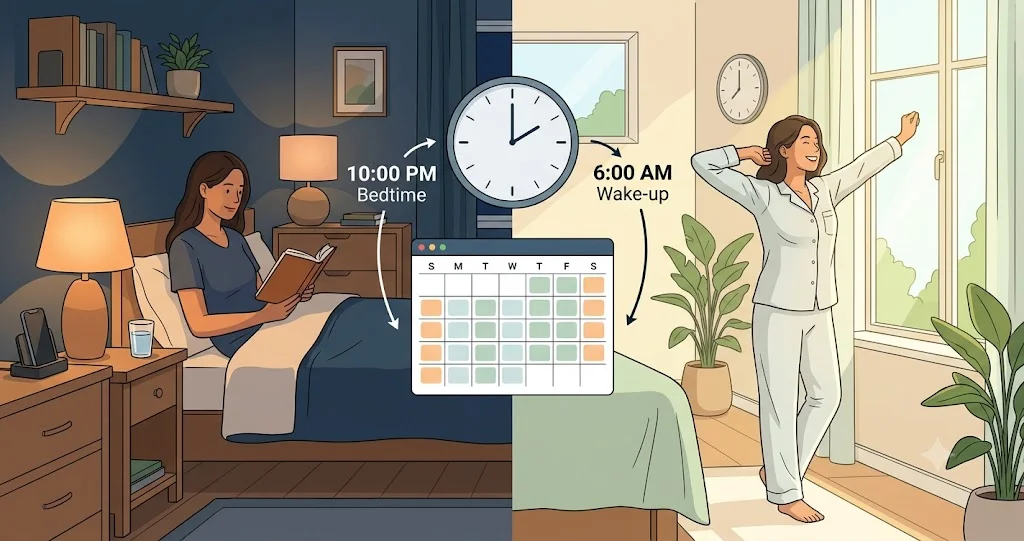
Feeling tired during the day is not always about how early you went to bed. The timing and regularity of your sleep also matter. A consistent sleep schedule means going to sleep and waking up at roughly similar times from day to day while allowing enough time for adequate sleep. Research in adults has found that greater variability in sleep timing is generally associated with less favorable health outcomes, although the evidence varies by outcome and study quality.
What does a consistent sleep schedule mean?
A consistent sleep schedule is a repeatable pattern for when you go to bed and when you get up. It does not require going to sleep at exactly the same minute every night.
For a working adult, a schedule might look like going to bed around 10:30 p.m. and getting up around 6:30 a.m. on most days. If work or family responsibilities require a different schedule, the principle remains the same: keep sleep and wake times reasonably predictable and make sure the schedule provides enough time for sleep.
Regularity is one dimension of sleep health. It should not be treated as a replacement for adequate sleep duration or good sleep quality. Current CDC guidance says adults ages 18–60 generally need at least 7 hours of sleep per day, while recommended ranges differ for older adults.
Why sleep timing can affect how you feel during the day
Your sleep-wake pattern interacts with the body's circadian system, an internal timing system that helps coordinate periods of sleep and wakefulness with the day-night cycle. Light exposure, activity, meals, and regular daily routines provide signals that help synchronize this system.
When bedtime and wake time move substantially from one day to the next, the timing of these signals can also change. Researchers use terms such as sleep variability, sleep regularity, and social jetlag to describe different aspects of this pattern.
A systematic review covering 41 studies and more than 92,000 unique adult participants found that later sleep timing and greater sleep variability were generally associated with adverse health outcomes. The authors also concluded that consistent bedtimes and wake-up times were favorably associated with health, while noting that evidence quality ranged from very low to moderate depending on the outcome.
What research says about sleep regularity
Sleep regularity has received increasing attention because sleep duration alone does not describe the whole sleep pattern.
A 2023 National Sleep Foundation expert consensus statement concluded that consistency in sleep onset and offset timing is important for health, safety, and performance. The panel also concluded that catch-up sleep on non-work days may be beneficial when people do not get enough sleep during the work week.
Large observational studies provide additional evidence, but they should be interpreted carefully. One UK Biobank study involving more than 60,000 participants found that higher sleep regularity was associated with lower mortality risk and was a stronger predictor of mortality in that dataset than sleep duration. Because this was an observational cohort study, the findings show an association rather than proving that changing sleep regularity alone causes the observed differences in mortality.
A more recent systematic review published in 2025 synthesized 59 studies and reported consistent associations between greater sleep-timing irregularity and several unfavorable mental, metabolic, vascular, cognitive, and mortality outcomes. The authors also emphasized differences between studies and the need for randomized intervention research.
Regularity and sleep duration are not the same thing
It is possible to have a very consistent schedule that provides too little sleep. For example, sleeping from 1:00 a.m. to 6:00 a.m. every night is regular, but five hours is not enough sleep for most adults.
For adults, major sleep-health guidance recommends at least seven hours per night on a regular basis. CDC data from the United States show that 30.5% of adults reported getting less than seven hours of sleep on average in 2024.
This creates two separate questions:
- Am I getting enough sleep?
- Is my sleep happening on a reasonably consistent schedule?
A healthy routine needs to address both.
How a regular schedule may support daily energy
It would be too strong to say that a consistent bedtime automatically makes everyone more energetic. Daytime energy depends on sleep duration, sleep quality, health conditions, medications, stress, activity, nutrition, work schedules, and many other factors.
However, a stable sleep-wake pattern can make it easier to protect sufficient sleep time and maintain a predictable relationship between sleep and the body's circadian timing. NIH guidance recommends going to bed and waking up at approximately the same time each day and keeping the difference between weekday and weekend schedules relatively small.
Good sleep itself is important for normal daytime functioning. CDC guidance notes that adequate, quality sleep supports health and emotional well-being, while insufficient sleep is associated with a range of health problems.

Practical ways to establish a consistent sleep schedule
1. Choose a wake-up time first
For many working adults, the morning is less flexible than bedtime because work, commuting, school runs, or other responsibilities set a fixed start time. Choose a wake-up time that works on most days and build the rest of the schedule around it.
If you need to wake at 6:30 a.m., work backward far enough to give yourself adequate sleep opportunity rather than deciding on bedtime only after the evening is almost over.
2. Protect enough time for sleep
A regular schedule cannot compensate for consistently insufficient sleep. Adults generally need at least seven hours, although individual needs vary.
If you currently sleep five or six hours because of work or screen time, simply making bedtime more consistent may not solve the problem. The schedule needs to include enough time for actual sleep.
3. Keep weekend changes modest
It is common to stay up much later on Friday and Saturday and sleep far into the morning. NIH guidance suggests keeping the difference between weekday and weekend schedules to about an hour when possible because large changes can disrupt the body's sleep-wake rhythm.
This does not mean a late weekend morning is automatically harmful. If you are catching up on sleep lost during the week, additional sleep can be useful. The practical goal is to avoid creating a completely different sleep schedule every weekend.
4. Use morning and daytime light
Light is an important environmental signal for the circadian system. NIH guidance recommends spending time outside during the day, and particularly notes the value of daytime and morning light for helping regulate circadian rhythms.
A simple habit is to spend some time outdoors after waking or during a morning walk when circumstances allow. This is not a substitute for treatment when someone has a circadian rhythm disorder, but it can be part of a healthy routine.
5. Create a repeatable wind-down period
A consistent bedtime is easier to maintain when the hour before it follows a familiar pattern. Quiet reading, light stretching, preparing clothes for the next day, personal hygiene, or another relaxing activity can become cues that the day is ending.
NHLBI recommends using the hour before bed for quiet time and limiting bright artificial light.
6. Pay attention to caffeine timing
Caffeine can interfere with sleep, and its effects can last for several hours. NHLBI notes that caffeine's effects may last up to eight hours in some circumstances.
If you regularly struggle to fall asleep, consider whether late-afternoon or evening caffeine is contributing to the problem. Individual sensitivity varies, so the useful question is whether your timing is affecting your sleep rather than whether everyone must follow one universal cutoff time.
7. Make the bedroom suitable for sleep
A bedroom that is quiet, cool, and dark can support better sleep conditions. NHLBI includes these environmental factors among its healthy sleep recommendations.
A realistic routine for a working professional
Consider someone who needs to leave home at 8:00 a.m. and usually wakes at 6:30 a.m. Instead of attempting to change everything at once, the person could establish a stable wake time first and then build a bedtime that provides sufficient sleep opportunity.
For example:
| Time | Example routine |
|---|---|
| 6:30 a.m. | Wake up and get exposure to daytime light |
| Daytime | Work, normal meals, physical activity when possible |
| Late afternoon/evening | Be mindful of caffeine if it interferes with nighttime sleep |
| 9:30 p.m. | Begin quieter activities and reduce stimulating tasks |
| 10:30 p.m. | Target bedtime, allowing enough sleep opportunity before the morning |
| Weekend | Keep sleep and wake times reasonably close to the weekday schedule |
This is an example rather than a medically prescribed schedule. Someone who works nights, has children, travels frequently, or has a sleep disorder may need a different approach.
What if your sleep schedule is already irregular?
Trying to move from a highly irregular schedule to a fixed bedtime overnight can be difficult. A gradual adjustment may be easier to maintain.
- Identify your current average bedtime and wake time for several days.
- Choose a realistic target wake-up time based on your work and personal commitments.
- Move your schedule gradually if a large shift is required.
- Keep the wake time consistent while establishing the new routine.
- Protect enough time for sleep rather than simply shifting the same short sleep period.
- Use daytime light, physical activity, and a predictable evening routine to reinforce the schedule.
NHLBI also suggests keeping a sleep diary when sleep problems need to be evaluated. Recording bedtime, wake time, naps, sleep duration, and how rested or sleepy you feel can help reveal patterns.
Common obstacles for working adults
Late work or changing shifts
People who work rotating or night shifts may not be able to maintain the same schedule as someone with a conventional daytime job. NHLBI provides separate guidance for shift workers because their work hours can conflict with the body's internal clock.
Weekend social activities
Social plans often push bedtime later. Rather than aiming for perfect consistency, focus on limiting large swings where practical and protecting enough total sleep.
Late-night screen use
Bright artificial light in the evening can interfere with sleep timing. NHLBI recommends reducing bright light before bed and using the final part of the evening for quieter activities.
Stress and an active mind
A fixed bedtime does not guarantee that you will fall asleep immediately. Stress, anxiety, medical conditions, medications, and other factors can interfere with sleep. If the problem persists, changing the schedule alone may not address the underlying cause.
Signs that the problem may be more than an inconsistent schedule
Persistent daytime sleepiness should not automatically be blamed on an irregular bedtime. If you frequently have difficulty falling asleep, repeatedly wake during the night, wake feeling unrefreshed, or struggle to stay awake during routine activities, it may be worth discussing the problem with a healthcare professional.
NHLBI specifically advises discussing persistent sleep problems and excessive daytime sleepiness with a healthcare provider.
People who regularly experience loud snoring, witnessed breathing pauses, choking or gasping during sleep, or severe daytime sleepiness should also seek medical evaluation because these symptoms can occur with sleep disorders.
What a consistent sleep schedule can—and cannot—do
| A consistent schedule can help you | It cannot guarantee |
|---|---|
| Protect a predictable sleep opportunity | High energy every day |
| Reduce large day-to-day changes in sleep timing | That you will fall asleep immediately |
| Support a stable sleep-wake routine | Enough sleep if you deliberately allow too little time |
| Make healthy sleep habits easier to repeat | Resolve an underlying sleep disorder |
| Provide a useful structure for working days and weekends | Eliminate fatigue caused by other health or lifestyle factors |
Frequently asked questions
Does going to bed at the same time every night really matter?
Regular sleep timing is considered an important component of healthy sleep. A systematic review of adults found that greater sleep variability was generally associated with less favorable health outcomes, while an expert consensus panel concluded that consistency in sleep onset and offset timing matters for health, safety, and performance.
Is seven hours of sleep enough for every adult?
No single duration is appropriate for every individual. CDC guidance states that adults ages 18–60 should generally get at least seven hours, while older adults have different recommended ranges. Sleep quality and individual circumstances also matter.
Should I keep the same sleep schedule on weekends?
When possible, keeping weekend sleep and wake times close to the weekday schedule can support regularity. NHLBI suggests limiting the difference to about an hour. However, additional sleep after a period of insufficient sleep may be beneficial, so the goal is not to sacrifice needed sleep simply for the sake of an exact clock time.
Can a consistent sleep schedule improve daytime energy?
It can support healthier sleep habits and a predictable sleep-wake rhythm, but it does not guarantee better energy. Daytime alertness also depends on getting enough quality sleep and on other health and lifestyle factors.
What is more important: sleep duration or regularity?
Both matter, and they describe different aspects of sleep. Research suggests that regularity provides information beyond sleep duration, but a regular schedule that consistently provides too little sleep is not a healthy solution.
What should I do if I cannot maintain a regular schedule because I work shifts?
Shift work creates a different sleep-planning problem because work hours can conflict with the body's circadian timing. NHLBI provides specific strategies for shift workers, including protecting available sleep time, managing light exposure, and limiting caffeine to earlier portions of the shift.
When should persistent tiredness be checked by a doctor?
If you frequently have trouble sleeping, experience excessive daytime sleepiness, or have difficulty staying awake during routine activities, discuss the symptoms with a healthcare professional. A sleep diary can also help document patterns before an appointment.
Final takeaway
A consistent sleep schedule is not about forcing yourself to sleep at one perfect time every night. It is about creating a reasonably stable pattern that gives you enough time to sleep and keeps your sleep-wake timing from changing dramatically from day to day.
For a working adult, a useful starting point is to anchor the wake-up time, work backward to allow enough sleep, keep weekend changes modest, get daytime light and activity, and create a predictable wind-down routine. Regularity should complement—not replace—adequate sleep duration and attention to sleep quality.
If fatigue continues despite adequate sleep opportunity and a stable routine, the next step is not necessarily to make the schedule stricter. Persistent sleep problems or excessive daytime sleepiness can have other causes and may warrant professional evaluation.