

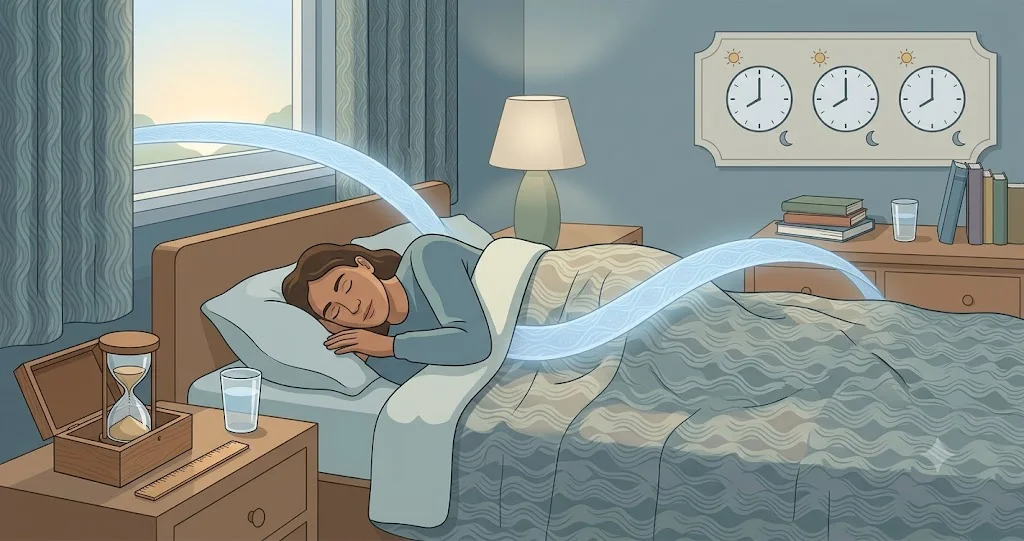
Getting enough sleep matters, but the number of hours on a clock does not tell the whole story. Two people can spend the same amount of time in bed and wake up feeling very different. One may have relatively continuous, refreshing sleep, while the other may spend much of the night waking, struggling to fall asleep, or sleeping at inconsistent times.
That is why sleep quality deserves attention alongside sleep duration. Healthy sleep is generally understood as a combination of adequate duration, good quality, appropriate timing and regularity, and the absence of sleep disturbances. The American Academy of Sleep Medicine describes these dimensions as important parts of healthy sleep rather than treating duration as the only measure.
What does sleep quality actually mean?
Sleep quality describes how restorative and uninterrupted your sleep is, rather than simply how long you were in bed. There is no single household measurement that captures every aspect of quality, but everyday signs can provide useful clues.
Higher-quality sleep generally means you can fall asleep without prolonged difficulty, remain asleep for most of the night, and wake feeling reasonably refreshed. Sleep that is repeatedly interrupted, poorly timed, or followed by significant daytime sleepiness may indicate that the total number of hours is not telling the complete story.
The distinction matters because the goal is not simply to maximize time spent in bed. The goal is to give the body enough opportunity for healthy sleep and support conditions that allow that sleep to occur consistently.
Sleep duration still matters
The idea that quality is important should not be interpreted as “hours do not matter.” They do. The joint consensus recommendation from the American Academy of Sleep Medicine and Sleep Research Society is that adults aged 18 to 60 should regularly obtain at least seven hours of sleep to promote optimal health.
The same consensus work also recognizes that healthy sleep involves other dimensions, including quality, timing, regularity, and the absence of sleep disorders. It therefore makes more sense to think of duration as one part of sleep health rather than the entire definition.
For example, deliberately sleeping for ten hours does not necessarily compensate for a sleep schedule that changes dramatically from day to day or for repeated nighttime disruptions. Likewise, someone who consistently sleeps too little should not use “sleep quality” as a reason to ignore the need for sufficient sleep.
Why uninterrupted sleep can feel different from simply spending longer in bed
Sleep is not one uniform state. Across the night, the brain and body move through different sleep stages. Repeated awakenings can interrupt this normal progression and may leave a person feeling less refreshed even if the total time in bed looks adequate.
There are many possible reasons for fragmented sleep, including environmental disturbances, an irregular schedule, stress, substances such as caffeine or alcohol, and sleep disorders. A single poor night is common and does not automatically indicate a health problem. Persistent patterns are different and deserve more attention.
The practical lesson is simple: do not judge a night's sleep only by the time you got into bed and the time you got up. Consider how easily you slept, how often you were awake, and how you functioned during the following day.
Consistency is an important part of healthy sleep
Your body operates on a roughly 24-hour circadian rhythm that helps coordinate sleep and wakefulness. Environmental cues such as light, darkness, meals, and physical activity help synchronize this internal timing system. NHLBI explains that disruption between the internal clock and the environment can make sleep more difficult and may reduce sleep quality.
This is one reason a regular sleep schedule can be useful. Going to bed and waking up at approximately the same times each day gives the body a more predictable pattern to work with.
Perfect consistency is not realistic for everyone. Shift workers, parents, travelers, and people with changing responsibilities may have limited control over their schedules. The practical goal is to make sleep timing as predictable as your circumstances reasonably allow.
The sleep environment can make a measurable difference to your experience
A bedroom does not need expensive equipment to support better sleep. Basic environmental conditions can matter. NHLBI recommends a sleep-friendly bedroom that is cool, quiet, and dark. It also advises reducing exposure to electronic devices and bright light around bedtime because light can interfere with the sleep-wake cycle.
Think of the bedroom as a place where unnecessary stimulation is reduced. If outside noise regularly wakes you, reducing the noise may be more useful than simply adding another hour to your planned bedtime. If the room is uncomfortable, improving temperature or bedding may help. If light enters the room early in the morning, appropriate light-blocking measures may be worth considering.
Everyday habits that support sleep quality
Sleep is influenced by what happens during the day as well as what happens at bedtime. A few practical habits can support a more predictable sleep pattern.
Keep a reasonably consistent sleep schedule
Try to go to bed and wake up at similar times each day. NHLBI specifically recommends maintaining a regular sleep and wake schedule, including on weekends where possible.
Give yourself enough time to sleep
Improving quality does not remove the need for adequate duration. If you routinely have to choose between sleeping and completing another activity, look at whether the evening schedule can be adjusted rather than treating reduced sleep as the solution.
Pay attention to caffeine timing
Caffeine can interfere with sleep for some people, particularly when consumed later in the day. NHLBI includes avoiding caffeine among healthy sleep-habit recommendations. Individual sensitivity varies, so the useful approach is to observe whether later caffeine consumption appears to affect your ability to fall asleep or remain asleep.
Be cautious with alcohol as a sleep strategy
Alcohol may make some people feel sleepy initially, but using it as a way to improve sleep is not a reliable strategy. NHLBI recommends avoiding alcoholic drinks before bed as part of healthy sleep habits.
Stay physically active
Regular physical activity is part of the broader set of healthy habits recommended by NHLBI. Getting outside during the day can also provide exposure to natural light, which is one of the environmental cues involved in circadian timing.
Create a quieter transition into bedtime
Rather than moving directly from demanding work or stimulating entertainment into bed, allow some time for quieter activities. NHLBI suggests using the hour before bed for quiet time and recommends avoiding bright light and strenuous activity close to bedtime.
Quality versus quantity: how to think about both
| Sleep factor | What it tells you | Practical question |
|---|---|---|
| Duration | How much time you spend sleeping | Am I allowing enough time for sleep? |
| Continuity | How often sleep is interrupted | Am I waking repeatedly during the night? |
| Timing | When your sleep occurs | Does my sleep schedule fit my daily rhythm and responsibilities? |
| Regularity | How consistent sleep and wake times are | Does my schedule change substantially from day to day? |
| Daytime function | How sleep appears to affect your waking life | Do I regularly feel excessively sleepy or poorly rested? |
| Environment | Conditions surrounding sleep | Are noise, light, temperature, or devices disrupting my sleep? |
This framework helps avoid a common mistake: treating “more sleep” as the only possible answer to every sleep concern.
Why sleeping longer is not always the solution
If someone is waking repeatedly during the night, simply extending the time available for sleep may not address the reason for those awakenings. Similarly, if a person's sleep schedule changes substantially between workdays and days off, adding more time in bed on one day does not necessarily create a consistent rhythm.
There is also an important distinction between association and cause. Research has found relationships between unusually short or long sleep and various health outcomes, but these relationships do not mean that simply increasing or reducing sleep duration will independently produce a particular health result. The AASM consensus discussion notes uncertainty around the health implications of regularly sleeping more than nine hours for some adults and emphasizes that long sleep can sometimes reflect underlying illness rather than necessarily causing it.
That is why a sensible sleep goal is not “sleep as many hours as possible.” It is to obtain an appropriate amount of sleep while supporting good quality, regularity, timing, and a suitable sleep environment.

A simple way to improve sleep quality without changing everything
Trying to change ten habits at once can make the process unnecessarily difficult. A more practical approach is to work through the basics in order.
- Set a stable wake time. Choose a wake-up time that fits your responsibilities and keep it reasonably consistent.
- Work backward to allow enough sleep. Give yourself adequate opportunity to reach the recommended amount of sleep for your age and circumstances.
- Improve the bedroom. Reduce unnecessary noise and light and keep the room comfortably cool.
- Review evening habits. Look at caffeine, alcohol, heavy meals, bright light, and stimulating activities near bedtime.
- Add daytime support. Stay physically active and spend time outdoors when possible.
- Observe the pattern. Pay attention to whether sleep becomes easier, more continuous, and more refreshing.
You do not need to make sleep perfect. The objective is to create conditions that make healthy sleep more likely and sustainable.
When poor sleep deserves professional attention
Occasional difficulty sleeping is common. Persistent problems are different. NHLBI describes insomnia as difficulty falling asleep, staying asleep, or getting good-quality sleep despite having enough opportunity and an appropriate environment for sleep.
If sleep problems continue, regularly interfere with daytime activities, or are accompanied by significant daytime sleepiness, it is reasonable to discuss them with a healthcare professional. This is particularly important when someone suspects a sleep disorder. The goal is not to self-diagnose based on an article, but to recognize when everyday sleep-habit changes may not be enough.
Common misconceptions about sleep quality
“If I sleep longer, my sleep must be better.”
Not necessarily. Duration is important, but healthy sleep also involves quality, timing, regularity, and the absence of sleep disturbances.
“I can fix poor sleep during the weekend.”
Extra sleep may be useful when someone has accumulated sleep debt, but relying on large schedule changes every weekend does not necessarily create a stable sleep pattern. A more consistent schedule is generally a better foundation.
“Waking once means my sleep quality is poor.”
A brief awakening does not automatically mean something is wrong. Sleep naturally changes throughout the night. The more useful question is whether awakenings are frequent, prolonged, distressing, or associated with persistent daytime problems.
“Sleep quality can be judged only by how I feel in the morning.”
Morning alertness is useful information, but it is not the only consideration. Look at the overall pattern, including sleep timing, continuity, regularity, and daytime functioning.
Frequently asked questions
Is sleep quality more important than sleep duration?
It is better to view them as complementary rather than competing priorities. Adults need adequate sleep duration, and healthy sleep also involves good quality, appropriate timing, regularity, and the absence of sleep disturbances. Improving one dimension does not make the others irrelevant.
How many hours of sleep should adults get?
The AASM and Sleep Research Society recommend that healthy adults aged 18 to 60 regularly obtain at least seven hours per night. Individual sleep needs can vary, and this recommendation should not be interpreted as a personalized medical target.
Can a good sleep environment improve sleep quality?
A suitable environment can remove common sources of disruption. NHLBI recommends a bedroom that is cool, quiet, and dark and advises reducing exposure to bright electronic light around bedtime.
Does sleeping at the same time every day matter?
Regular sleep and wake times can support a predictable sleep-wake rhythm. Perfect consistency is not possible for everyone, but maintaining a reasonably stable schedule is a useful everyday habit.
Why do I still feel tired after sleeping for many hours?
Feeling unrefreshed despite spending sufficient time in bed can have many possible explanations, including disrupted sleep, schedule problems, lifestyle factors, or sleep disorders. Persistent or significant daytime sleepiness should be discussed with a healthcare professional rather than assumed to be caused by simply needing more hours in bed.
Is poor sleep for one night a serious problem?
An occasional poor night can happen and does not by itself establish a health problem. The more meaningful issue is a persistent pattern of inadequate, disrupted, irregular, or unrefreshing sleep and how that pattern affects daytime functioning.
The practical takeaway
Sleep quality is not a replacement for getting enough sleep. It is a reminder that healthy sleep has more than one dimension. Aim for an appropriate amount of sleep, but also pay attention to continuity, timing, regularity, your bedroom environment, and the habits that surround bedtime.
If you want to improve your sleep, start with the basics: protect enough time for sleep, keep your schedule reasonably consistent, make the bedroom comfortable and low in stimulation, and review habits such as late caffeine, alcohol, bright evening light, and inactivity. If poor or unrefreshing sleep persists despite having enough opportunity to sleep, professional advice can help determine whether there is an underlying issue that needs attention.